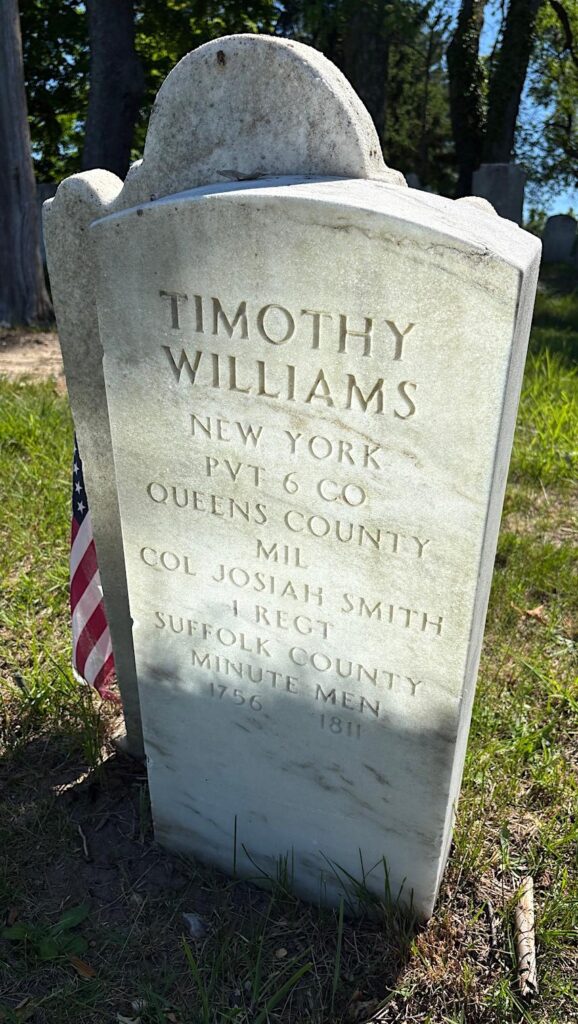
WILLIAMS, TIMOTHY (1756–1811). Associator, Huntington, New York; private, Captain Benjamin Coe’s 3rd Company, Colonel Josiah Smith’s Regiment, Suffolk County Minutemen. Timothy was born in Huntington, Long Island, to Nathaniel and Rachel (Fleet) Williams, followed nine years later by a sister, Rachel (1765-1799), according to Find A Grave.com. Frederic Mather’s Refugees of 1776 from Long Island to Connecticut (1913) (listing those who lived for a time in Connecticut to escape the British occupation of Long Island) mentions two other siblings—Content and Ens. Nathaniel Jr.
In 1775, Timothy Williams signed the Huntington Articles of Association. On May 8, 1775, 403 men, most of them Huntington residents (a few were from Islip), “shocked by the bloody Scene” that had occurred just weeks before at Lexington and Concord in Massachusetts, where patriot Minutemen and British regulars had engaged in a bloody armed struggle, put their signatures on Huntington’s Articles of Association. Only 37 Huntington residents, either Loyalists or those wanting to stay out of the fray, refused to sign. The Articles noted that the signers affirmed their “Love to our Country,” agreed “to whatever Measures may be recommended by the Continental Congress; or resolved upon by our Provincial Convention, for the Purpose of preserving our Constitution, and opposition to the Execution of the several arbitrary, and oppressive Acts of the British Parliament,” and prayed for “a Reconciliation between Great-Britain and America.” The actions of these associators were seen by both patriots and the British as a step towards rebellion. The fact that these men signed these Articles, placing themselves in danger of British retaliation, including imprisonment, seizure of their property, and exile from Long Island, is proof of their patriotic service.
Timothy Williams is listed as a private in Colonel Josiah Smith’s Regiment of Suffolk County Militia, Captain Benjamin Coe’s 3rd Company; the men were paid for their service in Queens County during July and August of 1776, as the Battle of Long Island loomed.
According to Mather, Timothy fled Huntington during the Revolutionary War’s British occupation and lived in Norwich, Connecticut. Perhaps the most interesting information about Timothy’s wartime activities comes from a descendant’s application for membership in the Daughters of the American Revolution (D.A.R.), which says that in 1780 (according to Mather’s book, he remained in Norwalk until that year) Timothy was taken prisoner by the British while on a secret mission, but escaped. The application further lists Timothy, his father, Nathaniel, and his future father-in-law, Wilmot Oakley, as Associators, signers of Huntington’s Articles of Association, in 1775. Timothy is listed on the July/August 1776 pay roll for Captain Benjamin Coe’s 3rd Company of militia, in Colonel Josiah Smith’s Regiment of Suffolk County.
According to New York City Marriage Records, Timothy married 19-year-old Jane Oakley (1772-1861) in Newtown (now Elmhurst), Queens, in 1791. As per a family tree on Ancestry.com, and information on Find A Grave, they quickly had four sons (William, Albert, George, and Wilmot) by 1792. William, Albert, and George’s birth years are all listed as 1790. Another son, Israel, is not listed on Find A Grave, but according to Cemetery Inscriptions from Huntington, Long Island, New York, compiled by Josephine C. Frost in 1911, there is an inscription on a gravestone in Huntington’s Old Burying Ground that reads: “Israel, son of Timothy and Jane Williams, died Sep. 20, 1798. age 7 years.”
After the war, Timothy and his family remained in Huntington. His name appears on the town property tax rolls of 1799 with his property valued at $2,675; he was doing well. The 1800 federal census counts nine members of his household, including four sons and one enslaved person. (Early census data often holds mysteries, for example: Only seven of nine household members can be accounted for, and the data suggests there were two girls younger than 10, one girl younger than 15, and a boy older than 10. The mystery endures.) By the next federal census in 1810, Timothy’s household had expanded to 13 members, including two enslaved people. (In this census, no analysis of the household’s count comes to a total of 13.)
Timothy’s name appears in the Huntington Town Records in 1790, 1794, and 1795, having been granted a license as a tavern keeper. In 1795, according to Huntington Town Records, he hosted a meeting of the Town trustees at his tavern. In 1805, he was part-owner of a pottery that produced stoneware and redware for everyday use, in response to a sudden need for American-made household wares, according to the blog “Huntington Pottery” [https://huntingtonpottery.home.blog/2019/06/04/samuel-j-wetmore-co/]. He only held his quarter-share in the pottery for about 70 days—long enough, however, to be listed as owner in Potters & Potteries of New York State.
Timothy died on August 31, 1811, at the age of 55. He is interred in the Old Burying Ground, Huntington, New York. As per Frost, his grave was originally marked by a stone on which were inscribed his name, his date of death, and that he was 55 years old. His grave is now marked by a gravestone issued by the Department of Veterans Affairs.