BENNETT (or BENNET), TIMOTHY (1748-1823). Sergeant, 2nd Regiment, Colonel Philip Van Cortland’s Regiment; 4th Regiment, Colonel Henry B. Livingston’s Regiment, Captain Jonathan Titus’s Company, Continental Army. As per the Find A Grave website, Timothy was born in Huntington, New York on November 21, 1748, to Joseph and Elizabeth née Bryant Bennett. A family tree on Ancestry.com shows that Timothy had three siblings: Titus (1744-1790), Samuel (1748-1810), and Esther (1758-1835). Family history has been verified by records of the Old First Church in Huntington and in Colonial Families of Long Island, New York (published in 1944).
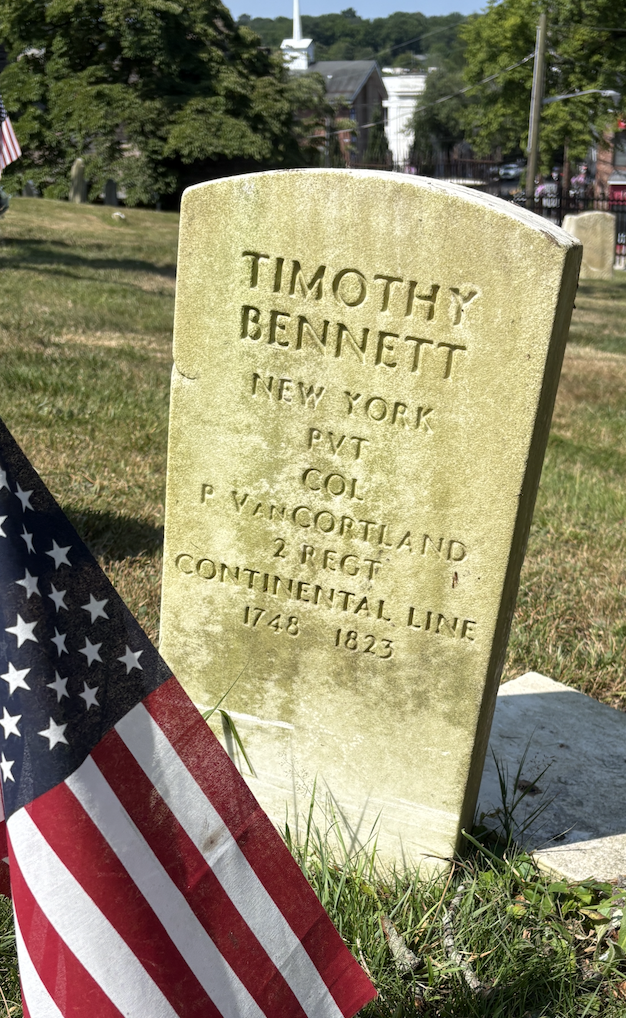
Although Bennett’s headstone is inscribed with his service as a private in the 2nd New York Regiment under Colonel P. Van Cortland (or Courtland, Cortlandt), Continental Line, other documents reflect a promotion to sergeant and show service in the 4th Regiment under Colonel Henry B. Livingston and Captain Jonathan Titus. The website, American Revolutionary War Continental Regiments: New York Regiments in the Continental Army, contains a detailed history of the 2nd New York. That site specifies that the 2nd New York Regiment was often re-organized, re-designated and consolidated. The history of the unit indicates that the 2nd Regiment was authorized as the 4th New York on May 25, 1775; after numerous changes, the unit was re-designated as the 2nd Regiment on January 1, 1781. Further, that unit’s history notes that the 2nd Regiment, at its organization, was under the command of Colonel Philip Van Cortlandt.
Military records from the National Archives show Timothy’s enlistment date as November 1776 for the 2nd Regiment and indicate a promotion to sergeant; Revolutionary War muster rolls report that the promotion occurred on June 1, 1779. A copy of his service record shows that from November 21, 1776, to September 5, 1777, Bennett and the 4th Battalion was camped near Louden’s Ferry, New York, and was at Valley Forge, Pennsylvania from September 1777 to April 1778 with a month off on furlough from January 1, 1778 through February 21, all under Captain Titus. His muster rolls, dated from October 1779 through April 1880, show a rank of sergeant in the 5th Company of the 4th Battalion at Camp Morristown, New Jersey, under Lieutenant Colonel Frederick Weisenfels. In May and June 1780, Timothy was at Camp West Point, then was at Camp Fort Schuyler from September through December 1780. His discharge is given as June 1, 1783; the 2nd was furloughed at Newburgh, New York on June 2 and disbanded on November 15 of that year. It is somewhat confusing when reading the records that show that he initially served in the 4th Regiment in 1776 but given the numerous re-organizations of the 2nd Regiment, it is apparent that it is the same Timothy Bennett and who served under both Colonels Livingston and Van Cortlandt.
As per North America Family Histories, 1500-2000, which spells his surname as Bennet, Timothy served as a sergeant under Captain Jonathan Titus and Colonel Henry B. Livingston and was present at the surrender of British General John Burgoyne, who surrendered his army at Saratoga, New York, on October 17, 1777. The history of the unit details that the 2nd Regiment saw action in the invasion of Canada, the Battle of Valcour Island, Battle of Saratoga, Battle of Monmouth, the Sullivan Expedition and the Battle of Yorktown.
Bennett’s name also appears in New York in the Revolution (1898) as one of the enlisted men serving in the 4th Regiment under Colonel Henry B. Livingston and Captain Jonathan Titus. Suffolk County, New York Genealogy and History, details that Timothy was a sergeant in the New York Line during the American Revolution. Timothy’s name also appears in Compiled Revolutionary War Military Service Records, 1775-1783, as a private as of November 21, 1776, in the Fourth Regiment, New York State. U.S. Revolutionary War Rolls, 1775-1783 lists Bennett as a sergeant in the 4th Battalion with the date of November 22, 1779.
Timothy married Martha Titus (born 1757), the daughter of Captain Jonathan Titus, his officer in the 4th Regiment, on June 5, 1785, in Smithtown, Long Island. The couple had two children, Sarah, who later married Joshua Weeks, and John. Huntington Town Records show that, according to the 1790 census, four people, two males and two females, lived in Bennett household. As per My Brother’s Keeper: Caring for Huntington’s Poor, an article on June 11, 2013, by Robert C. Hughes, Huntington Town Historian, there was a group named the Overseers which had the responsibility of caring for the town’s poor. Overseers of the Poor were elected or appointed individuals in New York municipalities, active from the late 18th and in the 19th century; these positions were abolished by the early 20th century. Townspeople who bid the lowest were assigned needy people (elderly, widows, disabled, etc.) and would provide food, clothing, lodging and other needs; the stipend varied in each case. Bennett was mentioned in that article as an overseer; he was paid $19 per year as a caregiver for a child, Elizabeth Price (no date mentioned). It is possible that Elizabeth is one of the three children living in the Bennett household in Huntington in 1800.
As per Pension Rolls of 1835, New York Pension Roll, County of Suffolk, Bennett was a sergeant who was placed on the pension roll on June 11, 1818, and received an annual sum of $96. A document from Suffolk County Court regarding Timothy’s original pension request and dated April 7, 1818, states his enlistment as a soldier in the 4th Regiment under Captain Jonathan Titus, commanded by Colonel Henry B. Livingston and later commanded by Phillip Van Courtland (sic) in the New York line of the Army of the United States.
According to U.S. Revolutionary War and Bounty-Land Warrant Application Files, 1800-1900, Timothy appeared at the Court of Common Pleas in Suffolk County on May 30, 1820 and attested:
I Timothy Bennett do swear and declare that I enlisted in 1776 in the company commanded by Capt Jonathan Titus in the fourth New York Regiment commanded by Henry B Livingston, and continued to serve in the revolutionary war on the continental establishment until 1783, when I received a regular discharge as stated in my original declaration dated the 7th day of April 1818—that I was placed on the pension list by virtue of the act of congress of the 18 of March 1818. The certificate whereof is numbered 985.”
In addition, he noted that he was a citizen and common laborer who at this time was infirm and unable to support himself or his wife without the “aid of government except by private or public charity.”
The census of 1820 reports that there were two others living in Timothy and Martha’s household in Huntington, including a white foreigner, under the age of 15, and a male, between the ages of 26 and 44, likely their son John. While most records show Timothy’s date of death as November 21, 1823, Suffolk County Genealogy and History reports the date as November 23. Burial was at the Old Burying Hill Cemetery in Huntington. Martha Bennett appeared in court on August 23, 1838, attesting that she should be awarded the benefits of a widow’s pension; her rate was increased to $120 per annum as of March 1848. She died at age 93 in 1850 and is buried with her husband and two children. Martha’s family is also noted in North America Family Histories, 1500-2000; her husband’s name is listed as Timothy Bennet.
In 1973, Rufus B. Langhans, Huntington Town Historian, filed an application for Timothy’s government-issued upright marble headstone, noting his rank as private, which then seems to have been corrected by a Department of Veterans Affairs reviewer, in red ink, crossing out the rank of private, and noting service as a sergeant in the New York Line under Colonel Philip Van Courtland (sic). A discharge date, circa 1783, was indicated on the application with no other service listed.