ROGERS, JOSHUA (1736-1785). Captain of a privateer raiding British ships on Long Island Sound; captain, Huntington Militia, Colonel Floyd’s 1st Regiment, Suffolk County Militia; associator, Huntington’s Articles of Association. Joshua Rogers was born in 1736 in Huntington, New York Colony; the month of his birth is shown as April in some genealogical sources and November in others. His parents were Jacob (or Jakob) Rogers, born 1705, and Sarah Smith, born about 1706. According to the Geneanet online database, he had a sister, Sarah, born in 1735. Joshua’s Rogers ancestors first arrived in America from England in the mid-17th century.
On May 19, 1761, Joshua married Hannah Smith in Huntington, as recorded in the New York, Marriage Index, 1600-1761. Hannah was born in 1740 in Huntington. They had several children; according to “Long Island Surnames,” the database archives of Long Island Genealogy, other genealogical accounts and cemetery records they were: William, born about 1764 in Huntington; Esther, born in Bay Shore in 1766; William; Sarah, born in 1769; Daniel born December 14, 1766 in Huntington; Henry W., born about 1771 in Huntington; and Rebecca, born about September, 1776 in Huntington. Eighteenth-century North American records can be unreliable and insufficient, so it is not always known exactly when people were born and died. A Long Island Historical Association Facebook posting, of September 29, 2025, shows December 14, 1766, the day of Daniel’s birth, as also the day he was baptized in Huntington. Cemetery records show that Sarah married Charles Platt Rogers and Rebecca married Samuel Wickham.
In 1775, Joshua was living in Huntington. Frederic Gregory Mather writes in his book, The Refugees of 1776 from Long Island to Connecticut (1913) that Joshua signed the Huntington Association, a statement of protest against the King, that year. On May 8, 1775, 403 men, most of them Huntington residents (a few were from Islip), “shocked by the bloody Scene” that had occurred just weeks before at Lexington and Concord in Massachusetts, where patriot Minutemen and British regulars had engaged in a fierce armed struggle, put their signatures on Huntington’s Articles of Association. Only 37 Huntington residents, either Loyalists or those wanting to stay out of the fray, refused to sign. The Articles noted that the signers affirmed their “Love to our Country,” agreed “to whatever Measures may be recommended by the Continental Congress; or resolved upon by our Provincial Convention, for the Purpose of preserving our Constitution, and opposition to the Execution of the several arbitrary and oppressive Acts of the British Parliament,” and prayed for “a Reconciliation between Great-Britain and America.” The actions of these associators were seen by both patriots and the British as a step towards rebellion. The fact that these men signed these Articles, placing themselves in danger of British retaliation, including imprisonment, seizure of their property, and exile from Long Island, is proof of their patriotic service.
It also appears that a Joshua Rogers living in the Township of Huntington signed the Oath of Loyalty to the British crown in 1778, as listed in Huntington Town Records, 1776-1873, Vol. III (1889), but it is unclear if that is the Joshua Rogers who is the subject of this biography, since there appears to have been another man with that name living on Long Island at that time. It should also be noted that, in 1778, Huntington was occupied by British armed forces, and many of those who signed the Oath of Loyalty that year were coerced into doing so. In fact, there are two Joshua Rogers mentioned in The Refugees of 1776; Captain Joshua Rogers and another Joshua Rogers who appears to have lived, at least in 1775-1776, on the far eastern south shore of Long Island, in Bridgehampton and Sag Harbor.
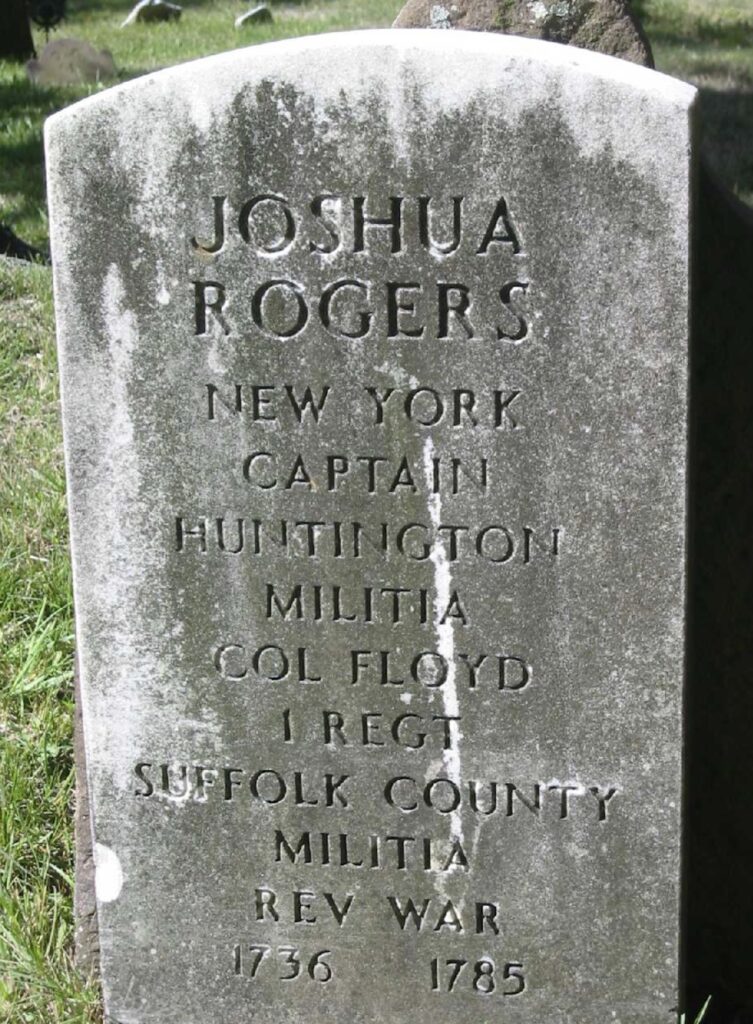
In any event, Mather reports in The Refugees of 1776 that Joshua served in the Continental Army as lieutenant and captain in Colonel Floyd’s regiment; as captain in Colonel Drake’s Provisional Regiment; and possibly in the 3rd Westchester. An application for a headstone for United States Military Veterans, signed by Rufus Langans, the historian of the Town of Huntington, on August 2, 1973, lists Joshua’s rank as captain in Captain Floyd’s 1st Regiment, Suffolk County.
It appears that Joshua was recruited to join Colonel Samuel Drake’s regiment. A Rank Roll of Colonel Drake’s Regiment in General Scott’s Brigade lists Joshua as captain, as does a “Muster Roll of Capt. Joshua Rogers’ Company Colo. Drake’s Regiment” from late 1776.
It also appears that Joshua, captaining his own boat, the Greyhound, became a privateer during the Revolutionary War, leading raids on British ships on Long Island Sound. It is likely that he is the same Joshua Rogers who served in local militias. Mather writes in The Refugees of 1776 about attacking parties, “which went from Connecticut to Long Island and were captured. For instance – the bad luck that befell . . . Captain Joshua Rogers,” among others, who were taken prisoners by the British.
The ship Montgomery preyed upon British vessels. The Refugees of 1776 mentions that Eliphalet Wood, a refugee in Connecticut from Long Island, acknowledged the receipt of $30 from Joshua Rogers, “being for one Quarter part of all My Prize Money due from the Sloop Montgomeria (sic) Late Commanded by William Rogers.” A copy of a naval record dated July 5, 1777, in Norwalk, Connecticut, reports the same amount given by Joshua, but with the name “Richard Knight” as the recipient of the money. Two other records of these naval transactions involving the ship Montgomery exist. One, dated July 22, 1777, in Middeltown (presumably Middletown, Connecticut), reports the receipt of the “full contents of the within order paid me, Joshua Rogers.” The second, dated January 6, 1778, Wilton in Norwalk, Connecticut, notes that Joshua Rogers received the sum of 94 pounds, 12 shillings of New York money from Gilbert Potter (see), as full payment for his service on board the “Sloop of War Mongomery.” Other records regarding Captain Joshua Rogers include loan office certificates issued in the State of Connecticut in 1782.
Connecticut Maritime Court records, 1777-1783, show that captains led their vessels to capture British and Loyalist ships and supplies on Long Island Sound and the Atlantic Ocean. Joshua was very involved in these ventures. Court records, held at Mystic Seaport, of a trial held in January and February of 1779 to resolve a dispute over goods captured and a whaleboat used by Joshua Rogers reveal that General George Washington had ordered a Major Gray to hire Captain Joshua Rogers, his boat, and crew on October 22, 1778, to go to Long Island on special occasions as needed “for the benefit of the Continental Army” and that there was to be no plundering. Captain Rogers testified that his orders from Major Gray required him ‘to make prisoners of the Enemy and destroy their property in all ways agreeable to the rules of war.’” At that time, it appears that Joshua was based across Long Island Sound in Norwalk, Connecticut, and was using a whaleboat to cross to Long Island. A jury held against Captain Rogers; he lost both the whaleboat and the goods.
On March 6, 1779, as per Mather at pages 217-218, the Council of Appointment commissioned Joshua Rogers of the Greyhound as a “Captain of Armed Vessels.”
The Refugees of 1776 reproduces a January 7, 1780 petition to the General Assembly of the State of Connecticut for tax relief, signed by, among others, Captain Joshua Rogers, in which the signers, who had once been “Inhabitants of Long Island were forced to quit their possessions or submit to the Tyranny of Great Britain.” They “cheerfully forsook their houses & lands, which are now possessed by British Subjects.”
Ultimately, Joshua was taken prisoner. On October 9, 1780, as written in Henry Onderdock, Jr.’s Revolutionary Incidents of Suffolk and Kings Counties (1849), Joshua and five others “in a whale-boat, were forced by stress of weather on Long Island shore, and are now prisoners in New York.” A note, added on October 11, 1780, attests that Captain Rogers and other “rebel gentry,” were “brought to Town by Captain Luke of the Royal Refugees, and safely lodged in Provost.” They were all deemed “notorious offenders, long practised in coming from the New England shore to murder and plunder the King’s loyal subjects, on Long Island. They were taken last Saturday by Lieutenant Pendergrass and a party of Colonel Cuyler’s Refugees, at Smithtown, with their whale-boat, and considerable booty.”
A later entry, dated October 19, 1780, shows that “General Parsons wants H. Scudder to go to Long Island to negotiate the exchange of Major Brush, Captain Joshua Rogers and other refugees from Long Island now prisoners.” Other records regarding Captain Joshua Rogers include loan office certificates issued in the State of Connecticut in 1782.
To sum up Joshua’s activities during the Revolutionary War, a firsthand account of his war service exists: Joshua swore under oath in Fairfield, Connecticut, to Thaddeus Betts, Justice of the Peace, on May 26, 1783, that American cruisers frequently sailed along Long Island’s north shore and into Huntington Bay and Cold Spring Harbor, in the area of Lloyd Neck, with the object of seizing British vessels. Joshua, himself, had assisted in capturing three vessels near Lloyd Neck, including one in broad daylight and within “Musket-Shot of Land.” He stated that a Maritime Court had judged all of his seizures legal and that they were considered as prizes to him as the ship’s captain.
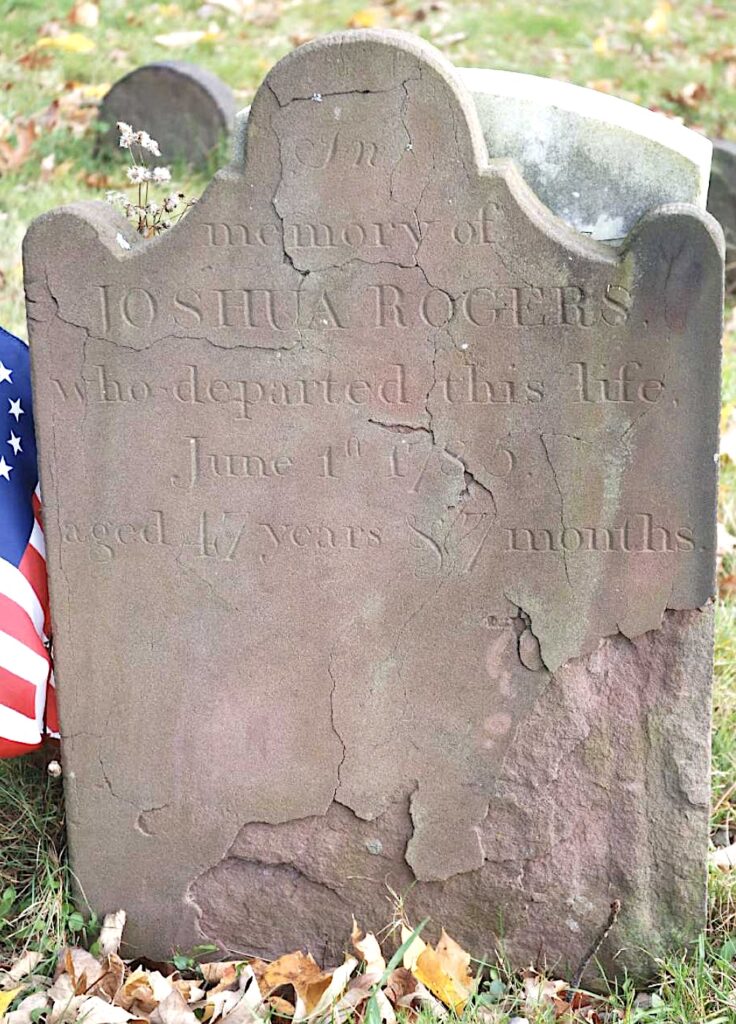
Joshua did not live long after the end of the war. Per Josephine Frost, in her Cemetery Inscriptions from Huntington, Long Island, New York (1911), he died in Huntington on June 1, 1785. His wife, Hannah, died, also in Huntington, on December 18, 1787. They are interred side by side in Huntington’s Old Burying Ground.