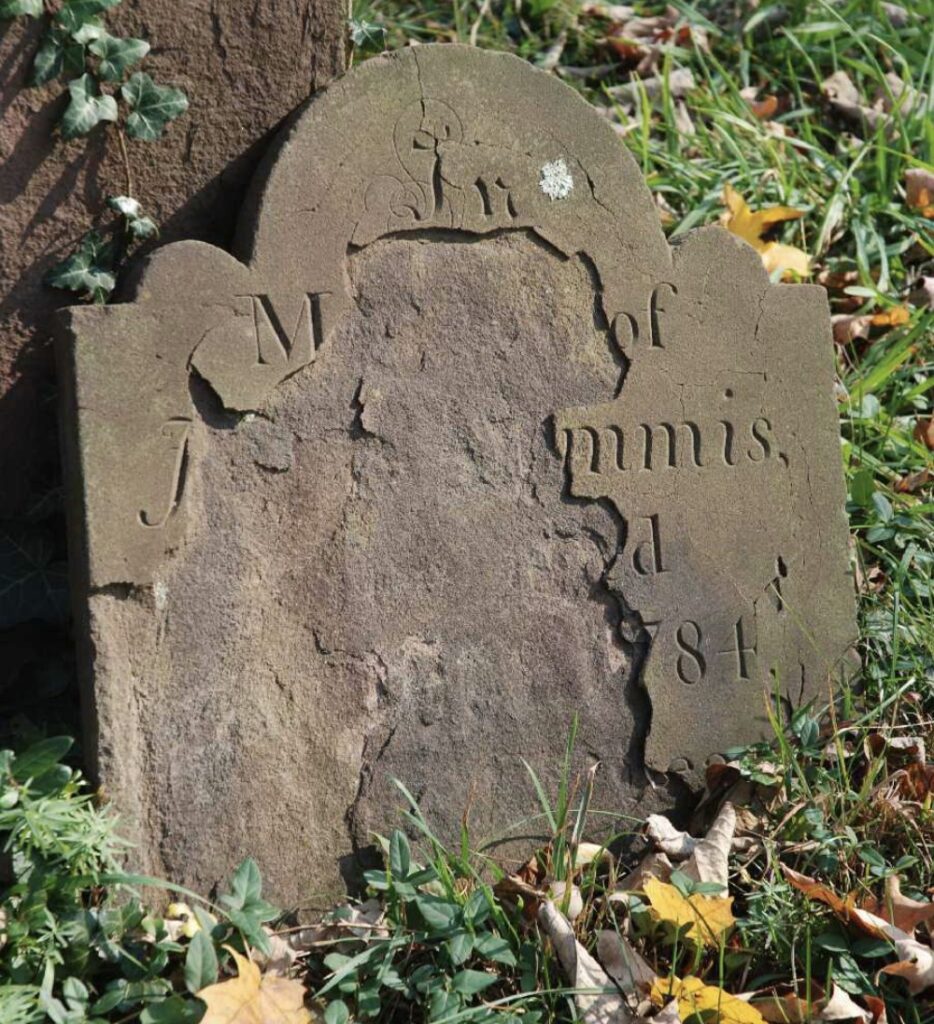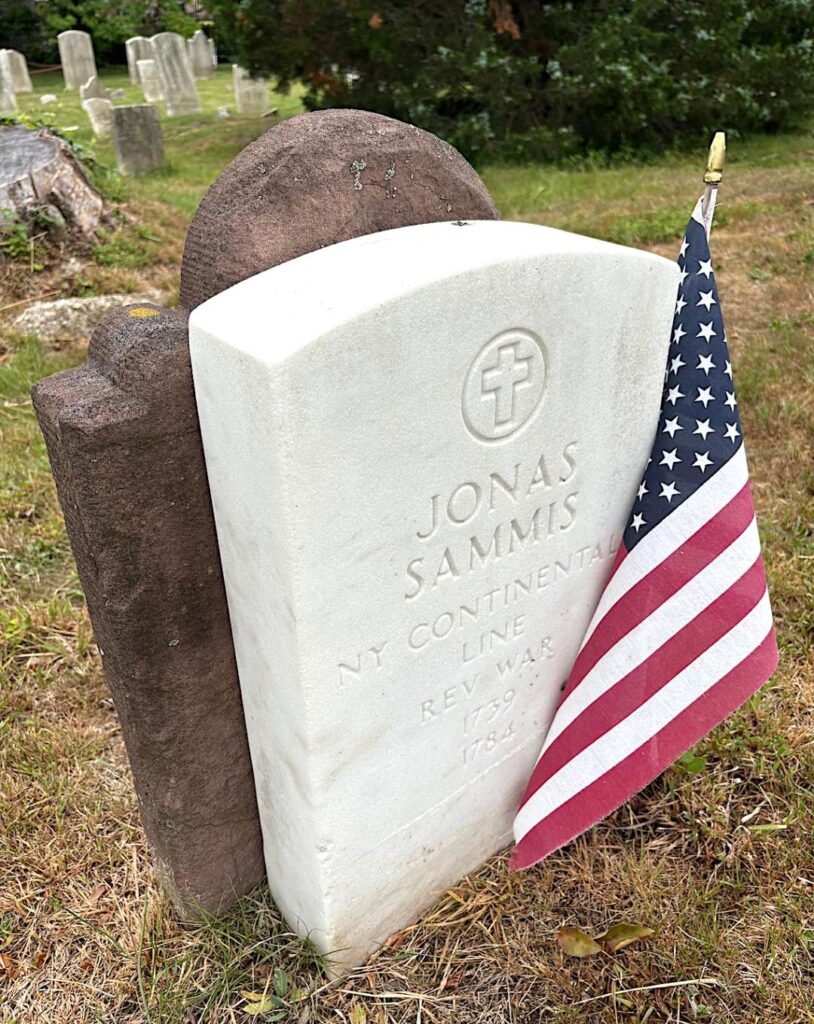
SAMMIS, JONAS (1739-1784). Private, Colonel Josiah Smith’s 1st Regiment of Minutemen, Captain John Wickes’s Company, Huntington Militia. Born in Huntington, New York Colony, in 1739, Jonas Sammis was a descendent of John Sammis who settled in that area in the mid-17th century, as detailed in The Refugees of 1776 from Long Island to Connecticut (1913) by Frederic Gregory Mather. According to cemetery records and A Genealogy of the Descendants of William Kelsey Who Settled at Cambridge, Mass. . . . (1947), by Edward A. Claypool, Jonas’s parents were John Sammis, born in Huntington in 1706, and Susannah (or Susanna) Kelsey. She was probably the eldest child of Daniel Kelsey and his first wife, was born about 1708, in either Hartford, Connecticut (as it is believed that her father was living there until 1710), or in Huntington. Susannah and John Sammis married on March 27, 1728, in Huntington.
Jonas’s date of birth is recorded as August 3, 1740, rather than 1739, on the Geneanet genealogical website. Other cemetery and genealogical records, including New York, Genealogical Records, 1675-1920, as well as A Genealogy of the Descendants of William Kelsey, list Jonas’s many siblings: Susannah, Abigail, John, Nathaniel, Henry, Ebenezer, and Jacob Sammis. The children’s names and baptismal dates were recorded in Huntington Church Records.
Jonas’s mother, Susannah, died in Huntington before September 1750. After her death, John Sammis married Phebe Platt, a widow, in Huntington, on January 14, 1753. There were no children from this marriage.
According to the New York Marriage Index, 1600-1784, Jonas married Rebecca (her name has also been spelled as Rebekah or Rebeccah), born in 1742, on April 27, 1770, in New York City. The children from this marriage included Abigail Sammis Gould; Henry; Jonas Jr.; and Susanna Sammis Brush, all born in Huntington between 1772 and 1784. Rebecca’s maiden name may have been Platt, although Jonas and Rebecca’s son Jonas Jr.’s second wife was born Rebecca Platt. Among the American colonists, children were often given the same names generation after generation, creating confusion for genealogists and historians.
Charles R. Street’s compilation Huntington Town Records 1776-1873, Volume III (1889) shows that Jonas Sammis served in Captain John Wickes’s Company, Huntington, of Colonel Josiah Smith’s Regiment of Suffolk County Militia from July 29 to August 31, 1776. That unit was “badly cut up and demoralized, and some of them were taken prisoners” during the Battle of Long Island on August 27, 1776, according to “Old Times in Huntington, an Historical Address” (1876) by Henry C. Platt. Jonas is also listed in Huntington Town Records as having been in the militia belonging to Captain Cornelius Conkling’s Company, which had been ordered on duty by Loyalist Colonel I. W. Cruger of the First Battalion on October 13, 1777. In the Orderly Book of the Three Battalions of Loyalists Commanded by Brigadier-General Oliver De Lancy, 1776-1778 (1917) and the National Park Service’s website, a Lieutenant Colonel John Harris Cruger is mentioned as commanding the First Battalion in his father-in-law Oliver DeLancey’s Loyalist Brigade. Cruger was responsible for overseeing the construction and garrisoning of a fort in Huntington. Jonas was listed among the men who were assigned (or forced) by the British to build the fort at Lloyd’s Neck in 1778, as shown in Huntington Town Records. It does appear, as also revealed in Huntington Town Records, that Jonas took the Oath of Loyalty to the British Crown in 1778, but it should be noted that many men residing in militarily-occupied Huntington at that time were forced to affirm their allegiance to Britain. A John Sammis, who may have been Jonas’s father, also signed that oath.
There are additional notations in the Huntington Town Records for Jonas during the period of the Revolutionary War. A November 7, 1779 entry, as recorded in the Town Records of the Militia of Captain Conkling’s district regarding oxen, wagons, horses, and servants, shows Jonas in West Neck with one ox and two horses. Jonas is included in a list of the inhabitants of Huntington who were in Captain Conkling’s Company and owned woodland as of July 11, 1780. Additionally, Jonas is listed as having worked for two days on Fort Golgotha, one of a network of British fortifications in and around Huntington, along with the fort on Lloyd Neck. Fort Golgotha was built on the site of the Old Burying Ground, desecrating the graves of the locals’ ancestors. After British forces withdrew from the region in 1783, the fort was dismantled and the burying grounds restored.
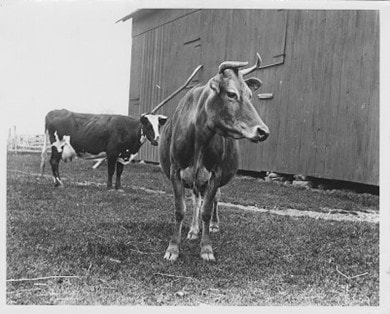
An entry for the “Assessment of Property in Huntington about the Close of the War.” in 1782, shows Jonas’s property’s worth as 137 shillings. Using Alan Eliasen’s online historical currency converter, the purchasing power of 137 shillings from 1780/1782 into 2026 United States dollars would amount to approximately $1,718.00 ($12.54 per shilling.) To give an idea of what 137 British shillings could purchase in the New York colony in 1782, as calculated by the United Kingdom Inflation Calculator, one shilling could buy approximately seven pounds of bread, while a cow could be purchased for 140 shillings. Moreover, a free laborer might earn about three shillings a day so that 137 shillings would roughly equal 45 days of hard manual labor. To sum up, 137 shillings was a significant sum in the late 18th century.
Jonas died in Huntington on April 14, 1784, “in his 46th year,” as noted by Josephine C. Frost in her Cemetery Inscriptions from Huntington, Long Island, New York (1911). Jonas’s will, dated May 9, 1786, and probated on April 13, 1786, in New York City, lists Rebeccah Sammis as his wife and Abigail, Susanah, Henry, and Jonas as his children, with Jesse Sammis and Timothy Conkling (see) as friends. Rebecca died in Huntington on October 22, 1808, as per the inscription on her gravestone recorded by Josephine C. Frost. Both she and Jonas are interred in the Old Burying Ground, along with their son Henry, Jonas’s parents, and other relatives.