By Emily Werner, HHS Curator & Collections Manager
In the late eighteenth and early nineteenth century, many professional weavers immigrated from Germany, Scotland, Ireland, or England after lengthy apprenticeships in specialized weaving techniques, such as damask or carpet weaving. Known as “fancy weavers,” they settled in small towns along the east coast, including New York, and adapted their specialized knowledge to weaving “bed carpets” or “carpet coverlets.”
Professional weavers were almost exclusively men. Although women continued to play a vital role in supporting textile production by preparing the raw materials and finishing the cloth after it was woven, few women actually became professional weavers themselves.
Many professional weavers were not only weavers, but also worked other jobs, such as farming, to support themselves throughout the year. They set up workshops at home or at another established location, where customers could bring their design preferences and homespun yarn for the textiles they were commissioning.
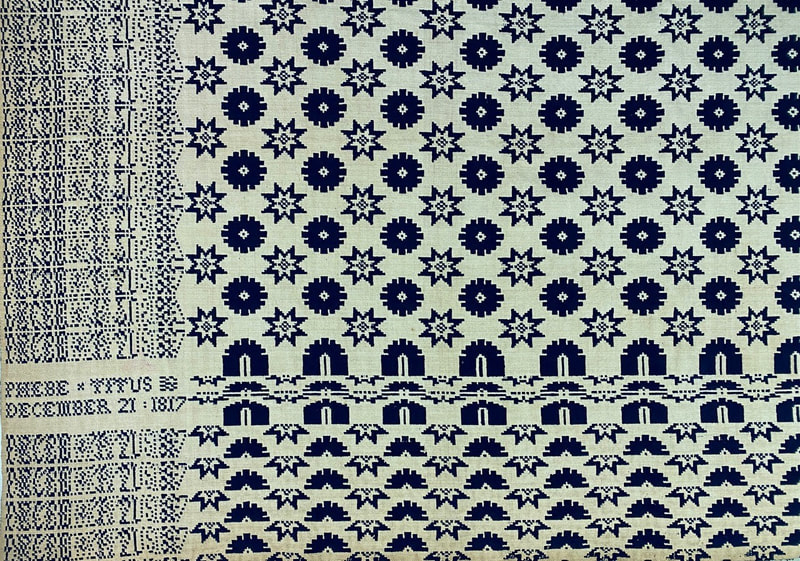
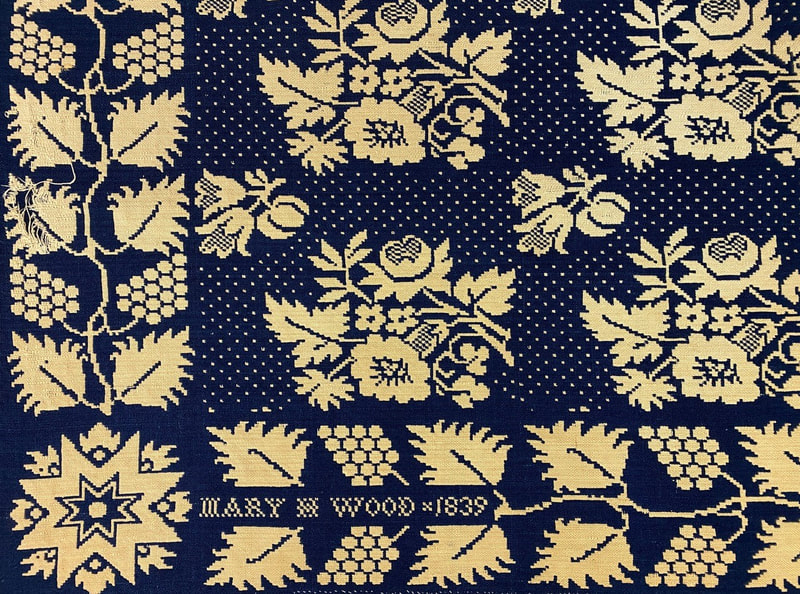
Professional weavers made coverlets for specific customers, typically women, and wove her name and the date into the corner block or along the border of the coverlet. Occasionally weavers included other phrases as well, such as their name, a town name, or even the name of the pattern. The text was almost always woven lengthwise into the coverlet (in the warp direction). Because of the reversibility of double cloth fabric, the text is legible on one side of the coverlet and appears reversed on the other. The practice of naming and dating coverlets in this manner is thought to have originated on Long Island.
Long Island coverlets were woven in a weave structure called double cloth. Double cloth coverlets are created by weaving two layers of fabric simultaneously, each layer intersecting at specific points to produce the pattern. The fabric is reversible, with one side predominantly dark and the other side predominantly light. The dark yarn was indigo-dyed wool, usually provided by the customer, while the light yarn was undyed machine-spun cotton.
Because they used twice as much yarn as other types of fabrics and required great skill and technology to weave, double cloth coverlets were some of the most costly and prized textiles in nineteenth-century American homes.
Visit our new exhibit, From Farm to Fabric: Early Woven Textiles of Long Island, to find out even more about these beautiful textiles! Open through September 17, 2023 at the Soldiers & Sailors Memorial Building at 228 Main Street, Huntington.
This exhibit was part of a collaboration with Preservation Long Island to highlight the importance of Long Island’s early weaving practices and industry. Their exhibit, Blanket Statements: Long Island’s Early Weaving Industry, explores Long Island’s early textile industry and the broader historical events that shaped its growth during the first half of the nineteenth century. Open through October 8, 2023 at the Preservation Long Island Gallery at 161 Main Street, Cold Spring Harbor.