By Barbara La Monica
The North Shore Land Alliance, the Town of Huntington, Suffolk County, New York State, the Village of Lloyd Harbor, and the Seminary of the Immaculate Conception have combined their advocacy efforts to insure the preservation of the seminary’s 200 acres of forest, fields and wetlands. In addition to its environmental importance, the property is linked to the past of Gold Coast Mansions and wealthy financiers because the seminary sits on the site of the former Rosemary Farm estate of Roland Ray Conklin (1858-1938).
Roland Ray Conklin, a descendant of John Conklin who settled in Huntington in 1653, was a successful real estate promoter and banker. Born in Huntington, his family soon moved to the mid-west where Conklin, shortly after graduating from the University of Illinois, founded a successful real estate business. He also invested in public work projects including irrigation canals and electric street railways. Eventually he moved his company to New York but was forced to liquidate due to the 1893 financial panic. But Conklin, ever resourceful, reorganized into the North American Trust Company, a general banking business. In 1898 he was appointed fiscal agent for the United States government in Cuba where he was one of the founders of the National Bank of Cuba and the Havana Telephone Company. In addition to other business ventures in Cuba he owned a 3,000-acre plantation.
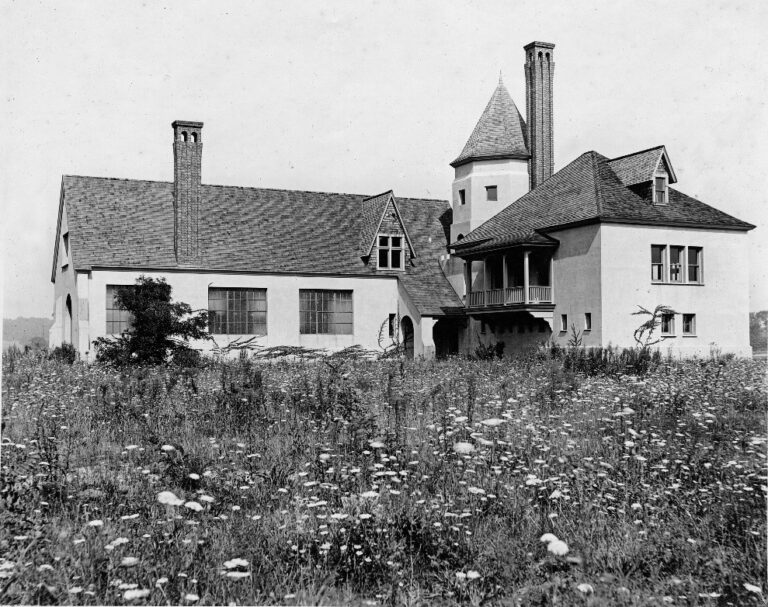
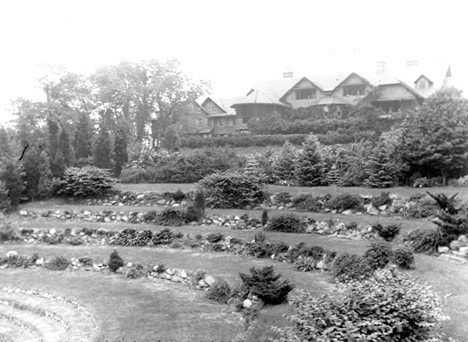
After his marriage to Mary Macfadden and the birth of their first child Julia Conklin, like many wealthy businessmen, he decided to establish a county home on the North Shore. Returning to his birthplace, Conklin purchased over 200 acres of property on West Neck in Lloyd Harbor. In 1907 he hired architect Wilson Eyre, well known for Shingle style architecture, to design an estate house with a barn, stables and formal gardens. Eyre drew inspiration from the simpler New England architectural style rather than the ornate European style which many of the Gold Coast estates mimicked.
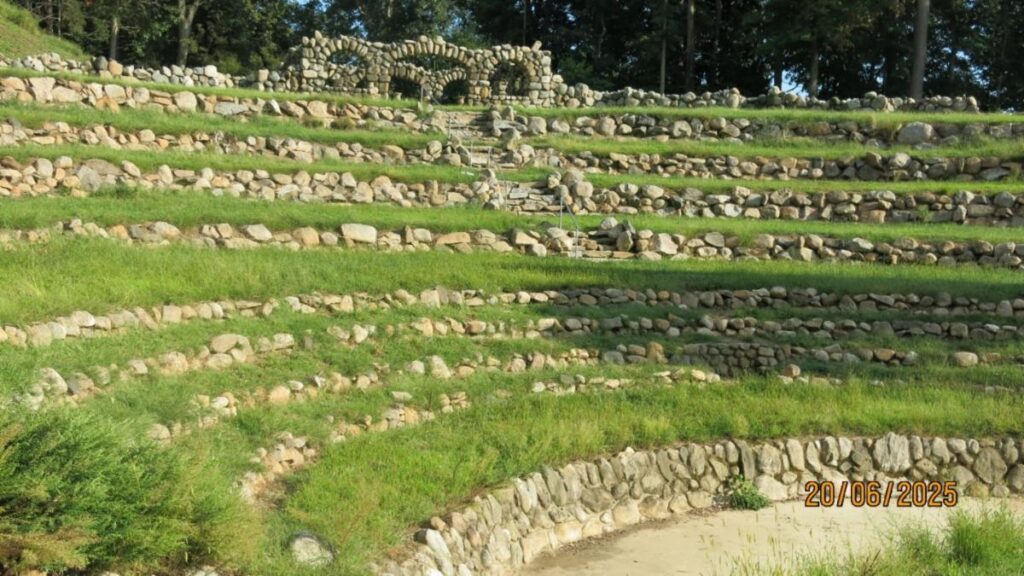
However, Rosemary Farm had one unique architectural structure- an outdoor amphitheater seating over 3,000 people. No doubt inspired by his wife, a former opera singer and patron of the arts, Conklin, using a design by the Olmstead Brothers firm, built a replica of a Greek amphitheater. Set into the wooded hill on the south side of the house the amphitheater, with its terraced seating and central moat, would serve as a venue for musical and dramatic productions. Eventually such luminaries of the day such as John Barrymore and Sarah Bernhardt would perform there. The most famous event was the 1917 National Red Cross Pageant designed to sell war bonds and support America’s entry into WWI. With a cast of over 500 performers of stage and screen the event was filmed and had a theatrical release in December 1917. However, as of today the film has never been found.
After the death of his wife, Conklin sold Rosemary Farm to the Diocese of Brooklyn, (today Diocese of Rockville Centre) in 1924. The diocese built a Seminary for students of the priesthood. At first the seminary used the original house as a retreat center and residence for nuns. But the house was abandoned and fell into disrepair when the seminary was not able to afford improvements to bring it up to fire code. Predictably, the mansion became a major attraction for vandals, and it burnt down in 1990.
In 1987 the amphitheater, now crumbling and overgrown, was semi-restored by a group of local volunteers including the seminary who lent their tools, the Town of Huntington Department of Parks and Recreation who donated benches and the Huntington Fire Department who filled the moat. Soon thereafter the Riverside Shakespeare Company put on a performance attended by over 500 people.
In the ensuing years the amphitheater once again returned to nature when in 2018 the seminary invited the North Shore Land Alliance to discuss the purchase of land for conservation purposes. Eventually North Shore Land Alliance, together with supporters from the town, county, state, and Lloyd Harbor Village got involved. The result was the largest New York State land acquisition ever made on Long Island. The original plan called for New York State Parks to purchase 180 acres as a preserve, Lloyd Harbor to purchase 20 acres which contained remaining outbuildings and amphitheater, and the Seminary would retain 16 acres.
Today the amphitheater has been restored to its former grass terraces, and stone steps and arches overlooking Long Island Sound. Perhaps someday performances will once again be staged in this magical environment.