CONKLIN (or CONKLING, CONKLINE), EZEKIEL (1739-1820). Associator (signer of the Huntington Articles of Association of 1775) and town constable and collector, Huntington, New York. As per Long Island Surnames in the database of Long Island Genealogy, Ezekiel was born on November 17, 1739, in Huntington, New York. His family tree, posted on Ancestry.com, names his parents as Thomas Conklin (1704-1793) and Abiah Hubbard (1696-1779), and his younger siblings as Abiah (1741-1824) and David (1744-1787), both born in Huntington. Older siblings named on Ancestry were Hubbard (see) (1736-1806) and Timothy (see) (1732-1811). Both older brothers were also known by their surname spelled as “Conkling,” as was Ezekiel; some documents record Ezekiel’s surname as “Concline.” The Geneanet Community Trees Index confirms his birth year, parents, date of marriage and spouse. The information posted on his Find A Grave page confirms the birth date of November 17, 1739, and names additional siblings, Thomas (see) (1704-1793) and Rebecca Conklin Gould (1734-1825), the wife of Ebenezer Gould (see) but does not name his son Abiel.
On December 15, 1762, Ezekiel married Mary Titus (1838-1804) at the First Church of Huntington, officiated by the Reverend Ebenezer Prime (see). Long Island Surnames names their children, some with approximate birth years: Abiel (1763-1858); Elizabeth (1765-1853); Philetus (1768-1778); Silas (1772-1854); and Titus (1776-1778). All of the children were born and died in Huntington. Ezekiel’s family tree on Ancestry.com also lists sons Matthew (1792-1880) and George (1797-1861), born in Rockland County, New York.
Anna Bruce Conklin, a descendant, filed for membership in the Daughters of the American Revolution (DAR). That organization’s database, which notes Ezekiel’s birth year as 1740, indicates that he was an associator who signed Huntington’s Articles of Association and recognized him for patriotic service in New York. On May 8, 1775, 403 men, most of them Huntington residents (a few were from Islip), “shocked by the bloody Scene” that had occurred just weeks before at Lexington and Concord in Massachusetts, where patriot Minutemen and British regulars had engaged in a bloody armed struggle, put their signatures on Huntington’s Articles of Association. Only 37 Huntington residents, either Loyalists or those wanting to stay out of the fray, refused to sign. The Articles noted that the signers affirmed their “Love to our Country,” agreed “to whatever Measures may be recommended by the Continental Congress; or resolved upon by our Provincial Convention, for the Purpose of preserving our Constitution, and opposition to the Execution of the several arbitrary, and oppressive Acts of the British Parliament,” and prayed for “a Reconciliation between Great-Britain and America.” The actions of these associators were seen by both patriots and the British as a step towards rebellion. The fact that these men signed these Articles, placing themselves in danger of British retaliation, including imprisonment, seizure of their property, and exile from Long Island, is proof of their patriotic service. Other descendants of Ezekiel, through his son Silas, are also recorded in the DAR database.
On May 7, 1776, the Huntington Town Records reported that Ezekiel Conkling was chosen as its constable and collector. After the Battle of Long Island (Battle of Brooklyn) on August 27, 1776, and the British occupation of Huntington within days, he was also chosen constable during annual town meetings in 1777, 1778, 1781 and was chosen constable and collector in 1782 and 1783. The 1783 town meeting recorded that Ezekiel Conkling was one of three men chosen to supply the shipping in Huntington Bay with fresh beef.
During the British occupation of Huntington, Ezekiel, as constable, was ordered to carry out British directives. As per orders of the British occupiers, Ezekiel was directed on October 4, 1776 to notify two Huntington residents to remove their “respective Vessels to the Dock in Huntington Harbour by the Morning Tide.” In September 1778, he was told to have another resident’s horse ordered into “Government Service.” Huntington Town Records during the occupation indicate that Ezekiel Conkling was growing mostly wheat and also some rye and corn; brothers Timothy and Thomas are among other farmers listed on that document.
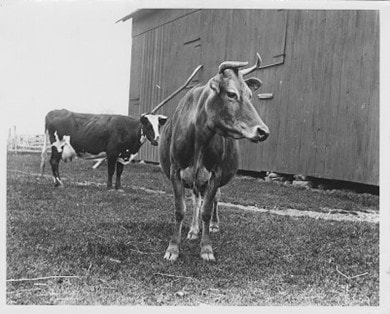
In 1778, Ezekiel signed the Oath of Allegiance to the Crown along with many other residents and associators; the oath was signed under duress by many of the signatories. Additional Huntington Town Records report that on September 23, 1780, Ezekiel Conklings’s wagons were employed for two days to transport the sick of the second Battalion of Light Artillery from Huntington to Jamica. Notes from a town meeting on October 2, 1781, show that he was asked to furnish beef to the British occupiers. Huntington Town Records of November 5, 1781, show that as constable, Ezekiel organized men with wagons, horses and ox-teams to facilitate the construction of Fort Golgotha, desecrating Huntington’s Old Burying Ground. Locals furnished their animals and worked with axes to build the fort in about 15 days. Ezekiel kept the records of the days the men worked, the value of the timber and the carting of straw.
Assessment of Property in Huntington at About the Close of the War in 1782 shows that Ezekial Conkling’s property was valued at £34, a modest amount compared to his neighbors. Further, the account of damages suffered during the occupation shows that among the receipts signed by British officers, Ezekiel Conkling losses included leather, horses, robbery totaling £281 6 shillings, and £14 in rails burnt by troops, a middling amount compared to contemporaries.
As per the 1790 census of Huntington, which uses the surname of Conkling, Ezekiel’s household there was comprised of three males and three females. That census noted one male had a freehold valued at £100 and one male had a freehold valued at £20. Suffolk County Probate Records compiled by Elizabeth R. Van Buren and part of the DAR Library show that upon the death of his father in 1793, Ezekial (sic) was bequeathed half of his estate. According to U.S. Tax Assessment Rolls of Real and Personal Estates, 1799-1804, Ezekiel Concline of Huntington owned $3,534 in real estate and $130 in personal estate and paid $3.66 in taxes, making him one of the town’s richest men. The 1800 census reports that Ezekiel Concline headed a household in Huntington with seven members: one free white male under ten, one free white male 16 thru 25, one free white male 26 thru 44, one free white male over 45, one free white female 16 thru 25, one free white female over 45 and one other free person.
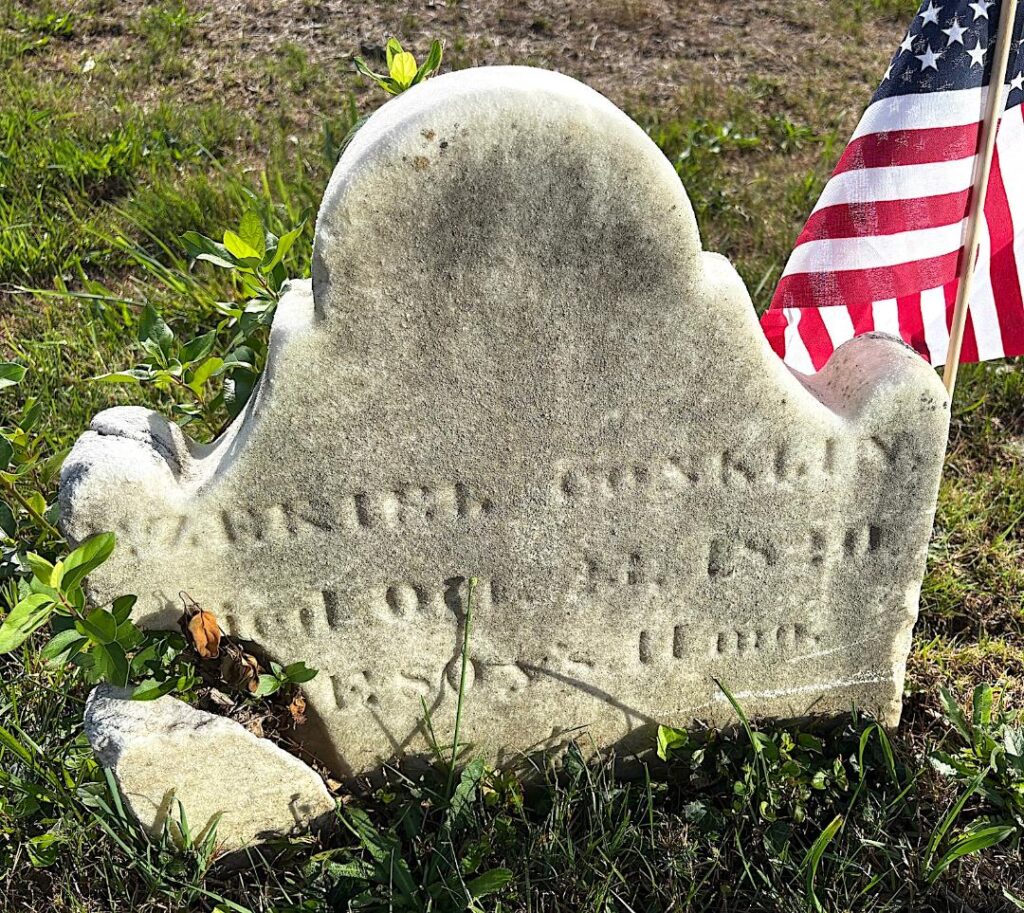
Ezekiel died on October 23, 1820, and was buried at Huntington’s Old Burying Ground. As per Josephine Frost, in Cemetery Inscriptions from Huntington, Long Island, 1911, his tombstone read, “Ezekiel Conklin, died October 8, 1820. Age 80 years and 11 months.” Ms. Frost recorded for Ezekiel’s wife, who pre-deceased him, “Mary, wife of Ezekiel Conklin, died Nov. 22, 1804 in her 66th year.”