WICKES (or WICK, WICKS, WEEKES), JOHN (1723-1801). Captain, Colonel Josiah Smith’s 1st Regiment of Suffolk County Minutemen, Fifth Company. As per his Find A Grave page and the online family tree posted on Ancestry.com, John was born in Huntington, New York in 1723 to Jonathan (1686-1749) and Mary Brush Wicks; however, The Patriot System database lists a birth year of 1722. His surname is listed as Wick/Weekes on Ancestry and as noted, Find A Grave lists his father’s surname as Wicks. As per the family tree on Ancestry, John had several siblings: Jonathan (1713-1759); Elizabeth Dennice (1717-1761); Dennice (1722-1891); Ruth (born 1730) and Hezekiah (1733-1800). His father’s will also lists a son named Samuel and a daughter named Purth.
John was named a beneficiary and co-executor in his father’s will on January 11, 1749. His father signed his will as “Jonathan Wicks” and wrote that he was weak of body but strong of mind. In that will, he bequeathed his son John his house and household where he currently resided and the land on East Neck that was not disposed of. His father bequeathed his wife, Mary, a dwelling room of her choice and also named his sons Jonathan, Samuel, Hezekiah and daughters, Elizabeth and Purth as heirs to land (sons) and/or property (with cows and mares given to the daughters).
On May 13, 1750, John married Bathsheba Higbee (1723-1763) at the First Church of Huntington in a ceremony officiated by the Reverend Ebenezer Prime (see). The couple had four children: Sarah (1750-1824); Hannah (1752-1805); Bathsheba (1754-1817) and John (1744-1822). After Bathsheba’s death, John married Elizabeth Tucker (who died December 11, 1786) and then married Sarah Mills in Huntington on January 3, 1788. After Sarah’s death, he married Deborah Vail on March 25, 1792, in Huntington; she died in 1810.
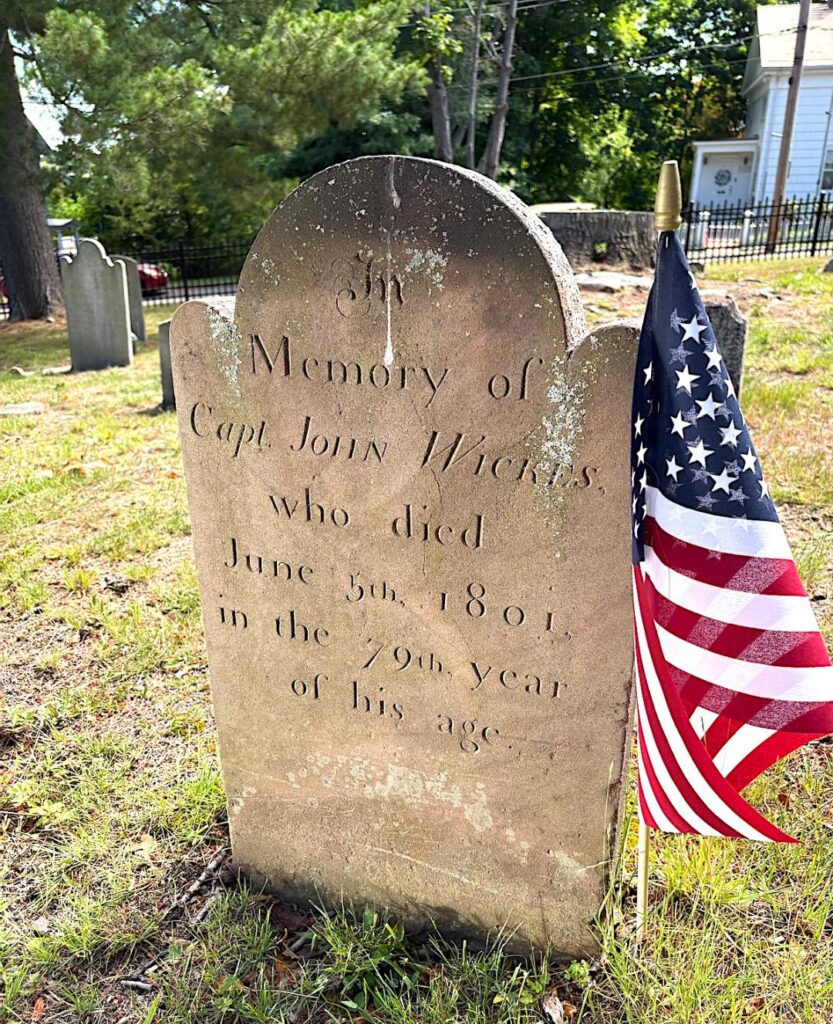
Huntington Town Records of September 11, 1775, report that a John Wickes was a captain of the 1st of three militia companies in the town; they were formed for the possibility of a war for independence. Additional records show that Wickes led the Fifth Company in Colonel Josiah Smith’s 1st Regiment of Suffolk County Minutemen. Further, according to Frederic Gregory Mather’s The Refugees of 1776 from Long Island to Connecticut (1913), Wickes was “one of the Officers from Long Island [who] were within the American lines at Brooklyn August 1776,” an apparent reference to the crucial Battle of Long Island, fought on August 27, which allowed British forces to occupy Long Island for the duration of the Revolutionary War. The Patriot Research System, a database of the Sons of the American Revolution (SAR), lists Wickes as a patriot who served as a captain, citing Huntington Town Records and other sources including Frederic G. Mathers scholarly work cited above. In 1911, Josephine Frost, in Cemetery Inscriptions from Huntington, Long Island, recorded the lettering on John Wickes’s grave: “In memory of Captain John Wickes, Who died June 5, 1801, In the 70th year of his age.” Given that there is no indication that this John Wickes was a sea captain, this inscription, plus the SAR database, establish that the John Wickes who served as a militia captain is the man who is the subject of this biography, rather than his son with the same name.
There are many references to “John Wickes” in Huntington Town Records and other documents. Some of those mentions refer to him as “Captain John Wickes,” the subject of this biography; others simply list “John Wickes.” Because the subject of this biography and his son have the same given name, it is unclear, in the latter cases, who is referenced. As per Revolutionary Incidents of Suffolk and Kings Counties; With an Account of The Battle of Long Island and Prisons and Prison Ships at New York by Henry Onderdonk Jr. (1849), in Huntington on March 27, 1782, while the town was under British occupation, John Wickes is listed among Huntingtonians who delivered hay and straw at Lloyd’s Neck for His Majesty’s troops and were entitled to receipts for payment of their services. Huntington Town Records of May 7, 1782, name Wickes as one of three commissioners. “The Assessment of Property in Huntington About the Close of the War in 1782” shows that Captain John Wickes’s property was valued at £100; among the 29 listed (two properties were assessed at £200 or over and seven properties were valued equal or higher than John’s). On April 10, 1783, a John Wickes wrote that people of Queens County met at Mr. Onderdonk’s house to discuss the confusion and robberies in their town and the hope that the residents could have a voice in the election for governor. On May 6, 1783, April 6, 1784, April 5, 1785, April 3, 1787, and April 1, 1788, a John Wickes was appointed as one of three commissioners for laying out of highways. At Huntington town meetings in 1789, 1790, and 1791, John Wickes was elected a trustee. At the 1791 town meeting, Trustee John Wickes was chosen to transact the public affairs of the town.
The census of 1790 shows a John Wickes having land valued at £100; he was living with his wife and one enslaved person. In 1799, a John Wickes of Huntington was named on the New York Tax Assessment Rolls of Real and Personal Estate as having $1580 in real and person estate and being assessed $1,58 in taxes.
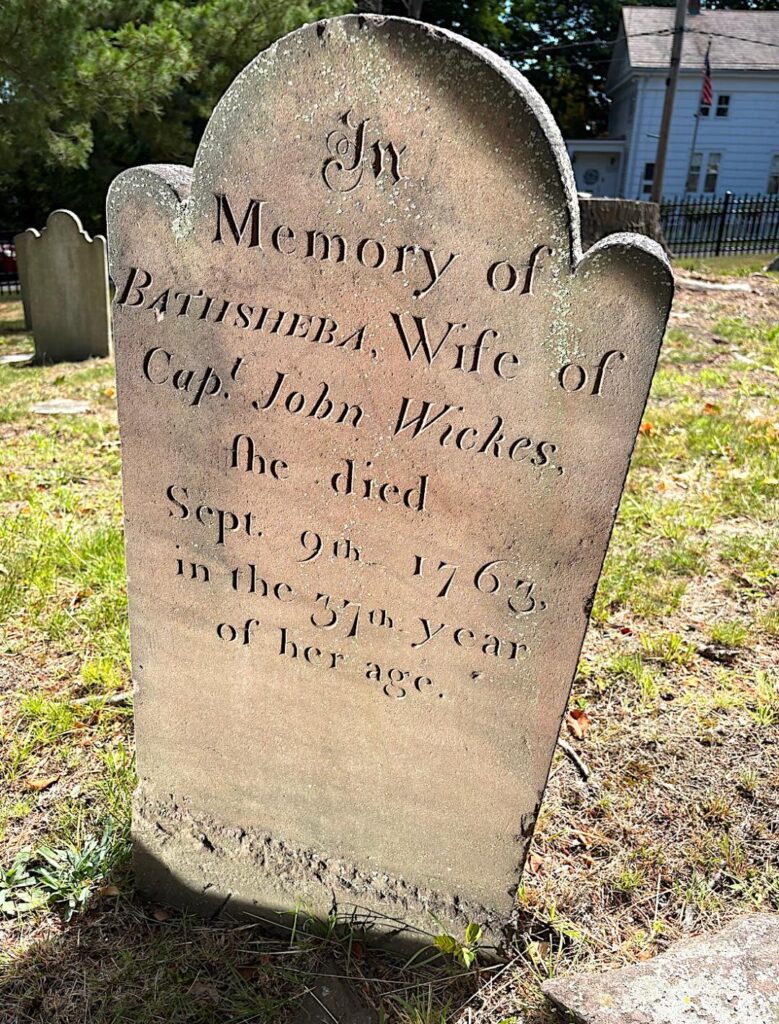
John Wickes died on June 5, 1801 in Huntington and was interred in Huntington’s Old Burying Ground. His first wife, Bathsheba, who died on September 9, 1763, at age 37, is buried beside him, as per Josephine Frost.