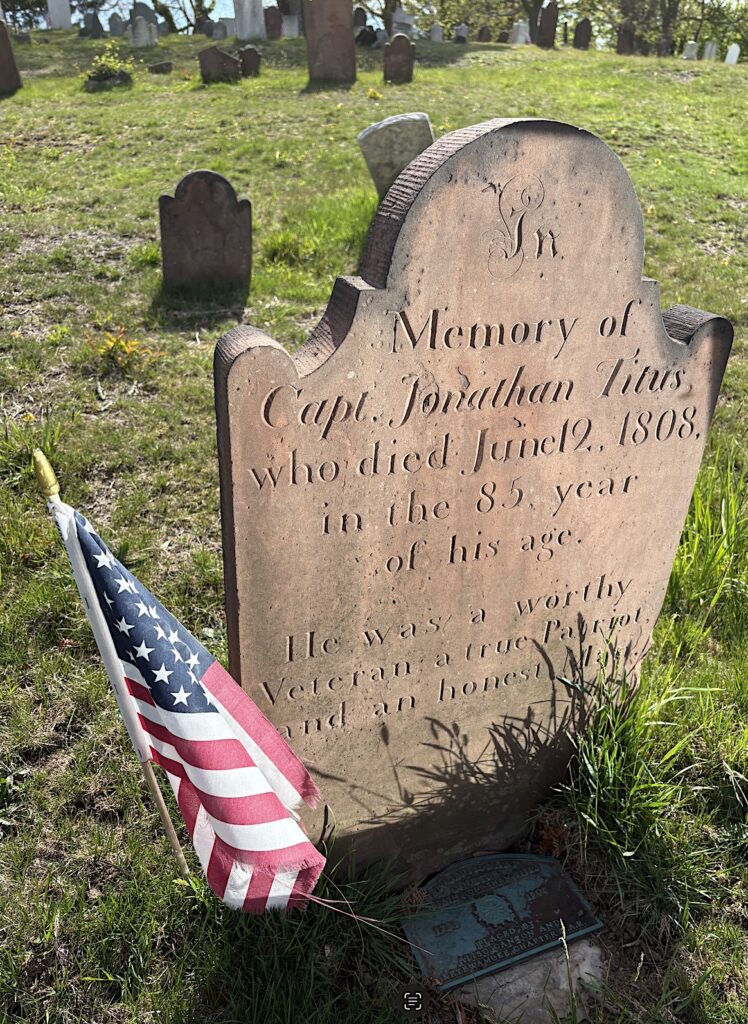

TITUS, JONATHAN (1724–1808). Captain, Colonel Henry Livingston’s 2nd and 4th New York Regiments. Jonathan Titus was born to John Sr. and Sarah Platt Titus in the village of Cold Spring Harbor in the town of Huntington, Long Island. He was the oldest of four siblings, and of four half-brothers from his father’s second marriage, according to records on Ancestry.com. One half-sibling was Israel Titus (see).
In 1749, at the age of 25, Jonathan married Elizabeth Martha Ketcham. Together they had four children. After Elizabeth’s death in 1761 or 1762, he married again, this time to Sarah Brush. Together they had three daughters: Ruth, Deborah, and Experience.
The online database of the Sons of the American Revolution records his patriotic service as a first lieutenant in the Suffolk County Militia in 1775 and as a captain in Henry Livingston’s Regiment from December 1775 through January 1781. Likewise, the online database of the Daughters of the American Revolution confirms that same military service. The Abstract of Graves of Revolutionary War Patriots lists Huntington’s Old Burying Ground as the place of interment of Captain Jonathan Titus. According to an application to the California chapter of the Sons of the American Revolution, Jonathan joined the 1st New York Continental Regiment as a 2nd lieutenant, and was promoted to 1st lieutenant in in the 2nd Huntington Company in November, 1775. By July 1776, he was captain of the 8th Huntington Company, 4th Battalion, of the New York Line. The U.S. Revolutionary War Burial Index confirms that Captain Jonathan Titus of the Fourth Regiment of the Continental Line is interred at Huntington’s Old Burying Ground.
Jonathan is also listed in Frederic Mather’s Refugees of 1776 from Long Island to Connecticut, meaning he lived for a time in Connecticut to escape the British occupation of Long Island. From November 1776 until he retired from the military in January 1781, he served on General George Washington’s staff, with much of that service at Newburgh, New York.
Jonathan returned to Huntington and his family after the war ended, becoming an active town representative and businessman. According to Huntington Town Records of 1785-1786, Jonathan was awarded the operation of the ferry from Huntington to Norwalk for 16 pounds a year, “in case he pays the money Annually.” In March of 1788, it was recorded that Jonathan was among a group of 20 men who obtained one-year sales licenses (at two pounds apiece) for “strong and spiritous Liquors.” Also in 1788, Jonathan was granted, as a veteran, a “war bounty” of 100 acres of land, according to a document directed to “the Geographer of the United States” or his appointed surveyors. The 100 acres was to be “in any of the Districts appropriated for satisfying the Bounties of Land, due to the late Army of the United States.”
In 1791, 1792, 1795, and 1797 Jonathan was appointed constable of the town of Huntington. He also served as tax collector almost continuously from 1798 to 1803, then returned to the office of constable in 1804 and 1805.
In the 1790 federal census, Jonathan’s household in Huntington consisted of five members, at least two of which were “free white males” under the age of 16. Since none of his children would fit that description, their identities are something of a mystery.
In the 1800 federal census, however, his household recorded only three members, including one enslaved person. The other two, presumably, were Jonathan and Sarah.
Jonathan died on June 12, 1808, and was interred in Huntington’s Old Burying Ground. His original brownstone tombstone, which still stands, is inscribed with his date of death (1808), that he died in his 85th year, and that “He was a worthy Veteran, a true Patriot, and an honest Man.” A bronze plaque at his grave, placed by the local chapter of the Daughters of the American Revolution, confirms his identity as a Revolutionary War captain.
In 1932, a bronze plaque with his name on it, as well as that of other patriots, was unveiled in the village of his birth, Cold Spring Harbor.