WOOD, ISRAEL (1723-1791). Patriot leader and President of the Town Board of Trustees of Huntington; associator. Israel Wood was born on February 9, 1723, in what is now Long Island City, Queens, New York City, according to the Geneanet Community Trees Index. His parents were Joseph Wood, 1684-1747, and Penelope Foster, 1687-1757. His siblings were John, 1705-1740; Keziah, born 1706; Joseph, 1710-1774; Deborah, born 1714; Joshua, 1716-1779; and Prudence, 1722-1775. He also had five half-siblings, since both of his parents had been married before they married each other. Israel’s paternal grandparents were Joseph Wood, 1637-1723, and Deborah Ketcham, 1640-1737.
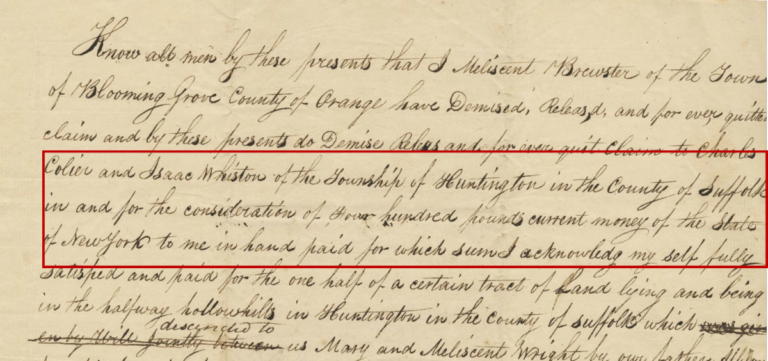
Geneanet records that on August 16, 1753, Israel Wood married Mary Prime and they had two children: Ebenezer Prime Wood, 1754-1771, and Experience Wood in 1756. Mary was born in 1731, the daughter of Rev. Ebenezer Prime (see) and Experience Youngs, and died in 1756. Sources are Ancestry.com and Peabody Genealogy, compiled by Selim Hobart Peabody (1909). It is possible that Israel Wood had an earlier marriage, to Sarah Ketcham, on June 26, 1751, in Huntington. Sarah, born in 1730, died on January 9, 1752, in Huntington.
Israel lastly married Vashti or Vashity Platt, of Huntington, Long Island on May 1, 1762, per the records of the First Church in Huntington and Huntington Town Historian, Robert C. Hughes. Born in 1723 or 1726, Vashti was the daughter of Epenetus Platt and Sarah Scudder. Israel and Vashti had three children: Lydia, 1762-1770, Jethro, 1764-1776, and Platt, 1766-1779.
Israel was president of the Board of Trustees of the Town of Huntington as the Revolutionary War approached. In that capacity, he presided over a significant meeting on June 21, 1774, where resolutions that are now considered Huntington’s Declaration of Rights were passed. First among these rights, as explained by Reginald Metcalf Sr. in an essay published by the Huntington Historical Society, was that “every freeman’s property is absolutely his own” and that the levying of taxes by a Parliament in which the American colonies were not represented was seen as a “violation of the most essential rights of British subjects.”
On May 8, 1775, 403 men, most of them Huntington residents (a few were from Islip), “shocked by the bloody Scene” that had occurred just weeks before at Lexington and Concord in Massachusetts, where patriot Minutemen and British regulars had engaged in a bloody and deadly armed struggle, put their signatures on Huntington’s Articles of Association. Only 37 Huntington residents, either Loyalists or those wanting to stay out of the fray, refused to sign. Both of the Huntingtonians named Israel Wood, including the subject of this biography, signed the Articles of Association. The Articles noted that the signers affirmed their “Love to our Country,” agreed “to whatever Measures may be recommended by the Continental Congress; or resolved upon by our Provincial Convention, for the Purpose of preserving our Constitution, and opposition to the Execution of the several arbitrary, and oppressive Acts of the British Parliament,” and prayed for “a Reconciliation between Great-Britain and America.” The actions of these associators were seen by both patriots and the British as a step towards rebellion. The fact that these men signed these Articles, placing themselves in danger of British retaliation, including imprisonment, seizure of their property, and exile from Long Island, is proof of their patriotic service.
Huntington Town Records show that Israel was again chosen president of the Board of Trustees at a town meeting on May 7, 1776, and was appointed as a town surveyor and one of the men overseeing intestate estates.
In his book, Revolutionary Incidents of Suffolk and Kings Counties (1849), Henry Onderdonk Jr. noted that Israel Wood recorded, as president, the minutes of a general town meeting of the inhabitants of Huntington held on June 21, 1774. Onderdonk also wrote that Israel was present at a meeting of “several committees in the First Regiment of Suffolk County held at Smithtown on October 24, 1775.” Additionally, Gregory Mather wrote in The Refugees of 1776 from Long Island to Connecticut (1913), that Israel Wood, a Huntington resident, was present at this meeting.
On September 2, 1776, following the defeat of Washington’s army in the Battle of Long Island, Israel, in his role as president of the trustees of Huntington and leader of the local Sons of Liberty, wrote to Colonel Henry Livingston, ordering him “to disperse his (rebel) army or the (British) regulars will be on him; the people are in a doleful situation . . .”
Israel continued to rally local patriots while experiencing severe hardships during the British occupation. Onderdonk wrote that, once the British troops left the area, Israel Wood and other patriots were considered “miscreants,” “traitors,” and “scoundrels” by loyalists whose property had been plundered by these patriots. Gaines’ New York Mercury of June 28, 1779, reported on news from Huntington, and named Israel Wood as one of seven of “the principal miscreants (rebels)” there, noting of these individuals: “several of whom smuggled goods out of New York to this place, for the sole purpose of supplying the rebels in Connecticut.” However, there was another Israel Wood living in Huntington at the time; it is unclear which man of that name is referred to here.
Israel was again elected a town trustee in 1778, and, in 1779, he was again president of the town board. On January 5, 1778, he wrote to Huntington’s militia captains, telling them they needed to join him at a meeting to determine the amount of grain that their men would be required to supply to the British and their loyalists; he threatened that, if they did not appear, he would give their names to loyalist General Oliver Delancy. Later that year, Israel Wood took an oath of allegiance to the British King and promised peaceable behavior. This oath, however, was made while Huntington was occupied by the British, and may have been coerced. If he had not taken the oath, he most probably would have had to flee to Connecticut, as other patriots did. Israel was listed as a 54-year-old farmer at that time.
As shown in Huntington Town Records, 1776-1873. Vol. III (1889), in 1782, at the close of the war, Israel’s property was assessed at 150 British pounds, about $30,000 today, according to the Bank of England and Oanda Business Information and Services. Relative to his neighbors, he was quite prosperous. On February 13, 1783, also as shown in Huntington Town Records, in an “Account of Rails Burnt by the Troops Under Coll. Tomsons Command Whilst in Huntington,” it was recorded that, for Israel Wood, 700 fence rails were burned, at a cost of 24 British pounds, 10 shillings.
Israel Wood was living in Huntington, New York in 1790, according to that year’s federal census. There were eight household members, including one free adult white male, one free white female, and six enslaved people.
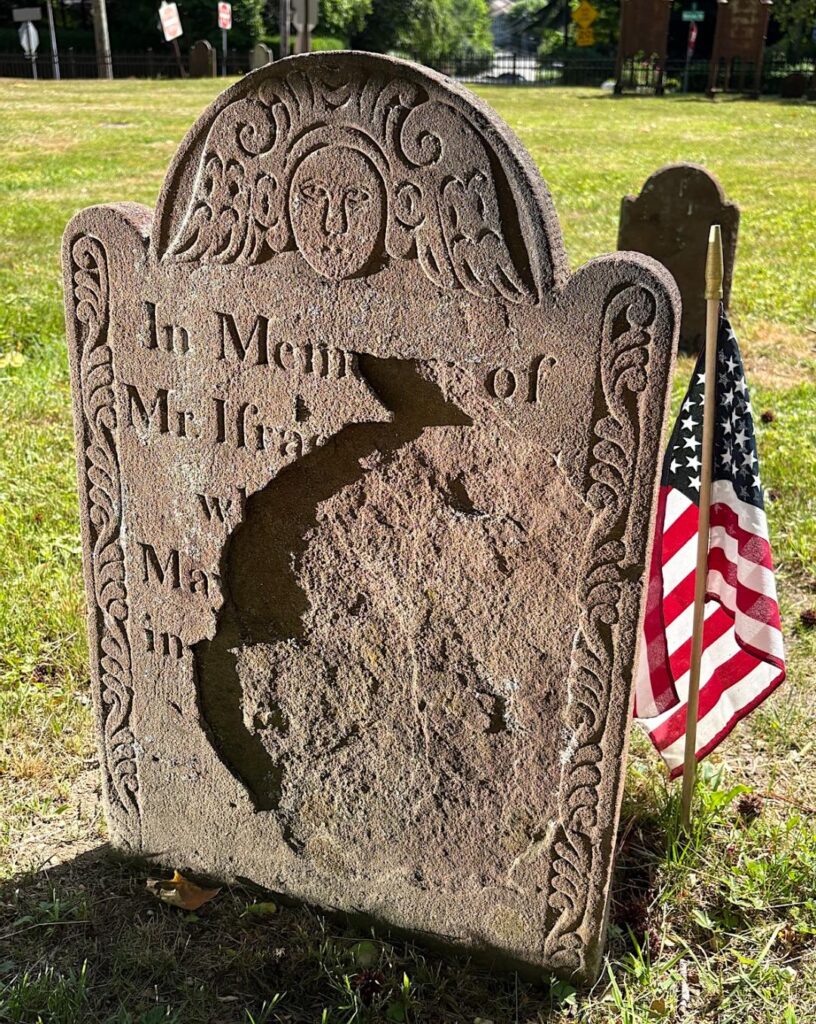
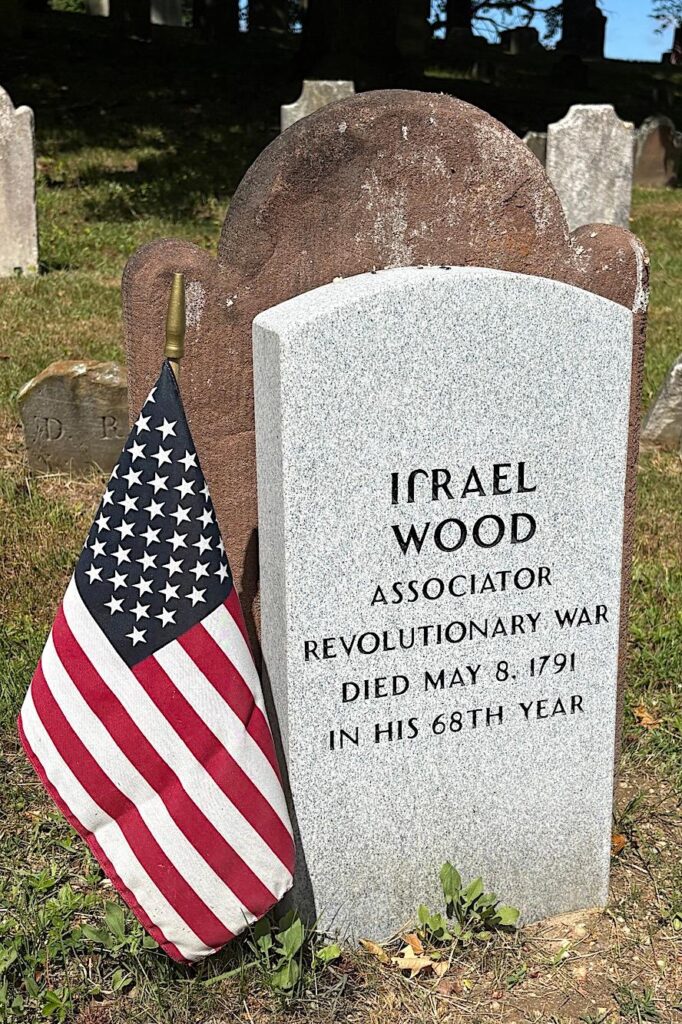
Almost all of Israel’s children predeceased him. An announcement in the Connecticut American Mercury newspaper, published on May 30, 1791, revealed that Israel’s death, in Sag Harbor, Long Island on May 8, 1791, was a suicide. In Cemetery Inscriptions from Huntington, Long Island, New York (August 1911), Josephine C. Frost recorded that Israel’s gravestone showed his date of death as May 8, 1791, in his 68th year. Both Israel and Vashti, who died on April 22, 1812, were interred in Huntington’s Old Burying Ground, side by side. His grave is marked with both his original brownstone (which has delaminated and is only partially readable) and a granite stone provided by the Department of Veterans Affairs.