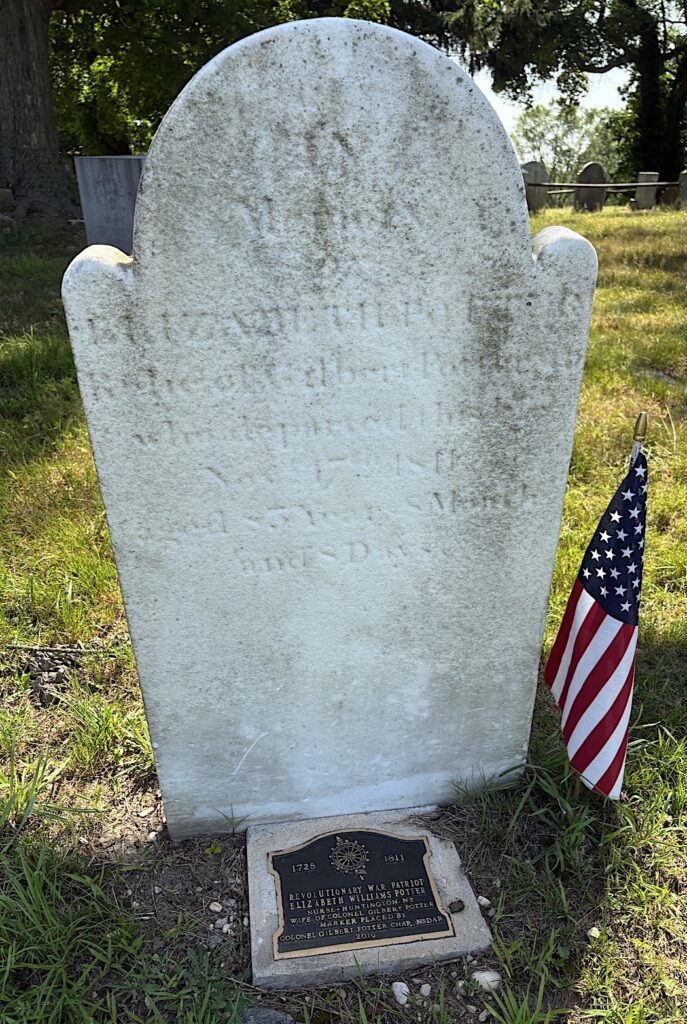

POTTER, ELIZABETH (1728-1811). Patriot. Born Elizabeth Williams in Huntington, New York, on June 9, 1728, Elizabeth’s parents were Nathaniel Williams, born in 1698 in Hartford County, Connecticut, and Elizabeth Platt, born in 1694 in Huntington. When she was only four years old, Elizabeth suffered the loss of her father on August 4, 1732, in Huntington. Elizabeth’s sister, Mary, born in 1724, was ten years old when she died on April 31, 1734, as shown on her gravestone in the Old Burying Hill Ground. Their brother, Nathaniel Williams Jr., born on May 27, 1721, is also interred in the Old Burying Hill Ground. According to the inscription on his gravestone, he was an “associator,” one who signed the Association in 1775 protesting British rule. He died on November 27, 1781, in Huntington.
Elizabeth’s widowed mother married Philip Ketcham in 1738. He died in Huntington on January 5, 1770, and is interred in the Old Burying Hill Ground. Much of the information about Elizabeth’s family is obtained from the Long Island Surnames database of Long Island Genealogy as well as research by Robert C. Hughes, Huntington Town Historian, on the Old Burying Hill Ground.
On February 23, 1748 or 1749, Elizabeth married Gilbert Potter (see), born in 1723 or 1725 at Huntington. A doctor and surgeon, Gilbert had served, when he was 20 years old, as a privateer against the French during King George’s War, the American phase of the War of the Austrian Succession. Per Robert C. Hughes piece, “Honoring Two Revolutionary War Patriots,” October 9, 2019, found online at huntingtonhistory.com, the couple had seven children, all born in Huntington, but only three lived to adulthood. A son named Peleg was born in May 1750 and died nine months later, on February 27, 1751. They named their next child Peleg as well. He was born in 1751 and died at age 13 on April 5, 1764. Other children were Sarah (1756-1823), Elizabeth (1757-1759), Nathaniel (1761-1841) (who served in the New York State Assembly and became a Suffolk County judge), Seraphena (born in 1762), and Martha (1764-1813.) Seraphena (Seraphina) died of smallpox on December 21, 1777, at either 14 or 15 years of age, or in 1782, when she was 19 or 20, according to Bob Pfeifle’s December 18, 1948 article, “Romantic Past Lives in Old Granite,” in Newsday (Suffolk Edition) or Cemetery Inscriptions from Huntington, Long Island, New York, copied by Josephine G. Frost in August 1911. Elizabeth’s mother died, also in Huntington, on December 26, 1773, as inscribed on her gravestone in the Old Burying Hill Ground.
In 1756, Gilbert served as a captain during the French and Indian War at Fort Ticonderoga, New York, and, in 1758, he was put in charge of an army hospital in Schenectady, New York. After the war, he returned to Huntington where he continued to practice medicine. Bob Pfeifle’s Newsday article relates how Gilbert was called back, in 1776, at the start of the American Revolutionary War, to serve as a lieutenant colonel at the Battle of Long Island.
When the British triumphed at that battle, and occupied Long Island, including Huntington, Gilbert fled to Connecticut and Elizabeth took over her husband’s medical practice. According to Bob Pfeifle, she was an educated woman and had learned much about medicine from helping her husband. She was commanded to treat Midshipman Hardy, a 15-year-old British sailor, who was from one of the British ships anchored in Huntington Harbor. He was suffering from smallpox and Elizabeth nursed him back to health. While recovering under Elizabeth’s capable care, Midshipman Hardy and her son, Nathaniel Potter, who was the same age as Hardy, became friends.
As the war continued, Gilbert acted as a spy for General Washington, safeguarded Long Island’s livestock, and sought refuge in Connecticut when the British overtook Long Island, per a National Society Sons of the American Revolution application dated 1938, submitted by descendant Gilbert Williams Griffiths. Robert C. Hughes wrote that Gilbert repeatedly snuck back from Connecticut to Huntington to see his wife and family and spy on British troops.
As he had done once the French and Indian War had ended, Gilbert returned to Huntington after the Revolution and resumed practicing medicine. He died in Huntington on February 14, 1786. Elizabeth died, also in Huntington, on November 17, 1811.
Elizabeth’s son Nathaniel became a successful silversmith and owned a sloop that was seized by the British during the War of 1812. On that ship was Nathaniel’s nephew Henry who was captured and put in shackles. When Nathaniel was brought out to the ship to ransom it, he was shocked to see that the commander of the British fleet was the same British sailor whom, when they were both teenagers, Nathaniel’s mother had successfully treated for smallpox. Commodore Hardy ordered Henry released and Nathaniel Potter was hosted at a lavish dinner aboard Hardy’s British ship where the commodore gave a glowing tribute to Nathaniel’s mother, the woman who had saved his life more than 30 years before.
Both Elizabeth and Gilbert Potter, as well as their children, are interred in the Old Burying Ground, as are Elizabeth’s parents, her stepfather, her sister, Mary, and her brother, Nathaniel Jr.