PRIME, EBENEZER (1700-1779). Patriot, clergyman. According to Appleton’s Cyclopedia of American Biography, 1600-1889, Ebenezer was born on July 21, 1700, in Milford Connecticut. The Connecticut, U.S., Church Records Abstracts, 1630-1920, document his parents as James and Sarah Prime and that he was baptized on July 28, 1700 in Milford. As per his family tree on Ancestry.com, he was the fourth of eight siblings, one brother and six sisters. A detailed compilation of Ebenezer’s marriages and children is documented by Ralph E. Prime in Prime:. The Descendants of James Prime, Who Was at Milford, Conn. In 1644, with Some Names in Allied Families. In the book, Ralph states that on October 2, 1723, Ebenezer married Margaret Sylvester and the couple had a daughter, Margaret and a son, Ebenezer. His wife passed away on September 26, 1728. On November 12, 1730, he and Experience Youngs were married. They had two daughters, Mary and Sarah, and one son, Benjamin. On January 1, 1734, Experience died. Ebenezer subsequently married Hannah Carll (Carle) on March 11, 1751, in Smithtown, New York. Ebenezer and Hannah had two children, Ebenezer and Experience. Hannah died on February 9, 1776. Not only did Ebenezer experience the passing of three wives, but he also faced the death of three children: Ebenezer (1724-1742), Sarah (1731-1731) and Ebenezer (1754-1755).
Appletons’ Cyclopedia of American Biography, 1600-1889 relates Ebenezer Prime’s steadfast vocation as a clergyman:
He (Ebenezer) was the grandson of James, who, with his brother, Mark Prime, came from England to escape religious persecution about 1638. Ebenezer was graduated at Yale in 1718, studied divinity, and the following year was called to Huntington, L.I., where he became an assistant to Rev. Eliphalet Jones. On 5 June, 1723, he was ordained pastor of the same church, which office he continued to hold until his death. A register of the sermons he preached, with texts, dates, and places of delivery, show that he prepared more than 3,000, many of which are still preserved. Although he was educated as a Congregationalist, in 1747, his own church and others in the county of Suffolk formed themselves into a presbytery and adopted the Presbyterian form of government, Mr. Prime being chosen the first moderator.
Ebenezer was also a prodigious member of the Huntington community. As per The Prime Family:
Soon after taking charge of the church at Huntington, the Rev. Ebenezer Prime purchased a farm with a residence near the church, which remained in the possession and occupancy of himself and his direct descendants of the name more than a hundred and fifty years. Here he devoted himself to the care of his flock, to preparation for his pulpit services, and to general study; enjoying the affection and commanding the respect of all whom he reached with his influence. He is described by one of his contemporaries as “a man of sterling character, of powerful intellect, who possessed the reputation of an able and faithful divine.” Cultivating, from the commencement of his ministry, a taste for learning, he early began the collection of what became, for that period, a large and valuable library, chiefly imported from England, and including choice editions of the Greek and Latin classics; many of his theological works being London editions in large folio.
Although too old to participate in the Revolutionary War as a soldier, Ebenezer, nonetheless, was a true patriot. There is considerable documentation on how he used his pulpit to convey his sentiments about the British. In “Huntington During the Revolutionary War,” Jeffrey I. Richman, Trustee, Huntington Historical Society 2026, relates:
What is today known as the Old First Church—the Presbyterian church on Main Street in Huntington—was widely known as a place of strong rebel sentiment. As a result, it was targeted relentlessly by British and loyalist troops during their Revolutionary War occupation. The pastor of that church, Reverend Ebenezer Prime, was an outspoken patriot. “‘A fearless advocate of independence,’ [he] gave sermons encouraging resistance against the British as a holy cause.” “Seven Years in Exile: The Long Island Refugees,” by Lora Horton Higgins; master’s thesis, University of North Carolina Charlotte, 2001, page 26. His congregants were overwhelmingly patriots. During the war, no worship was allowed in the church; occupying troops and horses were boarded inside it, its bells were stolen by the British, and its lumber was stripped. In contrast, “… in Huntington most loyalists attended St. John’s Episcopal Church, where the members were encouraged to fight against their rebellious neighbors.” Higgins, page 25, citing John Staudt, “A State of Wretchedness: A Social History of Suffolk County, New York in the American Revolution” (Ph. D. dissertation, George Washington University, 2005), page 77.
There are numerous accounts describing how, in life and in death, Ebenezer was despised by the British and loyalist troops, especially by Loyalist Colonel Benjamin Thompson. In “The Town of Huntington During the War of Independence: A Political and Social Study,” Eleanor S. Dennis describes:
Another sacrilege attributed to Colonel Thompson concerned Reverend Ebenezer Prime who had preached to the people of Huntington from his Presbyterian pulpit for sixty years and was always a fearless advocate of American Independence. When he was seventy-seven years of age, in 1777, he was driven from his home by the British who completely destroyed his library. Thompson was so hostile to the late, out-spoken pastor, who died in 1779, that in 1782 he pitched his tent in the Huntington graveyard, in order, he said, ‘that he might tread on the damned old rebel’s head whenever he went in and out of his tent.’
In his book, PRIME. The Descendants of James Prime, Ralph Prime recounts: …he was a revolutionary patriot of the most pronounced type, and so well known that when the British troops came to Huntington and encamped in the graveyard, his grave was desecrated as of a well ascertained and much hated rebel.
Another account, from The Prime Family, describes the suffering imposed on Ebenezer Prime during the Revolutionary War:
The Presbyterian church, in which Mr. Prime had so long ministered, was taken for a military depot, and the pulpit and pews were broken up and used for fuel. The pastor’s house was occupied by the troops, and his valuable library used for lighting fires, mutilated by the destruction of portions of sets of books, or recklessly scattered abroad. His study-chair, which still remains in the family, bears the marks of the rough usage to which his property was subjected. He was an object of special hostility on account of his having warmly espoused and advocated the cause of the country before the war broke out . . . . Toward the close of the war Colonel Thompson, of the British army, was sent with a body of troops to occupy the place. By his orders the venerable church building in which Mr. Prime had so long ministered was torn down, and the timber used for constructing barracks and blockhouses in the cemetery, which was occupied as a fort. The graves were levelled, and the gravestones used by the soldiers for the bottoms of their ovens.
Ebenezer’s love for the colonies passed on to his son, Benjamin (see). Benjamin graduated from Princeton in 1751 and practiced medicine in Easthampton, Long Island. A prominent physician, he was, according to The Prime Family of Long Island, “a true patriot, and on the passage of the Stamp Act wrote a song for the Sons of Liberty which was used to stir up the spirit of patriotism.”
An application for membership to The New Jersey Society of the Sons of the American Revolution was filed by Raymond Rogers Chatfield on June 10, 1921. That application notes that Chatfield was the great-great-great grandson of Reverend Ebenezer and Experience Prime. Chatfield cites the following reasons for the submission:
Rev. Ebenezer Prime, born in Milford, Conn., July 21, 1700, died in Huntington Long Island, September 25, 1779, preached the gospel for sixty years, was a fearless advocate of American Independence, in his seventy-seventh year was driven from his home by British Troops, who destroyed his Library, etc.
Benj. Youngs Prime, son of Rev. Ebenezer Prime, was born in Huntington, Long Island, December 20, 1733, and died there October 31, 1791, was a physician, a writer in “The American Whit.” A public speaker against British tyranny and the author of many patriotic songs and poems on of which form the basis of part of the Phraseology of the “Americans’ Test Oath” belong to the Sons of Liberty, was the special object of British hatred and was compelled to flee for his life with his wife and child and for seven years lived in exile in Connecticut.
The Long Islander of June 5, 1908, reported that veterans and Huntingtonians had just visited cemeteries and decorated the graves of the honored deceased. Among the many graves visited was that of Ebenezer as well as of his son, Benjamin.
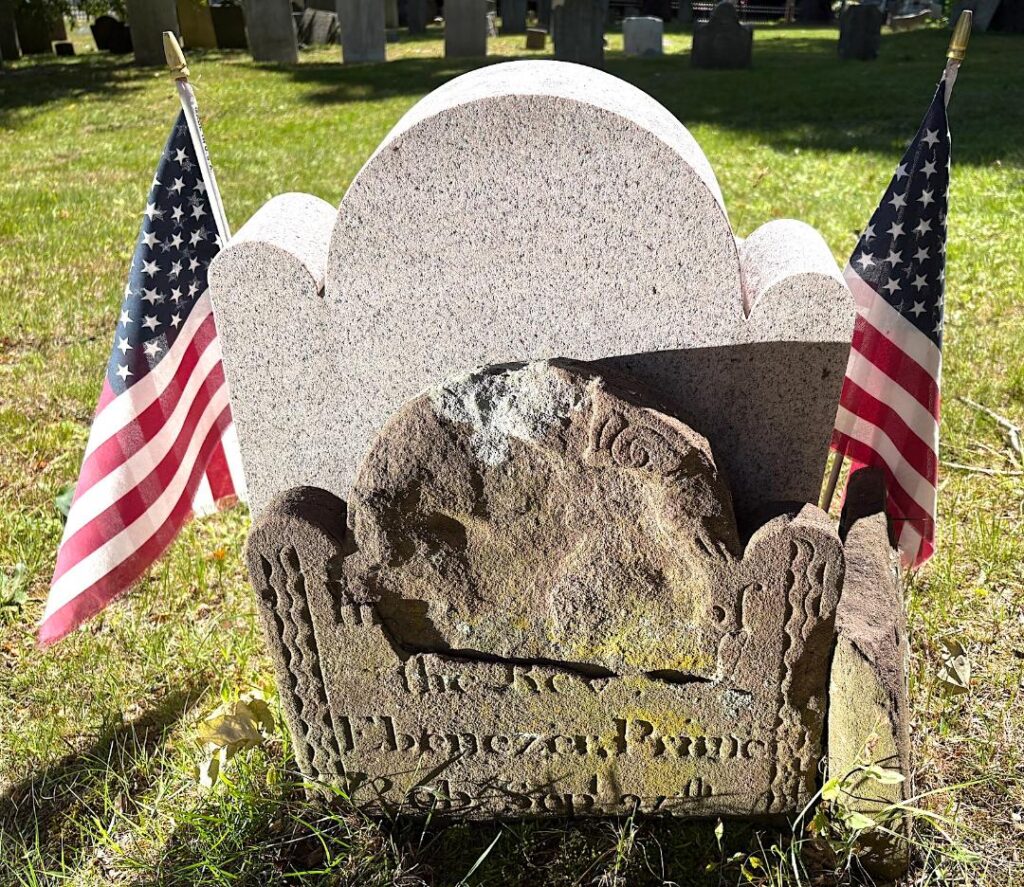
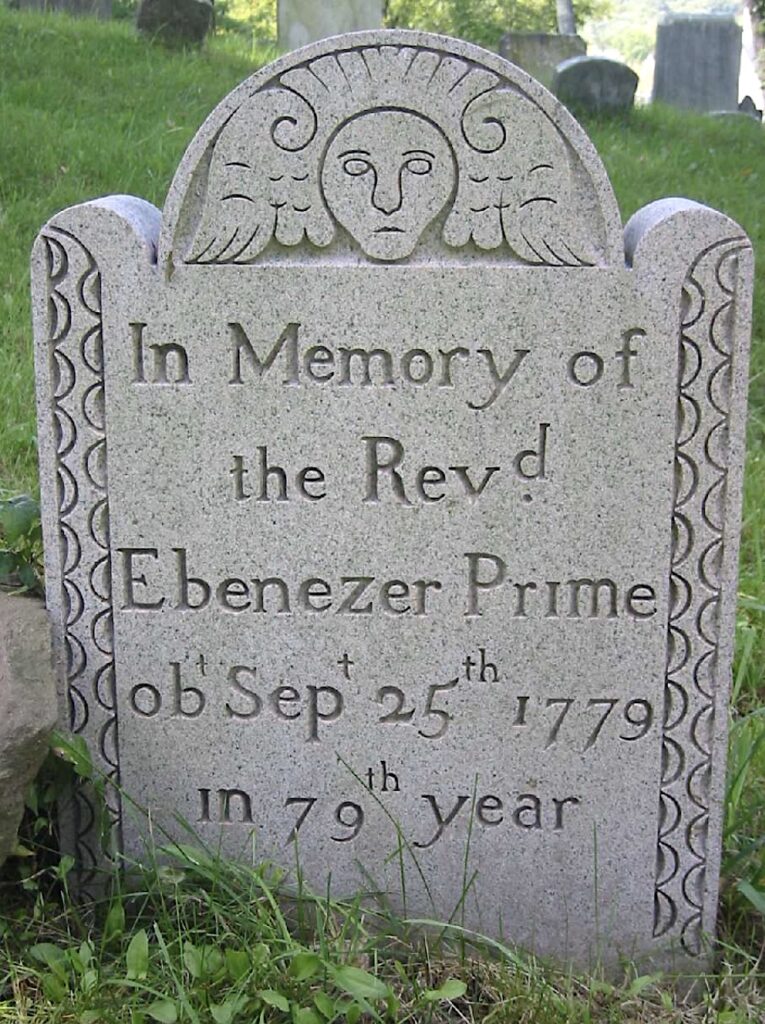
According to the U.S. Revolutionary War Burial Index, Ebenezer died on October 2, 1779. He is buried in the Old Burying Ground in Huntington, New York. The inscription on his original gravestone read “In Memory of The Revd Ebenezer Prime, Obt. Sept. 25, 1779, AE 79.” According to Cemetery Inscriptions from Huntington, Long Island, New York, by Josephine C. Frost (1911), others buried with him are his daughters Margaret, Hannah, Sara and Experience, as well as Experience, his wife. A newer gravestone at Huntington’s Old Burying Ground reproduces the inscription on his early gravestone.