ROGERS, WILLIAM (1741-1780). Captain of a privateer. William Rogers was born in Huntington, New York Colony, on November 19, 1741, per cemetery records, including Josephine Frost’s Cemetery Inscriptions from Huntington, Long Island, New York (1911.) However, William Rogers’s activities during the Revolutionary War are less clear.
Rogers may have been a private in the Suffolk County Militia, specifically in Colonel Josiah Smith’s first regiment, as shown on his cemetery headstone, but there were several other men with that name in the same militia. In his book, The Refugees of 1776 from Long Island to Connecticut (1913), Frederic Gregory Mather writes about another William Rogers, 1744-1813, who served in the same regiment, as well as a third William Rogers, 1751-1806, who was a quartermaster sergeant in the fourth regiment. Mather speculates that either of these two William Rogers may have been the private in Colonel Josiah Smith’s regiment.
However, it appears that William Rogers served as a privateer, notwithstanding that there were also other men with the same name who worked in that capacity as well. Mather asserts that William Rogers, with the same birth and death years as shown on his headstone (1741-1780), commanded both the sloop Montgomery and the frigate Congress. Conversely, sources such as Sons of the American Revolution and Daughters of the American Revolution suggest that William Rogers, same dates of birth and death, was indeed the captain of a privateer, but of only the Montgomery (or, in the DAR report, a captain of the Montgomery and the George Washington). In any event, Rogers began his command of the Montgomery as of mid-April 1776. In a May 22, 1776 letter to the New York Provincial Congress, Captain William Rogers detailed information regarding the cruise of the armed sloop Montgomerie (as he spelled it), emphasizing the protection of local transports and the boat’s actions against British vessels.
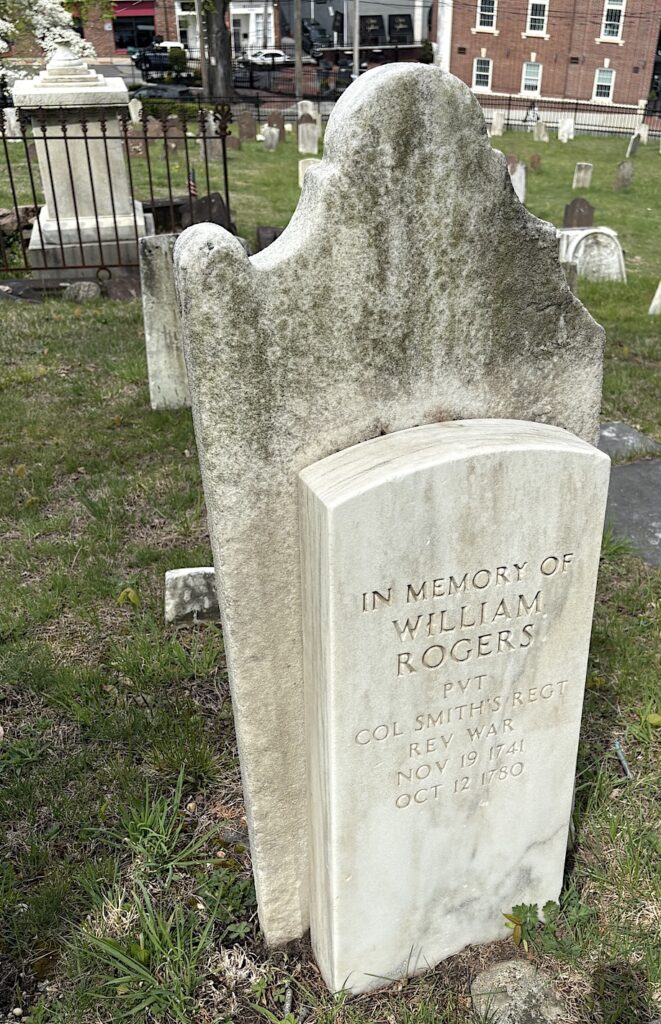
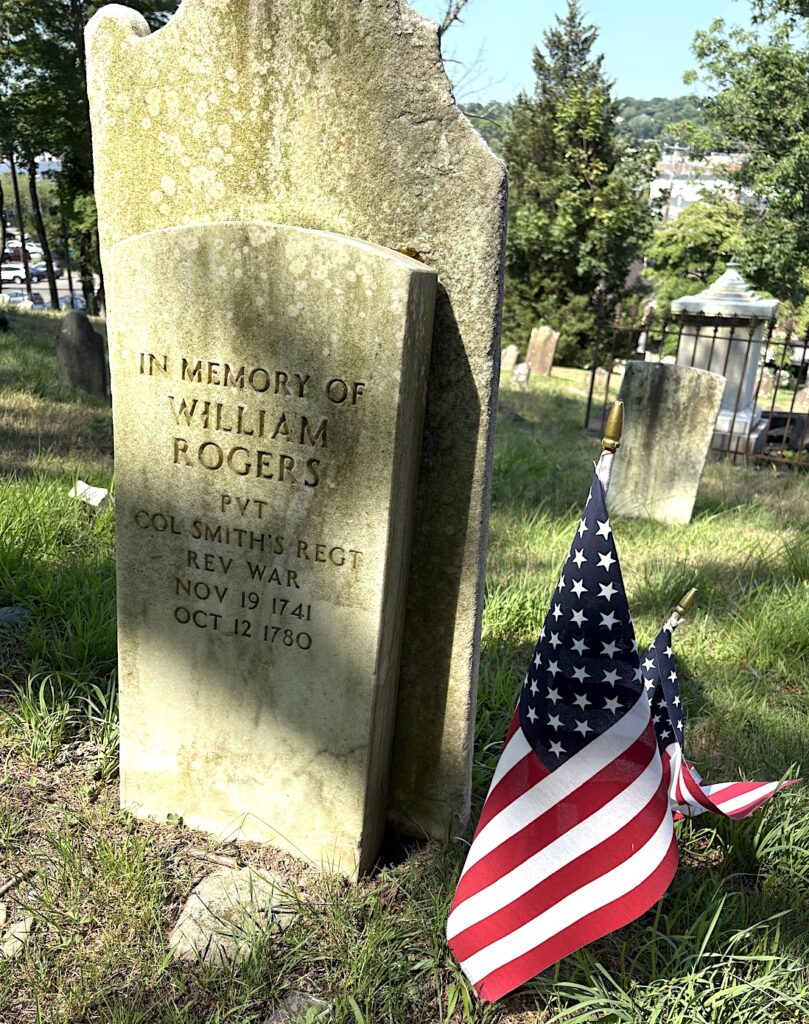
It would not have been feasible for Rogers to command ships in 1776 while also serving as a private in the Huntington militia. Yet, it is unclear why William Rogers’s 1979 headstone for military veterans in the Old Burying Ground shows his rank as private rather than captain if this was the William Rogers who was a commander of ships. In a supplemental application filed by Robert Woodhull Walker, a descendent of “Captain William Rogers,” for membership in the California Society of the Sons of the American Revolution that was approved in 1916, Walker attests that Rogers was captain of the commissioned armed vessel Montgomery, acting as a convoy for Continental troops. Rogers captured an armed vessel belonging to the British, which was “said to have been the first seize of the war.”
We do have further details of Captain Rogers’s work as a privateer in 1776. On June 27, 1776, Lieutenant Joseph Davison of the armed sloop Schuyler wrote to General George Washington. Davison reported that, working with Rogers and the armed sloop Montgomery, they had retaken four prize ships from the British Man of War Greyhound, two Nantucket brigs carrying whale oil, a Cape Ann schooner loaded with molasses and sugar, and a Rhode Island sloop carrying flour and lumber. Other reports have Rogers taking command of the Montgomery in April 1776, sailing her out of Fire Island, off of the southern coast of Long Island, and going as far south as Baltimore during the next twelve months. While in Maryland’s waters, he helped move patriot troops to the Eastern Shore. In May 1777, he became captain of the Massachusetts privateer General Washington, and in April 1778 he captured a British ship in the West Indies. He continued his service until June 1781, when he and his crew were captured. His service as a privateer was authorized by the Continental Congress and New York State.
In any event, earlier in 1776, William married Sarah Potter on February 11, at the First Church of Huntington, according to “Long Island Surnames,” the database archives of Long Island Genealogy. Sarah was the daughter of patriots Gilbert Potter (see) and Elizabeth Williams Potter (see). Sarah’s father was a colonel in a patriot militia regiment during the Revolution. Cemetery records show that William and Sarah had a daughter, Elizabeth Rogers, born on December 26, 1776, in Norwalk, Connecticut. This daughter’s obituary, from the Dayton, Ohio Journal of March 4, 1854, reveals that, although the family resided in Huntington, Long Island, Sarah Rogers fled to Norwalk, Connecticut in late 1776 to be safe from the invading and occupying British. The obituary continues, “Captain William Rogers, the father, holding a commission from the Colony of New York as commander of a vessel engaged in hostile activities, his family were particularly obnoxious to the enemy.” It also asserts that “Captain Rogers had the honor of bringing into port the first prize taken in the Revolutionary War.”
Elizabeth married General William C. Schenck in 1798. A memorial for Elizabeth Rogers Schenck reiterates the reason for her birth in Connecticut during the war, as well as offering a commendation of Captain Rogers by Mrs. Campbell, the wife of a British officer detained on her way to join her husband in the colonies. She praised his kindness and the consideration with which she had been treated by Captain Rogers and presented him with “beautiful pistols and a curious Dresden clock,” which remained in the Rogers’s and then the Schenck’s family’s possession for many years.
As already stated, there is, understandably, confusion over William Rogers’s identity and his life dates. However, Captain William Rogers, the privateer captain, was the only one of the three William Rogers to have a wife named Sarah. Mather suggests that the William Rogers born in 1744 may have started his military career as a private in Colonel Smith’s regiment, before rising through the ranks to lieutenant and then captain.
Lastly, on the original headstone that William Rogers shares with his wife, Sarah, it is written that he was born in 1741 and that he sailed for New London, Connecticut, on July 17, 1780, and was lost at sea in a hurricane on October 12, 1780. This inscription confirms that he was a seaman and supports the conclusion that he was a seaman—and therefore likely the privateer. In 1973, Huntington Town Historian Rufus Langhans applied for a Department of Veterans Affairs gravestone for William Rogers; he asserted on the application that William had served as a Navy captain. In 1979, Langhans submitted another application, this time claiming that William Rogers had served as a private in the Suffolk County Militia. The VA gravestone that now stands against Rogers’s original stone has this information. As noted above, it appears to be incorrect. Sarah, according to Josephine Frost’s records, died on April 13, 1823, and is interred in Huntington’s Old Burying Ground, next to William and her parents.