FLEET, THOMAS (1738-1818). Associator, Town of Huntington, New York. As per his family tree posted on Ancestry.com, Thomas was born in Huntington, New York, to Thomas and Frances Fleet. That family tree names his siblings: Rachel (1725-1790, born in Huntington); Gilbert (1728-1805, born in Huntington); Simon (1729-1790, born in Smithtown, New York); Luke (1732-1798, born in Swamp, Suffolk County); Elizabeth (1741-1810, born in Newport, Rhode Island); and Thankful (1743-1814, born in Huntington). Thomas’s father died in Huntington in 1757.
Thomas’s online family tree records his marriage to Frances Haviland on August 14, 1770 in Huntington. According to the Find A Grave website, the couple was married by Reverend Ebenezer Prime at the First Presbyterian Church. They had six children: John (1772-1800), Thomas (1774-1832), Hannah Carll (1776-1802), Isaac (1777-1814), Zebulon (1780-1780), and Gilbert (1785-1839). All but Zebulon, who was born in Monmouth, New Jersey, and died in infancy, were natives of Huntington.
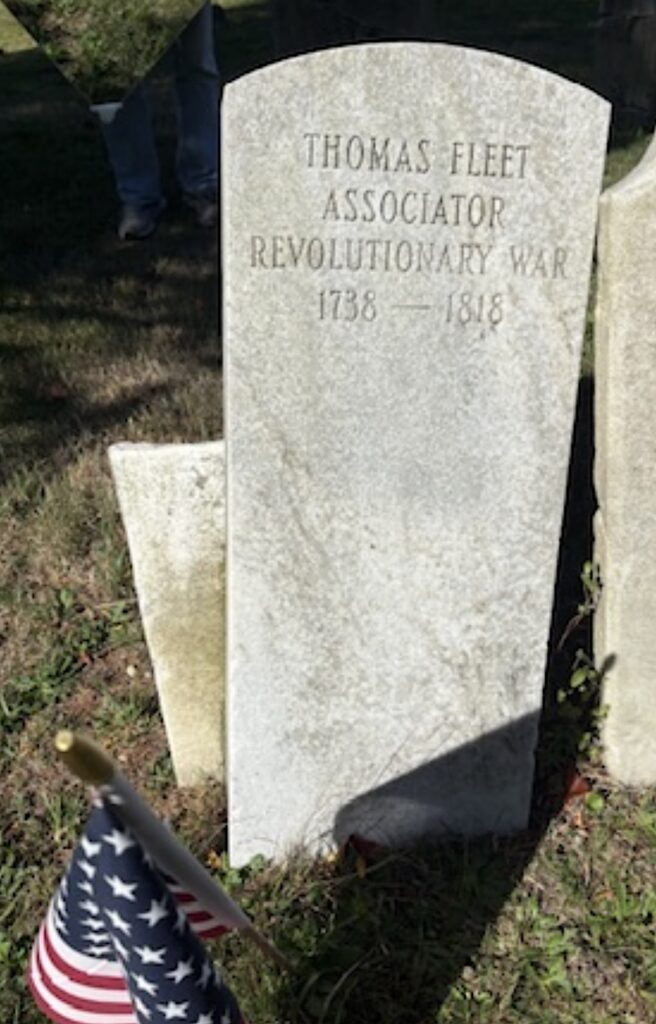
As per the inscription on his gravestone, circa 1973, Fleet was an associator during the Revolutionary War. As a signer of the Huntington’s 1775 Articles of Association (an associator), he demonstrated that he was a patriot. On May 8, 1775, 403 men, most of them Huntington residents (a few were from Islip), “shocked by the bloody Scene” that had occurred just weeks before at Lexington and Concord in Massachusetts, where patriot Minutemen and British regulars had engaged in a bloody armed struggle, put their signatures on Huntington’s Articles of Association. Only 37 Huntington residents, either Loyalists or those wanting to stay out of the fray, refused to sign. The Articles noted that the signers affirmed their “Love to our Country,” agreed “to whatever Measures may be recommended by the Continental Congress; or resolved upon by our Provincial Convention, for the Purpose of preserving our Constitution, and opposition to the Execution of the several arbitrary, and oppressive Acts of the British Parliament,” and prayed for “a Reconciliation between Great-Britain and America.” The actions of these associators were seen by both patriots and the British as a step towards rebellion. The fact that these men signed these Articles, placing themselves in danger of British retaliation, including imprisonment, seizure of their property, and exile from Long Island, is proof of their patriotic service.
According to the Patriot Research System of the Sons of the American Revolution (SAR), Fleet signed the Association of Huntington on May 8, 1775. That archive notes Thomas’s qualifying “Patriotic Service” from New York and details that a Thomas Fleet was listed as captured and put on the prison ship, Jersey, during the American Revolution, specifying that he was a naval prisoner; land prisoners were held in the Sugar House in New York City and in other New York churches. Huntington was occupied by the British after a crushing defeat of General George Washington’s Continental Army at the Battle of Long Island (also referred to as the Battle of Brooklyn) on August 27, 1776, and they remained in control of the town through the end of the war; Huntington was a major depot and supply center during that time. Huntingtonians were forced to swear allegiance to the Crown and were subject to British demands on their property, work skills, etc. The information in the Patriot Research System is confirmed by Refugees of 1776 from Long Island to Connecticut (1913) by Mather, page 1062. No descendant of Thomas has applied for membership in the SAR.
Wendy Polhemus-Annibel, the head librarian of the Suffolk County Historical Society, in “Brief Biography of Some of the Huntington Patriots,” on April 3, 2024, confirmed that Thomas signed the Association of Huntington and that a man with his name was captured and incarcerated on the Jersey, a prison ship, in Wallabout Bay.
He may be the Thomas Fleet listed in the 1790 census for Islip, New York. That census lists nine household members, four white males over 16, three white males under 16 and two females. He is likely the Thomas Fleet whose family is listed in the 1800 census for Huntington. That document lists four free white men 16 through 25; one free white male over 45; two white females 16 through 25; one white female over 45; and three slaves, totaling 11 members of the household. A landowner, Fleet’s name is listed in the New York Tax Assessment Rolls of Real and Personal Estates, 1799-1804. He owned $3,826 in house and land and was assessed $3.88 in taxes. Fleet’s family is also listed in the August 6, 1810 census for Huntington. Members of his extended family might be included here as a free male and free female under 10 are listed. In all, there are 12 members of the household including one enslaved person and one other free person; included are four free males 16 through 25; one free male 26 through 44; one male over 45; one free female 25 through 44, and one free female over 45. A Thomas Fleet of Huntington is listed in the 1820 census; that may be his son; seven people including a male lived in the residence and two members of the household engaged in agriculture.
Thomas died on January 8, 1818, in Huntington. He was survived by his wife, who died in 1820, and sons, Thomas, Isaac and Gilbert. His family tree posted on the Geneanet website lists his burial place as the Old Burying Hill Cemetery; Find A Grave lists the same burial site although the Old Burying Ground is commonly used; the U.S. Cemetery Index from Selected States, 1847-2010, names Fleet’s burial place as the Huntington Rural Cemetery.
On August 2, 1973, Rufus B. Langhans, town historian of Huntington, submitted an application for an upright marble headstone for Thomas Fleet, stating that he was a seaman in the Navy and a naval prisoner during the American Revolution; the application was denied. A privately-purchased gravestone, placed fairly recently, marks his grave.