By Toby Kissam
The year is 1826:
- John Quincy Adams is the 5th President of the United States of America, and the Erie Canal has just opened the far-reaching Great Lakes region to New York City, making New York City the center of trade for the country and earning the name “The Empire City.”
- The Town of Huntington stretches from the Atlantic Ocean to the Long Island Sound, but the main village is Huntington, a port on the Long Island Sound that already boasts a thriving pottery.
- Samuel Fleet of Huntington, establishes the first local newspaper, “The Portico” which publishes from 1826-1828. It will be 10 years after that when Walt Whitman starts the Long Islander in 1838 as the local paper that still serves the town today.
- Carman Smith, born in 1801 in the southern part of the Town of Huntington, today the Town of Babylon, comes to the village and establishes a chair manufactory business on Wall Street. The advertisement in the “The Portico,” dated July 20, 1826, promotes the different styles of chairs offered at his workshop.
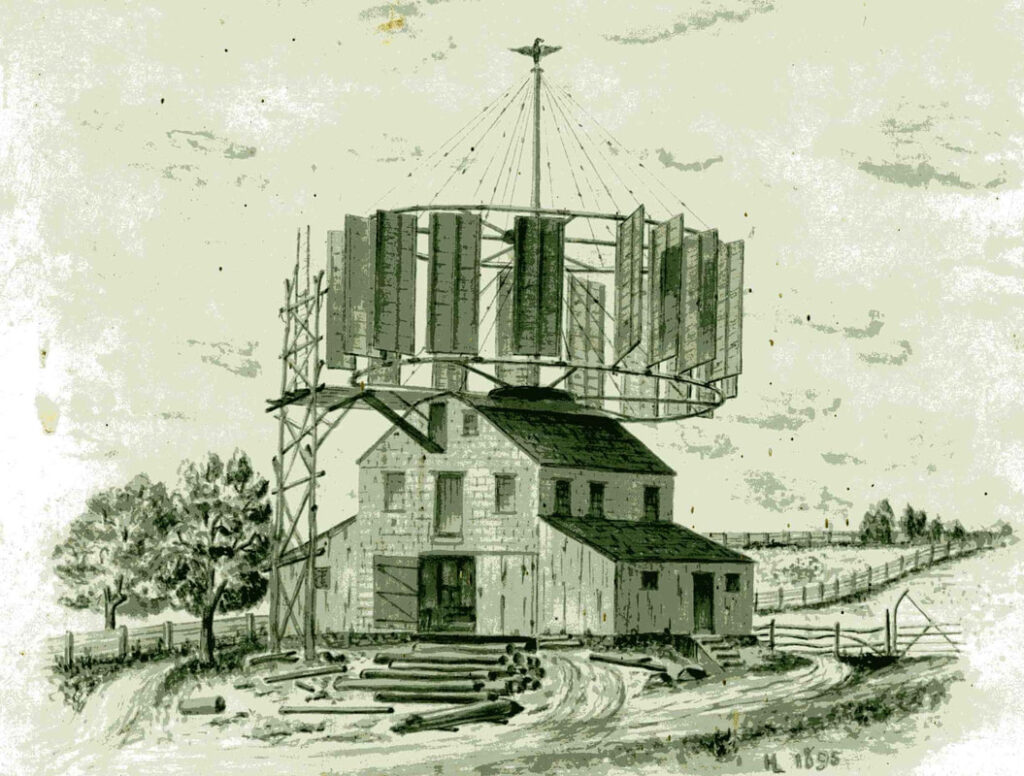
Daniel Sammis (1787-1869), a 5th generation Sammis in Huntington, erected a large and unusual saw mill, powered by wind, in 1825. It was described as “The most conspicuous building in the place.” One of his clients was Carman Smith. A circular dated December 21, 1826, and issued by the proprietor, stated the purpose for which the mill was built.
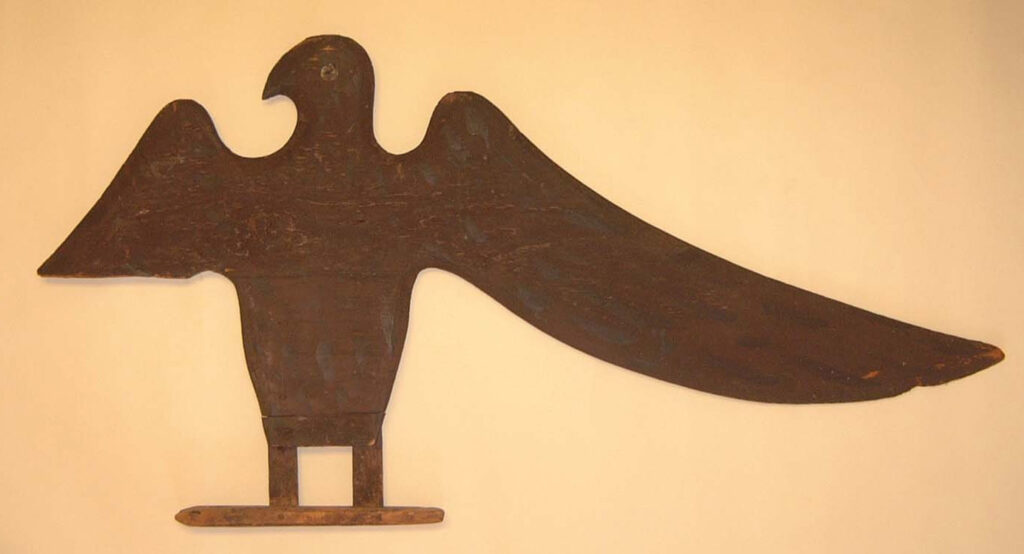
Sammis designed and built this unique mill, possibly from earlier Dutch examples in New Amsterdam. Built on the ridge, north of Main Street, between West Neck Road and Wall Street, in 1846 the mill was moved closer to Main Street into what is today a municipal parking lot across from the Post Office. In 1867, a hurricane blew off the circular carousel structure that powered the mill and its wind directional, breaking one of the eagle’s wings. The building was used after as a barn until it was torn down in the early 20th century.
Henry Lockwood (1838-1901), a grandson of Daniel Sammis, whose family owned the marble foundry next door and whose mother was the daughter of Daniel Sammis, recalled when he and his friends, as young boys, would climb the circular structure and “ride the wind.” Although considered dangerous, reportedly no one was seriously injured. Late in his life, Henry drew the sketch of the mill for an article in the Brooklyn Eagle.
In 1923, the Lockwood House was torn down and the “Eagle,” although damaged during the 1867 hurricane, was donated to the Huntington Historical Society and is today the symbol for the Society. You can visit this almost 200-year-old artifact at the History and Decorative Arts Museum in the Soldiers & Sailors Memorial Building on Main Street.