By Barbara LaMonica
If you grew up during the 60’s or 70’s you probably remember the A&P on Main Street in Huntington. Once a trailblazer for the coming age of supermarkets and big box stores, the Atlantic and Pacific Tea Company is now all but forgotten.
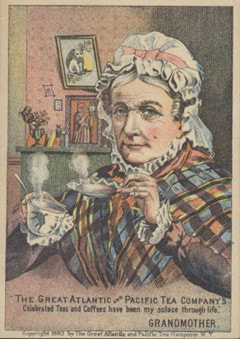
The Atlantic and Pacific Tea Company was founded in 1859 by George Gilman and George Huntington Hartford in New York City. The company originally operated as a wholesaler of tea and coffee, and later opened retail shops in New York City. Eventually the company expanded to include a mail order business, and by 1917 the company grew to over 2,000 nationwide stores which began to also offer meat and produce.
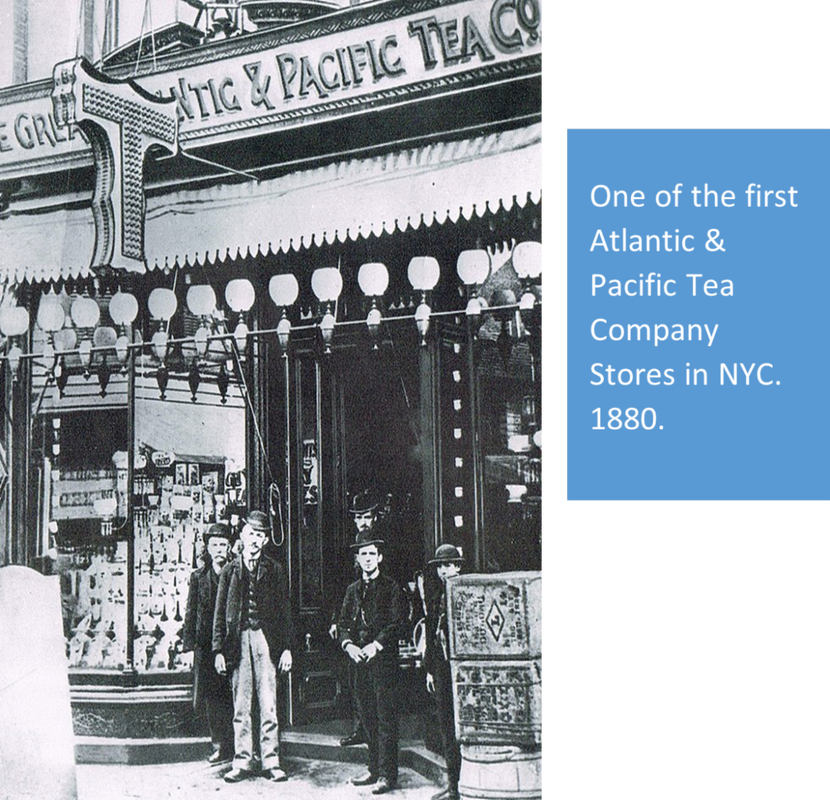
Gilman and Hartford were pioneers in retail and marketing concepts, innovations destined to become everyday features of grocery stores such as self-serve, shopping carts and company brand products.
In the 1880s A&P became the first to market its own private labels, most famously the Eight O’ Clock Breakfast Coffee, and in later years Jane Parker Baked Goods and Ann Page Foods.
In the 1890s A&P was the first to offer customer loyalty programs giving customers redeeming “checks” for dinnerware and other goods.
In 1912 the company introduced the concept of an economy store. This was possible because they operated on only a 12% profit margin, and the popularity of lower prices allowed the company to continue expansion.
By the end of WWI, A&P had grown to almost 5,000 stores.
In the 1930s A&P expanded into manufacturing, buying up dairies, canning factories and bakeries thus controlling both supply and retail while eliminating wholesalers. They also introduce the “supermarket” self-serve with shopping carts so customers no longer needed a clerk to retrieve items. By 1930 there were 15,000 stores all over the east coast, Midwest and California.
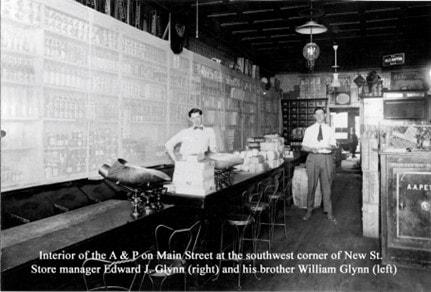
Beginning in the early 20th century A&P finally came to Huntington. One of the first stores (below) circa 1910 opened on Main Street. Over the years the store would change locations between Main Street and New York Avenue.
In 1939 A&P opened a self-serve supermarket at 337 West Main Street opposite Prospect Street. Self-serve was another A&P retail innovation, as clerks no longer had to retrieve products for customers, since wide aisles placed everything within convenient reach. Local newspapers reported the gala opening. The Suffolk Bulletin of August 8, 1939 effused that “the gala opening was largely attended with great interest aroused by the convenience of shopping in a big market…as an additional convenience are neat little rubber-tired carts so that packages need not be carried on the trip through the store.”
Eventually the store moved to New York Avenue, and then in the 1946 the company purchased property at 369 Main Street, (now Wild By Nature), where it remained until closing in 1982.
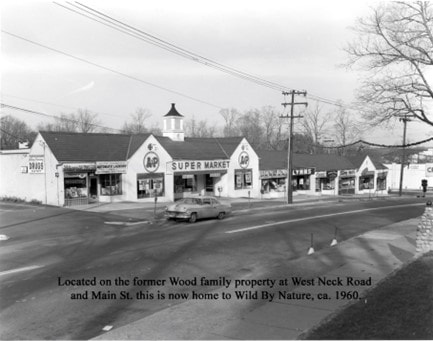
The 1960s saw the A&P company begin a decline which eventually led to the chain’s final bankruptcy. Several circumstances contributed to the A&P downturn; specifically, failure to contend with competition from big box retailers such as Walmart, and inability to recognize changing consumer preferences. A&P continued to emphasize traditional groceries such as milk, meat and eggs, while consumers were demanding more ethnic and specialty foods, (think Trader Joe’s). A&P was also unable to keep up with big box purchasing power that continued to drive prices down, as well as a failure to modernize with a digital presence and online shopping options. A&P began to shut down stores.
Beginning in the 1980s A&P attempted to reassert its dominance over retail grocery by buying up other grocery chains including Waldbaum’s, Food Emporium, and Pathmark. However, the company was ultimately unable to reduce operating costs and debt so they began selling off these stores. More A&P store closures ensued, as the Long Islander reported on February 4, 1982 that the last supermarket in the village would close. Shoppers in the neighborhood were angry as one exclaimed, “The neighbors are all angry about it but what can we do?”
Ultimately in 2015 A&P filed for Chapter 11 and finally closed all stores the following year. Ironically the company fell victim to many of the innovations it had initiated that other chains employed and improved upon.