JARVIS (or JERVIS), PHILIP (or PHILLIP) (1723-1786). Associator, Town of Huntington. His online family tree posted on Ancestry.com shows that Phillip was born in Huntington in about 1723 to Stephen Jarvis and Ann Susan (Susannah) Kellum Wheeler. A brother, Austin, was born in 1735. Find A Grave, which also spells his given name as Phillip, confirms his birth in Huntington.
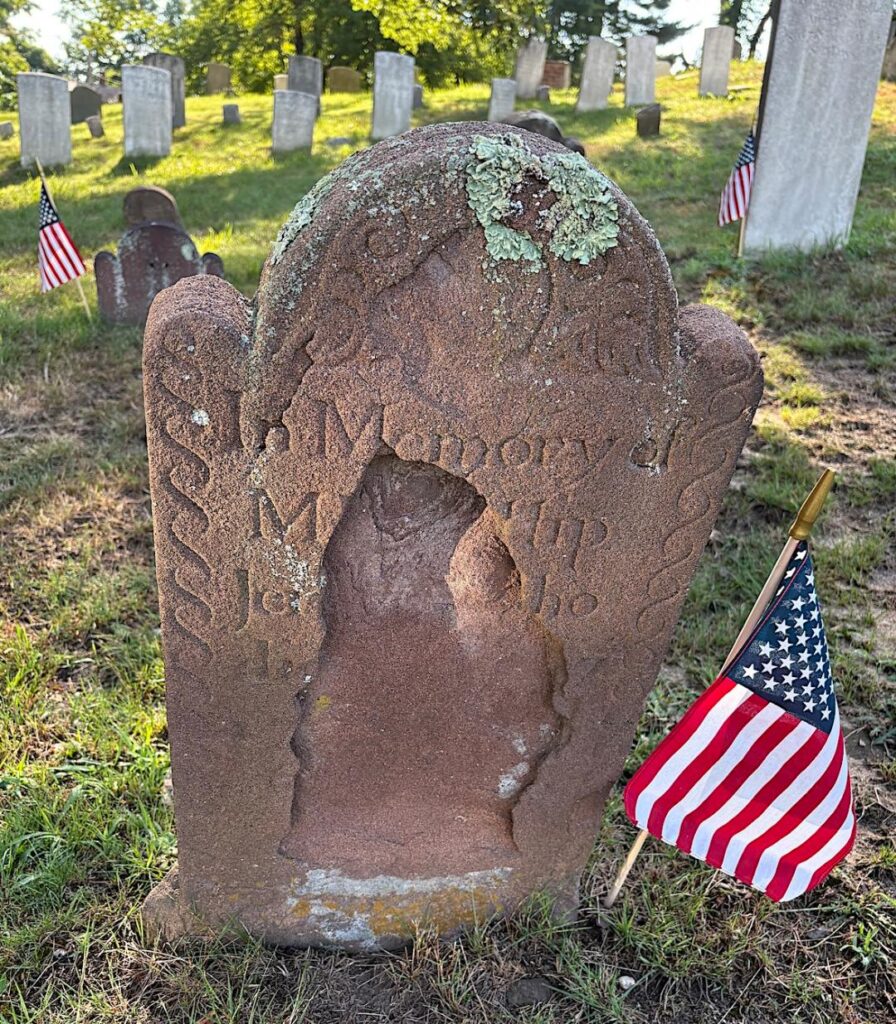
Although his surname is spelled as Jervis on his gravestone, other documents cite Jarvis as the family name; similarly, the spelling of his given name as Philip appears on many documents from Huntington, although Phillip (spelled as such) is also listed on online postings and is spelled that way on his old gravestone. North American Family Histories, 1500-2000, report that there were settlers in Massachusetts and Long Island with the name of Jarvis. Additionally, U.S. Family History Books report that a Phillip Jarvis married Elizabeth Sammis, which matches our subject, but lists the father as possibly named Phillip.
Philip married Elizabeth Sammis on November 12, 1749, in Huntington. Their son, Daniel, was born on February 29, 1764. New York Genealogical Records, 1675-1920, show that a Philip Jarvis resided in Huntington in 1775. Although Daniel is listed as the only child on the posting on Ancestry, that may be incorrect. A posting on Ancestry for a Phillip Jervis (1759-1815 and buried in Commack, New York) shows that he is the son of Phillip and Elizabeth née Sammis. That posting includes the birth of his brother Daniel, as cited on our subject’s online family tree, and more than ten other siblings, most with just birth years and no complete life dates, making their listings both confusing and possibly inaccurate.
Philip is among those residents who signed the Articles of Association in Huntington. On May 8, 1775, 403 men, most of them Huntington residents (a few were from Islip), “shocked by the bloody Scene” that had occurred just weeks before at Lexington and Concord in Massachusetts, where patriot Minutemen and British regulars had engaged in a bloody armed struggle, put their signatures on Huntington’s Articles of Association. Only 37 Huntington residents, either Loyalists or those wanting to stay out of the fray, refused to sign. The Articles noted that the signers affirmed their “Love to our Country,” agreed “to whatever Measures may be recommended by the Continental Congress; or resolved upon by our Provincial Convention, for the Purpose of preserving our Constitution, and opposition to the Execution of the several arbitrary, and oppressive Acts of the British Parliament,” and prayed for “a Reconciliation between Great-Britain and America.” The actions of these associators were seen by both patriots and the British as a step towards rebellion. The fact that these men signed these Articles, placing themselves in danger of British retaliation, including imprisonment, seizure of their property, and exile from Long Island, is proof of their patriotic service.
As per Huntington Town Records of 1778, Philip Jarvis is listed as a resident who signed the Oath of Allegiance to the Crown; many signed under duress and lost property and were forced to work during the British occupation after the humiliating defeat of the Battle of Long Island (Battle of Brooklyn) on August 27, 1776. Huntington Town Records of April 1, 1777, indicate that Philip Jarvis and another resident of Long Swamp were employed for eight days in the carting of wood for the barracks of the 3rd Battalion of General De Lancey’s Brigade; General Oliver De Lancey commanded loyalist troops on Long Island. Huntington Town Records also show that on June 29, 1777, one mare was taken from Jarvis by Colonel Fanningworth and never returned. On November 2, 1777, Huntington Town Records indicate that Philip Jarvis spent two days of service with Captain Wooly’s men as they proceeded eastward on Long Island as part of De Lancey’s Brigade. An undated record shows a Philip Jarvis possessing a freehold valued at over £100 and having one male, two females and one enslaved person in his residence.
As per U.S. Tax Assessment Rolls of Real and Personal Estates, 1799-1804, for 1799, Phillip Jarvis owned $1545 in real estate and $96 in personal estate and owed $1.64 in taxes; he was among wealthiest in the listing. According to Huntington Town Records, Philip signed a petition to the President & Trustees of the Town of Huntington in 1802 asking for permission to build a public dock at Bryans Landing, a site frequently used by local residents.
As per Cemetery Inscriptions from Huntington, Long Island, compiled by Josephine C. Frost in 1911, Philip’s gravestone in the Old Burying Ground reads “Philip Jervis, died Sep. 27, 1786, Age 63 yrs.” His wife’s gravestone, next to his, is inscribed, “Elizabeth, wife of Philip Jervis, died June 21, 1807 in her 79th year.” Daniel, their son, died in 1837.