By Barbara LaMonica
From West Hills to Palm Springs:
The Journey of the Aluminaire House.
Aluminaire House, (Visit Aluminaire House | Palm Springs Art Museum) the first prefab all-metal home, was built in 1931 for an architectural exhibition in New York City. At first it created a sensation, then was ridiculed, sold, forgotten, moved, disassembled, rebuilt as a student project, disassembled again and finally after over 80 years it was reassembled to take a final place of honor at the Palm Springs Art Museum.
Inspired by European Modernism, Aluminaire was built by Lawrence Kocher and Swiss architect Albert Frey, who studied under Le Corbusier. The 1,200 square foot 3 story aluminum and steel construction was an experiment in easy to put together affordable housing built with new industrial materials including sheet metal, plate glass, steel beams, and linoleum. The ground floor had a drive through garage with electrically controlled doors, and a dumbwaiter that serviced all three floors. The second floor had the living room, dining room, bedroom, bathroom, exercise room, and kitchen. The living area opened to the third-floor’s 17-foot ceiling. The top floor housed a library and outdoor terrace. The house, which was originally intended to solve the affordable housing issue, was to become a precursor to American Mid-Century Modernist design.
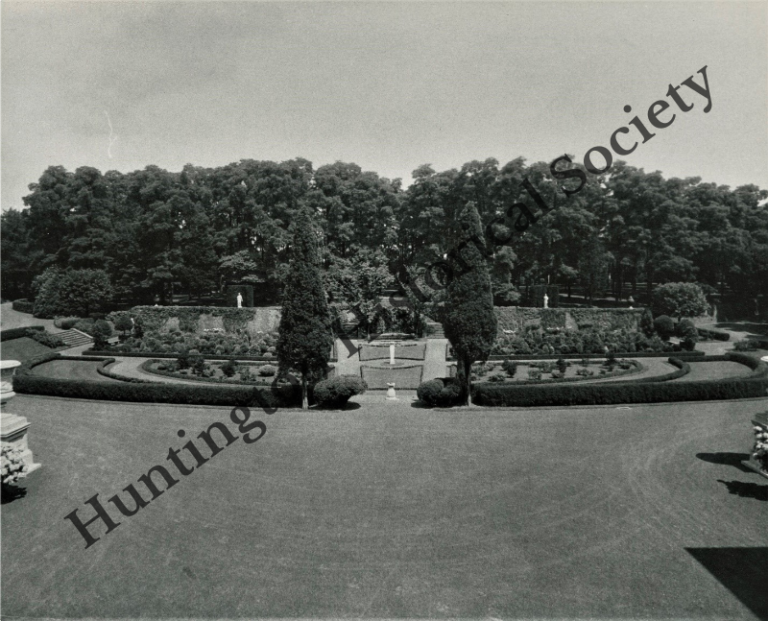
After the exhibit the house was taken apart and bought for $1,000 by architect Wallace K. Harrison who rebuilt it on his estate at 140 Round Swamp Road in West Hills. Harrison was a prolific architect also associated with the Modernist tradition. He was responsible for many office buildings and public spaces including Rockefeller Center, the Metropolitan Opera House at Lincoln Center, the United Nations Building and the Empire State Plaza in Albany. Harrison used the Aluminaire house as a guest cottage and expanded it to increase the number of bedrooms.
Eventually the Harrison estate was sold a couple of times, first to two art dealers, then in 1984 the property was sold to Dr. Joel Karen who subdivided the property into 2-acre plots with the intent to sell the land to developers. Since Aluminaire was on one of the plots, Dr. Karen applied for a permit to have it demolished, claiming the house had fallen into disrepair and would be too expensive to renovate. This set off a firestorm of debate, as the Harrison estate including Aluminaire, was listed on the National Register of Historic Places. On one side the Huntington Preservation Commission, the Huntington Historical Society and leading architectural professionals claimed Aluminaire was an architectural masterpiece, and on the other side Dr. Karen and his lawyers claimed it was just an ugly tin house resembling an erector set. Finally, Dr. Karen received a permit to demolish the house but instead agreed to donate the house to the New York Institute of Technology Department of Architecture in Central Islip. The house was disassembled and moved to the campus in 1988 where it would be restored as a student project.
In 1931 it took an estimated $4,000 to build Aluminaire, but by 1988 it would have cost over $100,000 to restore. With a $131,000 grant from NYS Department of Parks, Recreation and Historic Preservation, the school’s architectural students began restoring the house. With several other grants over the years work in the house continued. But by 2004 NYIT closed the Central Islip campus and eliminated the architectural program. The house was then sold to the non-profit Aluminaire House Foundation whose mission was to again dismantle the house and relocate it to a suitable location.
In 2014 an application was made to relocate the house to Sunnyside Gardens, a neighborhood in Queens listed on the National Register of Historic Districts and an official city landmark. Created in the 1920s Sunnyside Gardens was one of the first planned communities in the United States. But the Aluminaire House met with overwhelming opposition from residents who claimed the house was totally out of character with the brick row houses and open spaces of the neighborhood. Once again, the Aluminaire House was looking for a home.
Eventually several residents in Palm Springs California recognized the historical significance of the Aluminaire House. Albert Frey had moved to Palm Springs in the 1940s and remained there until his death in 1995 at the age of 98. Collaborating with architect John Porter Clark Frey was responsible for creating the American Mid-Century architectural legacy of the Coachella Valley. So, it was fitting that the Aluminaire’s permanent home should be at the Palm Springs Art Museum.
For further reference:
Albert Frey: Inventive Modernist | Palm Springs Art Museum (control, click to follow link)
Aluminaire House – Alchetron, The Free Social Encyclopedia (control, click to follow link)
“The Home of the Future”, Popular Mechanics, August 1931, p. 276-279.
https://archive.org/details/PopularMechanics1931/Popular_Mechanics_08_1931/page/n149/mode/2up