WILLIAMS, SR., NATHANIEL (1721-1781). Associator, Huntington, New York. Three generations share the name Nathaniel Williams: our subject, his father, and his eldest son. In addition, the Nathaniel Williams who was born in 1721 is not listed consistently with the suffix “Sr.” He is sometimes referred to with the suffix “Jr.” or, in other records, with no suffix at all, leading to confusion. In The Refugees of 1776 from Long Island to Connecticut (1913), the author, Frederic Gregory Mather, writes that our subject “is usually described as Nathaniel Jr.; and his father as Nathaniel Sr.” But, as Mather wrote, in his research he found our Nathaniel at times referred to simply as Nathaniel, while his son, who became Ensign Nathaniel Williams, born in 1752, is mentioned as Nathaniel Jr.
In any event, this Nathaniel was born about 1721. “Long Island Surnames,” the database archives of Long Island Genealogy, as well as research by the Huntington Town Historian Robert C. Hughes and cemetery records, list his birthdate as May 27, 1721, in Huntington, New York Colony. As previously stated, his father was also Nathaniel Williams (1698-1732), born in Hartford County, Connecticut, who married Martha Brush about 1720 in New York. Martha was born in Huntington about 1696. After his wife Martha’s death, Nathaniel’s father married Elizabeth Platt in about 1722 in Huntington. They had several children, including a daughter, Mary, who died when she was ten years old, and another daughter, Elizabeth Williams Potter (1728-1811.) Nathaniel’s paternal grandfather was Jonas Williams.
Nathaniel and Keziah Brush, born in 1723 in Huntington, were married by Reverend Ebenezer Prime (see) on April 30, 1741, at the First Church, Huntington. Her parents were Jacob Brush and Mary Smith. Sadly, Keziah died on September 17, 1751, in Huntington. Following her death, Reverend Prime remarried Nathaniel, at the same church, on December 9, 1725, to Rachel Fleet, the daughter of Thomas (see) and Frances Fleet. The couple had many children: Nathaniel (born 1752), Hannah (1754-1784), Timothy (1756-1811) (see), Hannah (1754-1784), Sarah (1760-1787), Jane (1762-1846), Rebecca (born 1763), Rachel (1765-1799), Content, Charlotte (1769-1794), and Zebulon (1769-1794), although there are inconsistencies with names and dates. Sources on Nathaniel’s marriages and children include The Refugees of 1776, “Long Island Surnames,” headstone inscriptions, and genealogical records, including the Lineage Book: National Society of the Daughters of the American Revolution, Volume 094 (1911.)
Although there does not seem to be a definitive record of Nathaniel serving in an active military role during the American Revolution, his actions in the years leading up to and during the war indicate that he strongly supported the patriot cause. According to information from “Huntington During the Revolutionary War” (2026), by Jeffrey I. Richman, on the Huntington Historical Society’s website (https://huntingtonhistoricalsociety.org/huntington-during-the-revolutionary-war/), gleaned from The Newport (Rhode Island) Mercury newspaper, published on February 24, 1766, Nathaniel hosted a town meeting at his home to discuss opposition to the Stamp Act of 1765.
Charles R. Street’s compilation, Huntington Town Records, including Babylon, Long Island, New York 1688-1775, Volume II (1888), specifies that Nathaniel was chosen as one of the overseers of the poor at a town meeting on May 5, 1767, as well as at a meeting the next year, on May 31, 1768. At the May 7, 1771 town meeting, he was selected to continue his roles as overseer of the poor and caring for the parsonage land and funds.
Nathaniel’s responsibilities increased as the years went by. Town records indicate that he was granted permission to build a dock at Huntington harbor in 1769. At a town meeting on May 1, 1770, it was decided that Nathaniel would be responsible for the care of properties in the West Neck and East Neck areas, as well as for the oversight of funds.
Most importantly, Mather, in his book The Refugees of 1776 from Long Island to Connecticut, listed Nathaniel as one of the 403 signers, on May 8, 1775, of the Association in Huntington. Most of the signers of this historically-significant document were Huntington residents who had been shocked by the events at Lexington and Concord in Massachusetts, where patriots and British regulars had engaged in a bloody armed battle. By signing the document, they were perceived as rebels against the British Crown and put themselves in danger of retaliation by the British, including imprisonment, property seizure, and exile from Long Island. Mather also related that Nathaniel was considered by the British to be a significant rebel, “miscreant,” and troublemaker in Huntington, and was among those accused of smuggling goods out of New York to the “rebels in Connecticut.”
As per Mather, Nathaniel was a member of the Sons of Liberty, a radical patriot organization. Mather adds that Nathaniel “according to the Enemy, was one of the leading Rebels in Huntington” and fled to Connecticut during the British occupation of Huntington. Mather further reports that Nathaniel “probably served (in the patriot forces) in Conn.”
Gaines’ New York Mercury of June 28, 1779, reported on news from Huntington, and named Nathaniel Williams as one of seven of “the principal miscreants (rebels)” there, noting of these individuals, “several of whom smuggled goods out of New York to this place, for the sole purpose of supplying the rebels in Connecticut.”
In 1778, Nathaniel was listed among the individuals who signed the Oath of Loyalty to the British Crown, as shown in Huntington Town Records. This can be explained by the fact that almost all heads of households in the area signed the Oath, since they were coerced into doing so or would have risked their land and possessions being confiscated by the occupying British military. Later town records show that a Nathaniel Williams sold a horse, on June 23, 1781, for £35 for use by the government of Huntington.
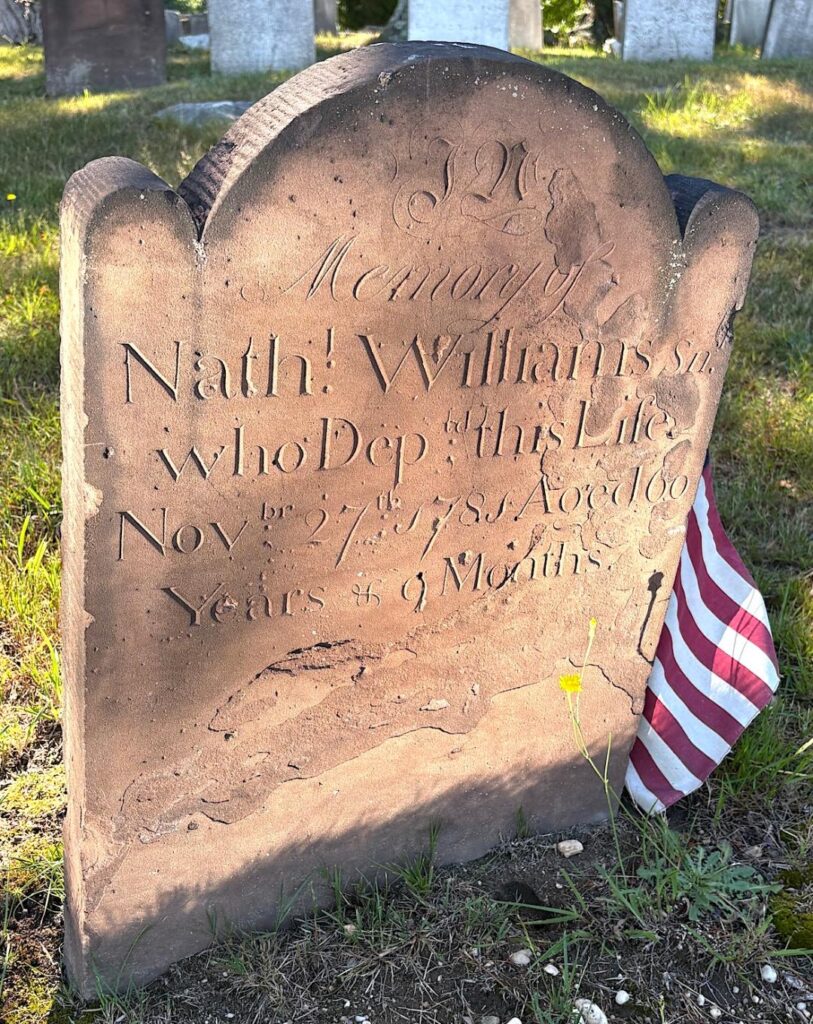
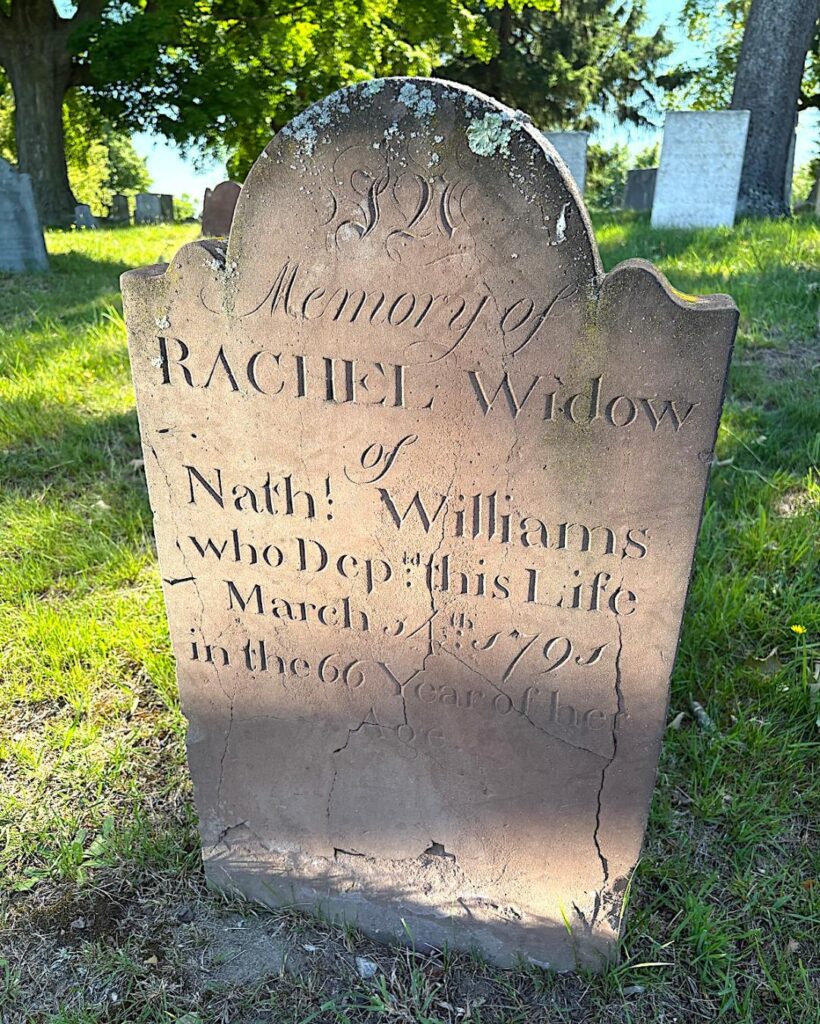
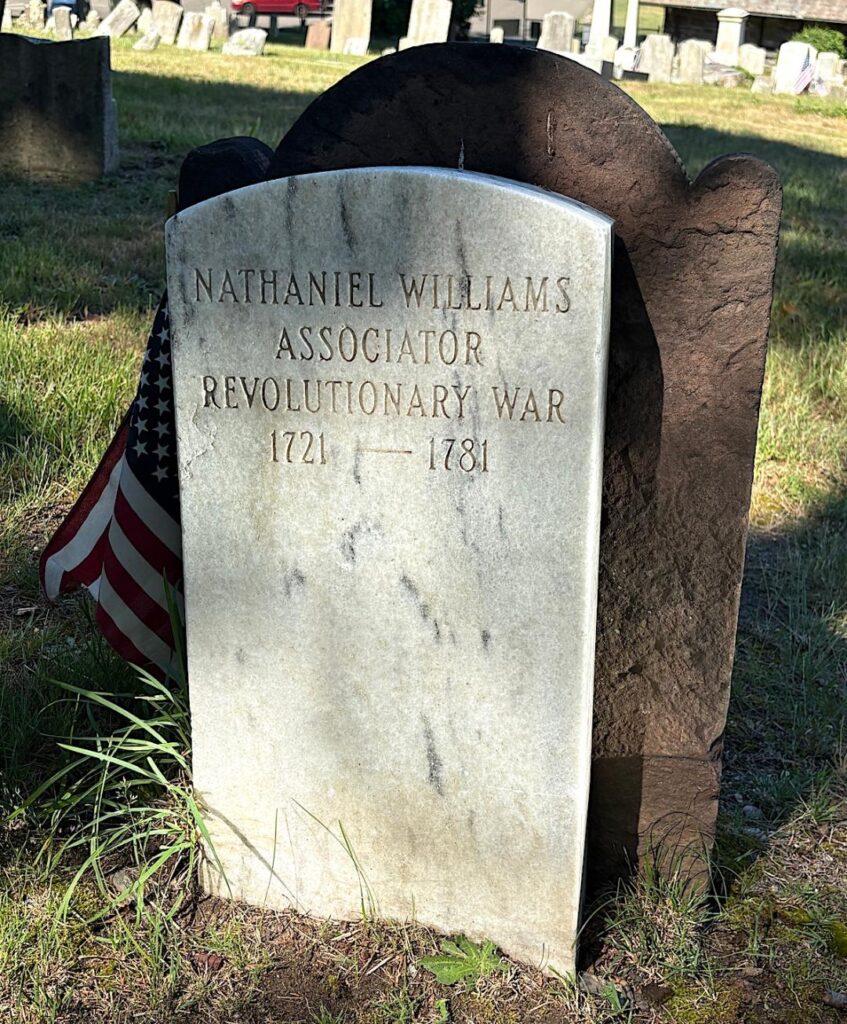
After the war, according to Robert C. Hughes’s October 19, 2011 huntingtonhistory.com online article, “Bells of Huntington,” Nathaniel was responsible for restoring a bell to Huntington that had been taken by British troops. He arranged to retrieve the bell by 1793, and it was returned to service in the church that was built in 1794, replacing the earlier church that was razed by the British during the war. Nathaniel owned an inn on the north side of Huntington’s Main Street, opposite what is now New York Avenue; his son Timothy operated it after Nathaniel’s death, per Hughes’s September 8, 2014 huntingtonhistory.com online article, “What’s Old is New Again.” Nathaniel died on November 27, 1781, in Huntington, as inscribed on his original brownstone gravestone. A second gravestone, of marble, stands with it, having been obtained by the then-town historian for Huntington, Rufus B. Langhans, by his application to the Department of Veterans Affairs on August 2, 1973. Nathaniel’s will was probated on March 14, 1782, in New York, New York, with his wife Rachel as administrator. Rachel passed away on March 4, 1791, and both are interred in Huntington’s Old Burying Ground, along with many of their children and other close relatives.