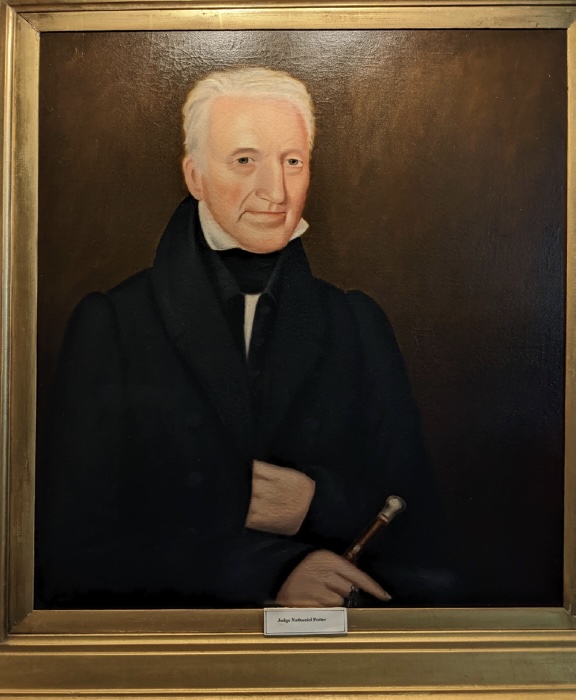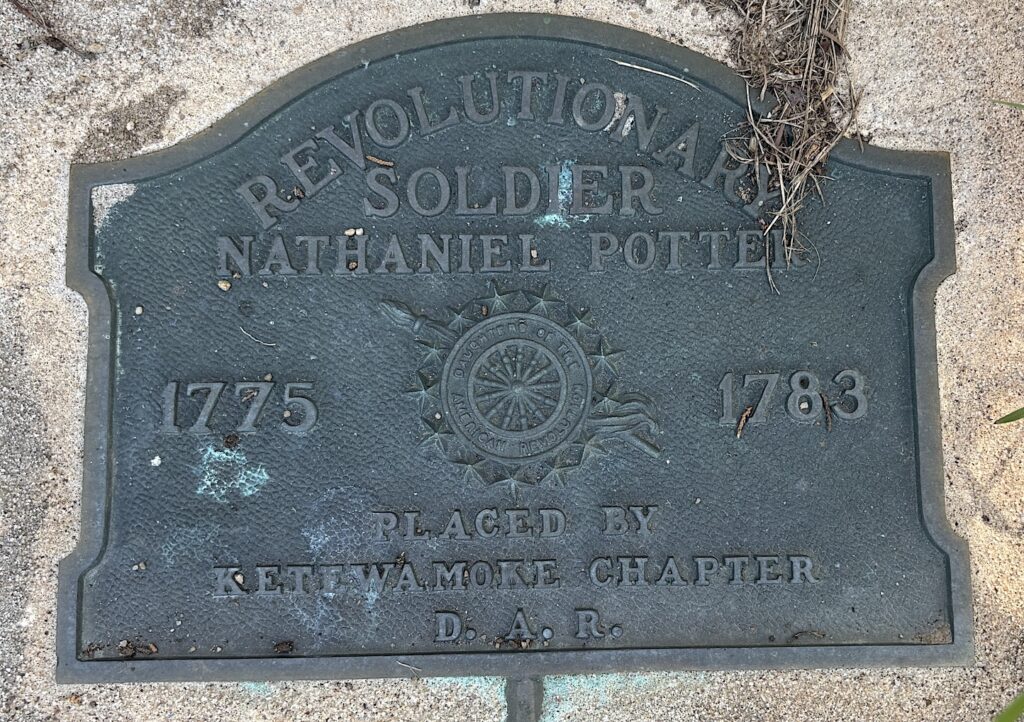
POTTER, NATHANIEL (1761-1841). Privateer. Nathaniel was born in Huntington on December 23, 1761 to Dr. Gilbert Potter (1723-1786) and Elizabeth Williams Potter (1728-1811) and was baptized there at the Old First Church by Reverend Ebenezer Prime (see). His ancestors lived in Rhode Island until his grandfather, Nathaniel, moved to Huntington in 1713. Nathaniel was the fourth of six children born to his parents and bore the same given name as his paternal and maternal grandfathers.
Gilbert Potter (see), who sailed as a surgeon on a privateer during the French and Indian War sided with the Patriots during the American Revolution and was a signatory of the Articles of Association in Huntington. On May 8, 1775, 403 men, most of them Huntington residents (a few were from Islip), “shocked by the bloody Scene” that had occurred just weeks before at Lexington and Concord in Massachusetts, where patriot Minutemen and British regulars had engaged in a bloody armed struggle, put their signatures on Huntington’s Articles of Association. Only 37 Huntington residents, either Loyalists or those wanting to stay out of the fray, refused to sign. The Articles noted that the signers affirmed their “Love to our Country,” agreed “to whatever Measures may be recommended by the Continental Congress; or resolved upon by our Provincial Convention, for the Purpose of preserving our Constitution, and opposition to the Execution of the several arbitrary, and oppressive Acts of the British Parliament,” and prayed for “a Reconciliation between Great-Britain and America.” The actions of these associators were seen by both patriots and the British as a step towards rebellion. The fact that these men signed these Articles, placing themselves in danger of British retaliation, including imprisonment, seizure of their property, and exile from Long Island, is proof of their patriotic service.
Frederic G. Mather in his scholarly text, The Refugees of 1776 from Long Island to Connecticut (1913), notes that Dr. Potter was a member of the Committee of Huntington, the Committee of the 1st Regiment and the Sons of Liberty. Appointed a lieutenant colonel of Colonel Floyd’s Regiment during the American Revolution, Dr. Potter was engaged in protecting Long Island; when it was occupied after the Battle of Long Island in August 1776, he retired within the American lines, then fled to patriot-occupied Connecticut during the war while his wife, Elizabeth, remained in Huntington. Mather notes that Elizabeth (see) carried on his medical practice and his affairs until Gilbert returned to Long Island. Nathaniel’s mother was sometimes referred to as Dr. Elizabeth Potter, the first woman physician in Huntington. In 1783, Dr. Potter returned to his medical practice in Huntington.
Wendy Polhemus-Annibell, the head librarian of the Suffolk County Historical Society, in “Brief Biography of Some of the Huntington Patriots,” dated April 3, 2024, notes that Nathaniel, only 15 during the war, spent part of his time with his father in Connecticut. While there, with his father’s help, he outfitted a privateer ship at Greenport, and captured several British ships. A Newsday article (Melville edition), written by Bob Pfeifle on December 18, 1948 headlined, “Romantic Past Lives in Old Granite,” notes that Nathaniel went on to study law after the war.
Ms. Polhemus-Annibell adds that in civilian life, Nathaniel was a silversmith and member of the New York State Assembly in 1812 and 1814 as well as a Suffolk County judge from 1823 to 1828; this information is elaborated on in many newspaper articles. Other civic jobs that Nathaniel held included being elected as a town assessor in 1805 (and re-elected the following two years) and being one of the commissioners of excise. As per the Long-Islander on October 12, 1950, Nathaniel was elected president of the Board of Trustees on eight occasions beginning in 1812 and lastly, in 1832. Many records refer to him as Judge Potter. On October 12, 1950, the Long-Islander published an article, Nathaniel Potter, One of Town’s Finest Citizens, Had Interesting Background.” That article outlined his many charitable endeavors helping the people of Huntington throughout his life and after his death. In addition to noting his town posts, political life and silversmithing, it reported that he maintained his farm, only getting help during harvest, was a shipowner, and raised his widowed sister’s four boys and one girl after she died.
As per the 1790 census, Potter owned two enslaved persons. The census of 1800 lists one enslaved person in his household.
Nathaniel’s prominence as a silversmith has been featured in several newspaper articles. The Long-Islander of November 21, 1919, reported that the Huntington Historical Society was interested in the town’s silversmiths and that a resident, Frank W. Shadbolt owned a Potter teaspoon from 1807 and another Amityville resident cites that her grandmother, born in 1794, owned spoons held by the family that were bought from Nathaniel’s Huntington shop and bore his trademark. Another article in the Long-Islander of October 12, 1950 reports that, as per family lore, during the Revolutionary War, the Williamses buried their silver to protect it from the British; because the site was not marked, the treasure never was found. Long Island Historian Dean Failey wrote an article in The New York Times on November 12, 1978 highlighting the important silversmithing trade in colonial times. Mentioned in this article is Nathaniel Potter whose silver flatware were recognized and whose name was used by a thimble manufacturer in Huntington, the silversmith George Wood Platt. Nathaniel’s trade as a silversmith was also reported in a Newsday (Suffolk Edition) article on May 5, 1975. That feature noted that he was also a jeweler in New York City, returned to Huntington to manufacture thimbles and had a general store there.
During the War of 1812, Ms. Polhemus-Annibell adds that Nathaniel owned at least one privateer ship, a fact mentioned in several of articles along with the interesting anecdote that follows. Mather at page 512, recalls the odd coincidence aboard the Amazon, a sloop owned by Nathaniel Potter that was captured by the British in Huntington Bay during that war. The British Commodore Hardy was at the helm and was the same man who Nathaniel’s mother had nursed when he had smallpox during the American Revolution. On board the Amazon was Henry Williams, the nephew of Nathaniel who was did not surrender peacefully and was put in the brig. Nathaniel ransomed the ship, went on board to look after his nephew, and recognized Hardy. Hardy then released young Henry and treated Nathaniel to a grand dinner on his flag-ship under the flag of truce; Hardy, too, honored Nathaniel’s late mother. That anecdote is repeated in Pfeifle’s Newsday article of December 18, 1948 which was cited above, and indicates that Nathaniel had assisted his mother in treating Hardy and that his sister, Seraphina, succumbed to smallpox at the age of fifteen. In addition, the Long-Islander article cited above of October 12, 1950 recounts this story to highlight the family’s prominence in Huntington.
Two of Nathaniel’s properties were still standing in the twentieth century and one still stands today. The aforementioned Newsday article of May 5, 1975, reports that his house, built before his death in 1841, was “one of the few remaining examples of Greek Revival architecture,” and was listed as a building that should be preserved. However, the woman who owned the house couldn’t maintain it as a multi-family dwelling and it was bulldozed late in 1974. However, an earlier home, the Potter-Williams house, built in 1827 at 165 Wall Street, was featured on the website, thedesignimperialist, in 2012. That edifice was added to the National Register of Historic Places in 1985, and is representative of the late settlement period of Huntington. That structure, a clapboard home, featured four bays, a central chimney, three-pane frieze windows and a gable roof; the house was bequeathed to Nathaniel’s mother’s family, the Williams’s, after his death.
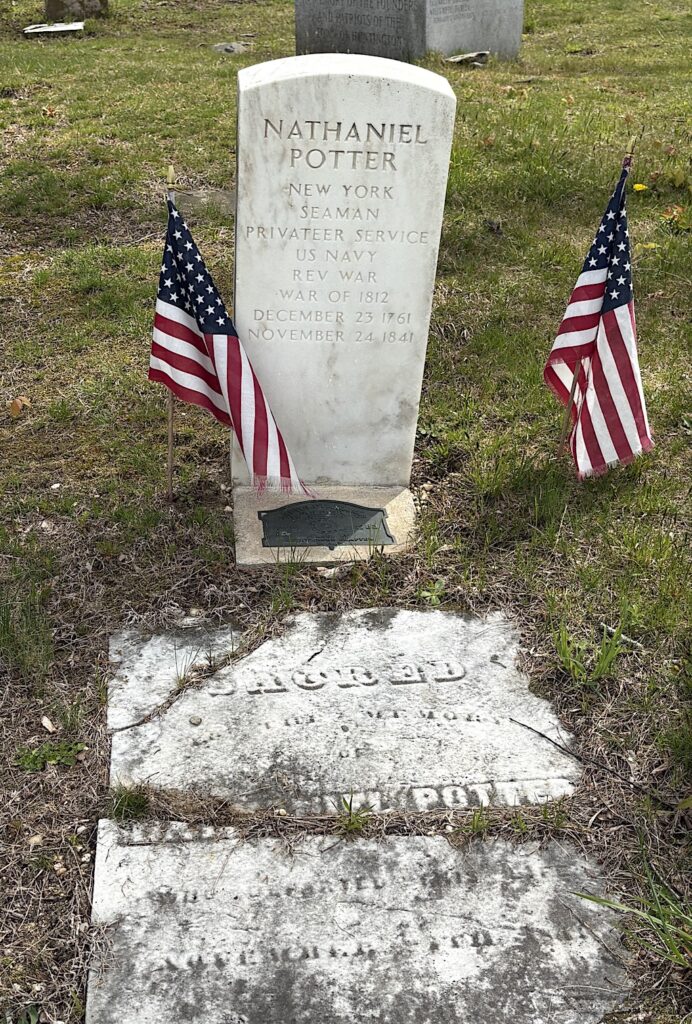
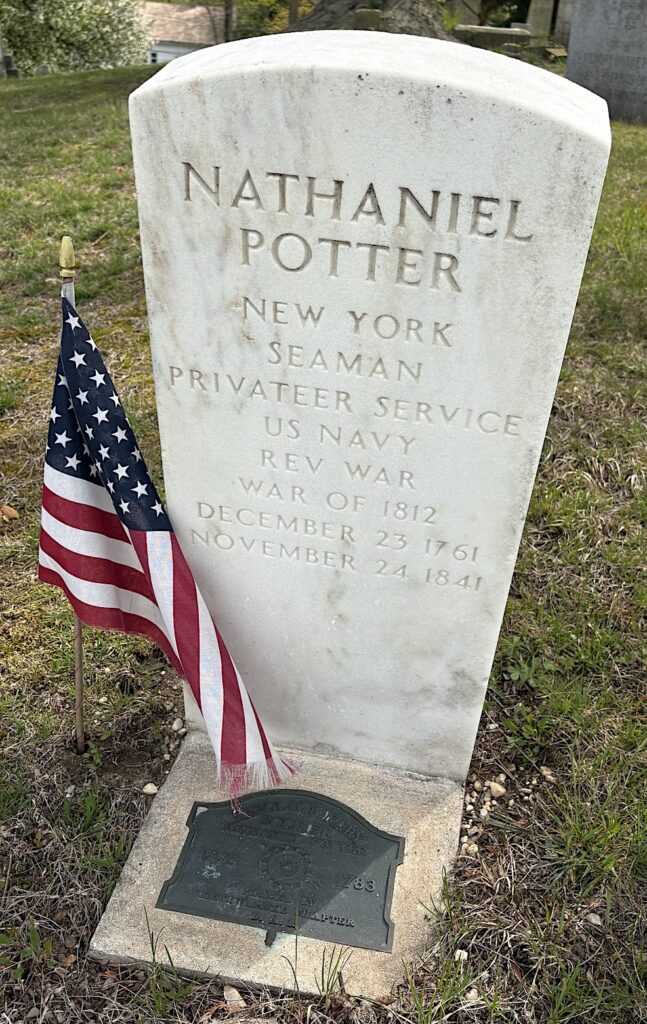
Nathaniel Potter died on November 21, 1841, eight days shy of his 80th birthday and is buried in Huntington’s Old Burying Ground. On August 2, 1973, Rufus B. Langhans, the Huntington Town Historian, applied for a government-issued upright granite headstone with no emblem citing Nathaniel’s privateer service during the American Revolution and the War of 1812. In 1911, Josephine Frost, in Cemetery Inscriptions from Huntington, Long Island, recorded “Nathaniel Potter, died Nov. 24, 1841 in his 80th year.”
Potter never knew that when he wrote out his will on November 11, 1841, that controversy would ensue. Nathaniel never married and according to Wendy Polhemus-Annibell and other newspaper articles, left a trust of $6,000, the Potter School Fund, to educate poor children at the Huntington Academy, a private school, of which he was a founder in 1793. Perhaps, Potter’s interest in education stemmed from the fact that his mother taught children in their home during the American Revolution when schools were closed. The trustees were instructed to invest the fund in mortgages and to reserve half the income until the trust reached $10,000. The monies were to be disbursed without regard to color or creed of the child. Eight years after his death, the Academy closed and was replaced by the first public school in Huntington. The trustees didn’t know what to do with the growing fund which remained in existence until 1951 when it had grown to $15,000: as early as 1946, the trustees applied to the Suffolk Surrogate Court to interpret Potter’s will. The Long-Islander article of 1950 reports that Potter had no idea that his charitable gift would be controversial; the fund was dissolved by Surrogate Hawkin’s decision noted in that newspaper on May 25, 1950 when the monies were distributed to remaining Potter nieces and nephews due to free universal education. The judge’s ruling was overruled in 1955; the trustees had hoped the monies would go toward college tuition while the seven relatives had contended that monies were earmarked for small children to have shoes and books as per Kirk Price’s article in Newsday’s Suffolk edition of May 25, 1950. As per the final ruling, a report in Newsday’s Suffolk edition of May 25, 1955, the trustee’s “sound judgment” to decide what level of education to use the funds won over the school district’s wish to use funds for eyeglasses and gym suits that “do not enrich minds of the poor.”