PLATT, EBENEZER SMITH (1754-1839). Private, Colonel Josiah Smith’s 1st Regiment of Minutemen, Suffolk County, Captain Thomas Wickes’s Company; associator, Huntington, New York. As per his online family tree on Ancestry.com, Ebenezer was born May 9, 1754 in Huntington, New York, to Dr. Zophar Platt (1702-1792) and Rebecca née Wood (1715-1782), and was baptized in Smithtown, Long Island. That family tree lists Ebenezer’s middle name as Smith and reports that he had two older sisters, Elizabeth (1748-1784) and Sarah (1750-1782), and a younger sister, Hannah (1756-1812). Find A Grave does not mention Elizabeth as a sibling but reports that he had an older sister named Phoebe (1739-1814) and an older brother Jeremiah (1745-1811). The United States Craftperson Files, 1600-1995, identifies an Ebenezer Smith Platt as a clockmaker in New York City in 1774.
Wendy Polemus-Annibell, head librarian, Suffolk County Historical Society in “A Brief Biography of the Some of the Huntington Patriots” (April 3, 2024), includes a biography of Ebenezer Platt which emphasizes his active role as a patriot. Much of the information in her sketch is confirmed by other documents and is elaborated in Frederic G. Mather’s scholarly work, The Refugees of 1776 from Long Island to Connecticut (1913). Platt was a signer of the Articles of Association in Huntington. On May 8, 1775, 403 men, most of them Huntington residents (a few were from Islip), “shocked by the bloody Scene” that had occurred just weeks before at Lexington and Concord in Massachusetts, where patriot Minutemen and British regulars had engaged in a bloody armed struggle, put their signatures on Huntington’s Articles of Association. Only 37 Huntington residents, either Loyalists or those wanting to stay out of the fray, refused to sign. The Articles noted that the signers affirmed their “Love to our Country,” agreed “to whatever Measures may be recommended by the Continental Congress; or resolved upon by our Provincial Convention, for the Purpose of preserving our Constitution, and opposition to the Execution of the several arbitrary, and oppressive Acts of the British Parliament,” and prayed for “a Reconciliation between Great-Britain and America.” The actions of these associators were seen by both patriots and the British as a step towards rebellion. The fact that these men signed these Articles, placing themselves in danger of British retaliation, including imprisonment, seizure of their property, and exile from Long Island, is proof of their patriotic service.
In August 1775, Platt was sent 100 pounds of gunpowder by the New York Provincial Congress; the gunpowder was stored in the home of Job Sammis, a residence still standing, now owned by the Town of Huntington and known as the Arsenal. Mather notes that the powder was sent to him for the Militia on the Western end of Long Island (page 88); 200 pounds of gunpowder were sent to troops of the Eastern Militia. Polemus-Annibell also notes that Ebenezer was a member of the Committee of Huntington to raise local troops and was in attendance at several of the meetings of the Committees of Suffolk County in Smithtown on September 5 and October 24, 1775; as per Frederic Mather, the Committee of Huntington organized the 1st Regiment of Suffolk County Minutemen in 1775. During the American Revolution, Ebenezer Platt was a private in Colonel Josiah Smith’s 1st Regiment of Minutemen, Captain Thomas Wickes’s Company. After the Battle of Long Island (also called the Battle of Brooklyn) on August 27, 1776, when the Patriots suffered a humiliating defeat and Huntington was occupied, Ebenezer fled to Connecticut and refused to sign the Oath of Allegiance to the King.
Although no application was filed for Ebenezer in the Daughters of the American Revolution (DAR), he is listed as a patriot and associator in their database which confirms his status as a patriot in Captain Thomas Wickes’s Company under Colonel Josiah Smith’s 1st Regiment of Suffolk County Minutemen. That database, in contrast to other documents, lists 1756 as his birth year. Supporting references in the DAR system include Revolutionary War Graves Register, the SAR Revolutionary War Graves Registers and Mather. Mather adds that Ebenezer also served in Colonel William Floyd’s Regiment (1st Suffolk Militia), though no rank or dates are specified. Floyd was named colonel at the meeting in Smithtown on September 7, 1775; Wickes was chosen captain on September 11; Mather noted that Ebenezer was at the meeting on September 5. Ebenezer’s service from Suffolk County is also recorded in the book Military Minutes of the Council of Appointment of the State of New York, 1783-1821.
During the British occupation of Huntington, while Ebenezer was living in Connecticut, he returned to Huntington at least three times. Mather notes that on March 27, 1781, Platt petitioned Governor Jonathan Trumbull and the Council of Safety of the State of Connecticut for leave go to Huntington to secure his money and effects. Ebenezer’s petition, published by Mather at page 975, states that he fled to Connecticut to “avoid British Tyranny and Oppression” leaving behind considerable interest. He adds that he has done little business since his exile other than navigation, which has not been successful, nor had he received any money from his estate or from friends. He asked to go to Long Island to secure “hard money” for his and his country’s benefit and would not secure or purchase any British goods. The petition was granted the next day and Ebenezer went to Huntington, accompanied by Lieutenant Caleb Brewster (who had fled from Setauket in Suffolk County to Connecticut and was involved in several patriot raids back to Suffolk).
With regard to Platt’s statement that he engaged in navigation, his name is recorded in History of Maritime Connecticut During the American Revolution, 1775-1883. In that report, he is named among those who raised money for the Privateer Sloop Wonder to make a second cruise to the Hudson River on May 31, 1777. A request was made to Governor Trumbull to raise £420 to outfit the sloop; Ebenezer paid £17.10 toward that amount. This petition is now held by the New Haven Colony Historical Society.
On August 7, 1781, Platt again petitioned for permission to return to Long Island to secure cash. Mather (page 976) published Ebenezer’s plea in which he noted that he was grateful for having been allowed to return to Huntington but that he had not been able to procure all his money on that visit, given that it was “so large a sum” and that he also wanted to secure “one pair of Pistols, one pair of Bridle Bitts, one pair of spurs, one Horse whip & one pocket book for my own use only & which cannot be procured here…” He added,
My Situation and Circumstances are such, having the principal part of my property and dependence on the Island where I can receive no benefit from it unless in this way. I find it necessary, and think it is my duty to try by every means to procure what money I can from thence that I may be improving it to advantage where it does not interfere with the public good….
Ebenezer’s request was approved that day. Polemus-Annibell notes that he returned to Huntington again on February 27, 1783. Onderdonk’s “Suffolk County” (page 108) reports that the trip was to get cash.
During the Revolutionary War, on December 2, 1781, Ebenezer married Abigail Lewis of Smithtown; she had been baptized at the First Presbyterian Church in Huntington on September 28, 1760. A record of their marriage is on microfilm at the Family History Library in Salt Lake City, Utah. Platt’s biography on Find A Grave’s website notes that the couple married at the Smithtown Presbyterian Church. Their children, as per Mather, were: Isaac Watts Platt (born 1788), who became a Presbyterian minister in Bath, New York; Ebenezer (born 1794), who became a banker in New York City; and daughters Elizabeth (born 1786 and married to James Rogers) and Rebecca (born 1790 married to Edmond Rogers). The online family tree on Ancestry lists other children, two of whom died in infancy: Sarah (born 1782), Zophar (born 1785), Egbert (1793-1793), and Naomi (1797-1798). Find A Grave indicates that Egbert and Naomi died young.
After the war, Platt was a member of the New York State Assembly 1784-1785 and 1792-1793, supervisor of the Town of Huntington 1792-1793, and the first judge of Suffolk County from 1793 through 1799.
As per the census of 1790, Ebenezer was living in Huntington with 12 members of the household including one free white male over 16, two white males under 16, six free white females and three enslaved persons. According to the census of 1800, there were ten members of the Platt household in Huntington. The residents included one free white male under 10, one free white male 10 to 15, one free white male 16 to 25, two free white males over 45, two free white females aged 10 to 15, one free white female aged 16 to 25, one free white female aged 26-44, and one enslaved person. The census of 1810 shows eight members of the household in New York, with three white males, aged 16 to 25, one male over 45, one female aged 10 to 15, two females aged 16 to 25 and one female over the age of 45.
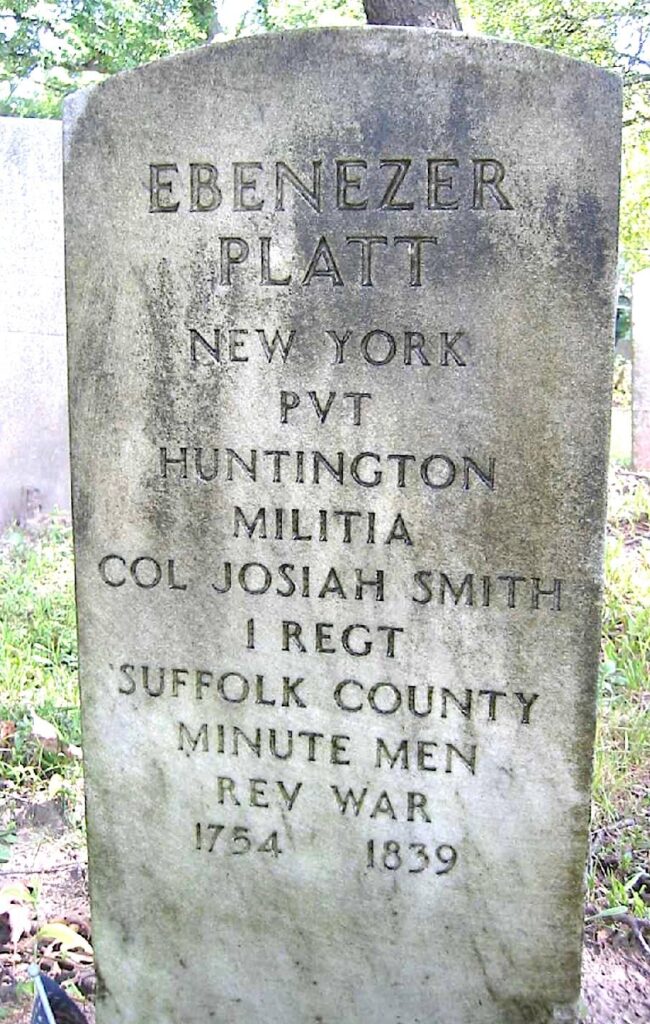
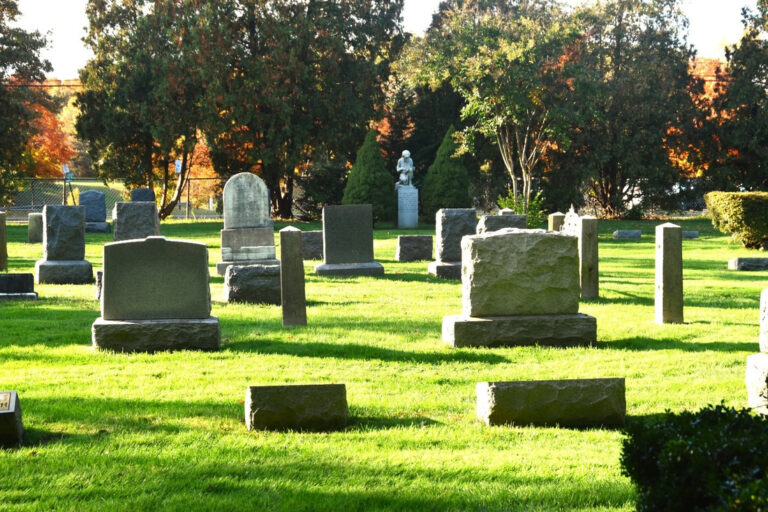
The New York Evening Post reported on June 27, 1839, that Ebenezer Platt Sr. died the previous day at the home of his son-in-law James Rogers at the age of 85 and that his remains would be buried in Huntington. As per Cemetery Inscriptions from Huntington, Long Island, copied by Josephine C. Frost (1911), his gravestone is inscribed, “Ebenezer Platt, died June 26, 1839, Age 85 yrs.” His wife, who predeceased him and is interred next to him, has the following inscription on her gravestone, “Abigail, wife of Ebenezer Platt, died May 19, 1828, Age 68 years. On August 3, 1973, Rufus B. Langhans applied for a government-issued upright marble headstone with no emblem citing Ebenezer’s service as a private in Josiah Smith’s 1st Regiment of Suffolk County Minutemen. Although Langhans included the word “judge” next to Platt’s name, that title was crossed out. Find A Grave includes a picture of his new gravestone which is inscribed with his military service.
In front of the Huntington Post Office on Gerard Street, a historic marker now stands to honor Ebenezer Platt. It was erected in 1986 by the Huntington Historian’s Office. The five-line inscription reads: “Huntington Post Office/Established Sept. 25, 1794/Ebenezer Platt First/Postmaster Rev. Soldier &/Judge.”