CONKLIN (or CONKLING), SR., TIMOTHY G. (1732-1811). Private, Westchester County Militia, 3rd Regiment, Captain Samuel Haight’s Company. As per Timothy’s timeline on the Geneanet website, he was born on February 4, 1732, in Huntington, Suffolk, New York, to Thomas Conklin and Abiah Hubbard Conklin. He was the second eldest of seven siblings, four boys and three girls. Timothy was baptized on November 29, 1732 at Huntington’s First Church. He married Ruth Ketcham on May 10, 1753 in Suffolk. The couple had four sons and three daughters. Their youngest daughter, Keturah, passed away while still a toddler and their oldest son, Timothy Jr. (see) served as a patriot during the Revolutionary War, earning promotions to lieutenant colonel in the Suffolk County Regiment.
All dates of Timothy’s early life as recorded on Geneanet are validated by two separate submissions to the Sons of the American Revolution Membership Application. Neither application is submitted for Timothy Sr.’s service, but for his son’s, Timothy Jr., role in the war. Timothy Sr. is referenced in each application as the father of Timothy Jr. The first application, submitted in 1909 by his great-great-great grandson, Walter S. Funnell, lists Timothy and his wife, Ruth, as his ancestors. The other application, submitted by his great-great grandson, Douglas Conklin in 1911, states that Timothy Sr. was born on November 29, 1732 and married Ruth on May 10, 1753 and also refers Timothy Sr. as the “4th”.
Timothy’s family was well established in Huntington. Huntington Town Records indicate that his great-grandfather, John Conklin, journeyed from Nottinghamshire, England to Huntington with stops at Salem and Southold.
As per the United States Revolutionary War Burial Index, Timothy served in the Westchester County Militia (with land bounty rights), in the Third Regiment. According to the article “Researching American Revolutionary War Patriots” by David Allen Lambert, Chief Genealogist of the American Ancestors Organization, Bounty Land Rights are described as follows:
At the beginning of the Revolutionary War, the Continental Congress offered land grants to officers and soldiers who would fight in the Continental Army. There were at least two problems with the promise, made in 1776. First, the Continental Congress had zero authority at that time to issue land, and more importantly, they did not have any land to give.
After the Revolutionary War, the new Congress of the United States had to make good on their promise. They had to find the land and devise a process to award the land to eligible soldiers. The original 13 colonies had been generous in their interpretation of what was theirs and their land claims frequently overlapped each other’s territory…
New York authorized bounty land in 1783. They allowed double dipping (state and federal) and the minimum award was generous: 50 acres. Land in the present-day counties of Cayuga, Cortland, Onondaga, Seneca, Oswego, Schuyler, Tompkins and Wayne was set aside for soldiers. The entire tract encompassed about 1.5 M acres. The 28 townships each had about 60,000 acres and were named for classical literary heroes. The land was distributed by a process known as the balloting box.
Although not stated how much, if any, land Timothy received, he is enumerated in the americanwars.org website as an enlisted man under Captain Samuel Haight of the Westchester County Militia: Land Bounty Rights, 3rd Regiment, therefore being entitled to some land.
According to the article “Samuel Haight (1738-1806)” by Randy Charles Haight, the 3rd Regiment took part in defending “Neutral Ground” in Westchester. If so, it is possible that Timothy participated in patrolling parts of northern Westchester. As per the research:
By the end of 1776, the British Army, aided by loyalist groups, controlled Manhattan, Long Island, and lower Westchester County, while American forces were stationed in the region north of the Croton River around Peekskill.
The area between the two armies (essentially, Westchester County) became a no-man’s land, called “Neutral Ground.” The military reality belied this designation; the region was not neutral. The area was really a battleground for both armed forces and for marauding bands operating independently.
A newspaper article, “Bay Boulder Dedicated to Old Whalers: Cold Spring Harbor Also Unveils a Tablet to World War Heroes,” published on November 13, 1932, reports the dedication of a boulder and two engraved tablets to honor the whalers and war heroes of the past. Although the clipping erroneously reported that Timothy died in the war, it honors his service to the patriotic cause:
Five former residents of the village who gave their lives in the Revolution were listed along with those who died in the World War on the tablet which was placed on the south wall of the Cold Spring Harbor Library. These men were Richard Conklin, Thomas Conklin, Timothy Conklin Sr, Timothy Conklin Jr., and Jonathan Titus.
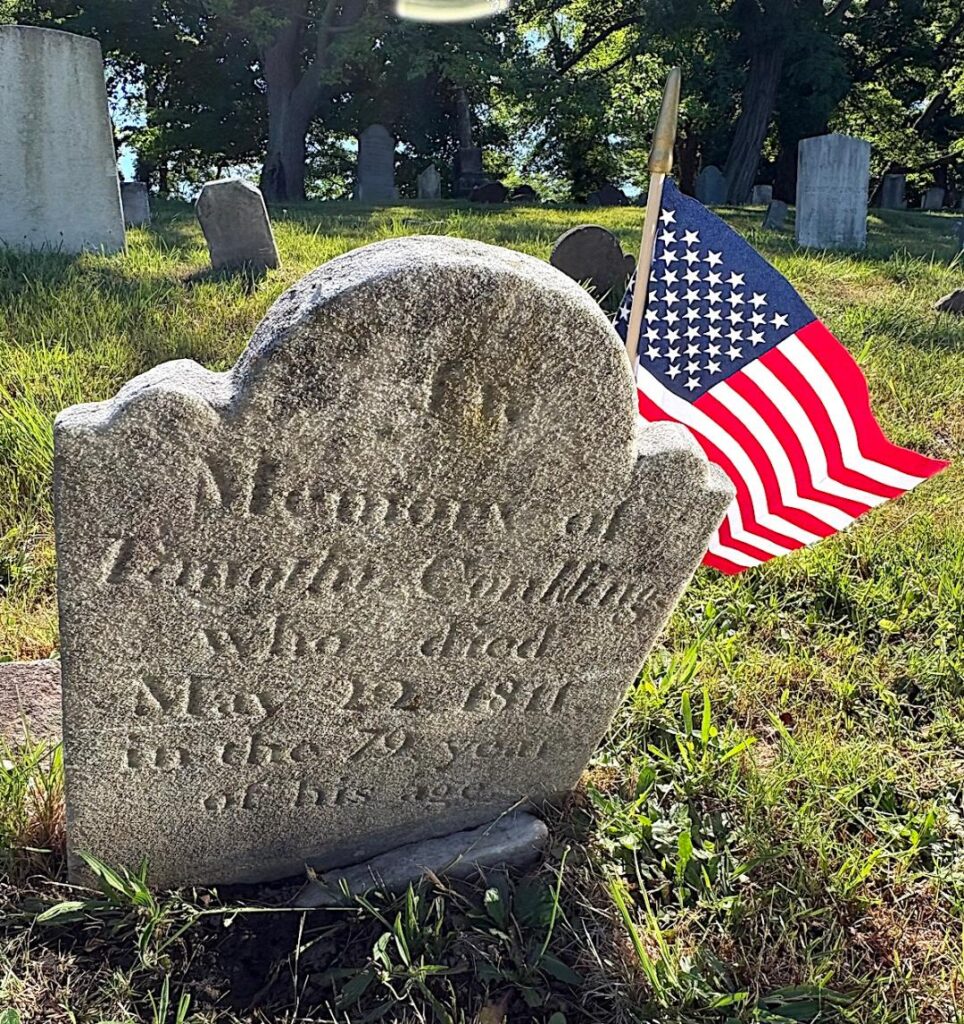
As per his family tree on Geneanet, Timothy died on May 22, 1811. He is buried in the Old Burying Ground in Huntington. He is interred under an old gravestone, that uses the spelling Conkling, that appears to have been placed at his grave soon after his burial. “In memory of Timothy Conkling who died May 22, 1811 in the 79th year of his age” is engraved on his tombstone.