SAMMIS, DAVID SILAS (1761-1820). Private, Colonel Josiah Smith’s 1st Regiment of Minutemen, 2nd Company, Huntington Militia. Frederic Gregory Mather, in The Refugees of 1776 from Long Island to Connecticut (1913), states that John Sammis was the original member of David’s family to settle in Huntington after a grant of land was given to him at the head of Cold Spring Harbor, with most of his family settling in West Neck or at the “Town Spot.” This ancestor of David Sammis was admitted as a freeman of Connecticut in 1664.
As per the Find A Grave website and an online family tree posted on Ancestry.com, David was born in Huntington, New York, on June 13, 1761 to Silas Sammis (1731-1803) and Ruth née Rogers (1735-1788). Both sites list siblings and children but they do not match exactly. His siblings, posted on the Ancestry family tree were: Mary (1748-1769); Ruth Sammis Conklin (1763-1790); Content Sammis Platt (1763-1832); Stephen (1765-1804); and Silas (1770-1803). Find A Grave lists siblings Phillip (1757-1823) and Sarah Sammis Wicks (1759-1795) in addition to Ruth, Content and Stephen, but does not list Mary or Silas.
During the American Revolution, David was a private in Colonel Josiah Smith’s 1st Regiment of Minutemen, Huntington Militia. That service is confirmed in New York in the Revolution as Colony and State classifiedby James A. Roberts and in the U.S. Revolutionary War Burial Index which cites the scholarly work by Frederic G. Mather, The Refugees of 1776 from Long Island to Connecticut (page 996, 1913). David’s service as a private is also confirmed in the Patriot Research System, an index compiled by the Sons of the American Revolution (SAR), which shows applicants approved in 1974 and 2006 through descendants of Luther Sammis, the son of David and Mary née Carpenter. According to Huntington Town Records, Volume III, David Sammis’s name is among those in the militia serving under Captain Cornelius Conkling who were ordered on duty on October 13, 1777, when Huntington was occupied by the British. On May 18, 21, 22 and 23, 1778, David was among those ordered by the British to build the fort at Lloyd’s Neck, an example of the oppression and suffering imposed on Huntington’s citizens during the occupation. Like many Huntingtonians, he signed the Oath of Loyalty to the Crown in 1778, although in the signatories were coerced by the occupying British and loyalist forces to do so. In 1782, Huntington Town Records (Assessment of Property in Huntington About The Close Of The War) show that David owned farm land (15 acres) and that he headed a family of two males and two females and no slaves. Further, the appendix for 1782 names him as one of the two town collectors of forage.
Although not mentioned on his family tree on Find A Grave and the one posted on Ancestry, the Geneanet website reports a middle name of Silas and notes that he was married on October 28, 1781 in Smithtown to Deborah Ketchan (sic) (1765-1792); Geneanet also lists a daughter Mary (1788-1865) who is not mentioned elsewhere. A marriage of a David Samis (sic) and Deborah Ketcham in 1781 is on microfilm at the Family History Library in Salt Lake City and in New York Genealogical Records. It is unclear if this marriage to Deborah is for another David Sammis who may have lived in Suffolk County at that time. On January 17, 1785, David married Mary Carpenter (1760-1835) in Huntington, New York. As per his online family tree, they were the parents of Ruth Sammis Gould (1785-1884); Luther Carpenter (1791-1831); Elizabeth (1794-1863); Prudence (1800-1855); and George (1802-1879), all born in Huntington. Find A Grave lists Ruth, Luther and Elizabeth but does not name Prudence or George; however, Find A Grave names a son, Daniel (1793-1873).
At the time of the 1790 census, there were four members of the Sammis household living in Huntington: one free white male over 16, one free white male under 16 and two free white females; given that the Sammises had only one daughter before 1790, it is unclear who was the male under 16. New York Tax Assessment Rolls of Real and Person Estate for 1799 report a David Sammis of Huntington having $805 in real and personal estate and owing less than $1.00 in taxes (amount is illegible). As per the 1800 census, there were six members of the Sammis household: one free white male under 10, two free white females under 10, one free white female ages 10-15, and two household members over 25. The 1810 census also identifies six household residents: one male and one female aged 10-15, one male and one female over 45, one male 16-25, and one female under 10. The 1820 census reports seven household members living in Huntington, one engaged in manufacture and two in agriculture. There were three free white males aged 16-25, two free white females aged 16-25, one free white male over 45 and one free white female over 45.
David Sammis may have served during the War of 1812. As per New York, U.S. Military Equipment Claims, War of 1812, a David Sammis filed a claim for $58.
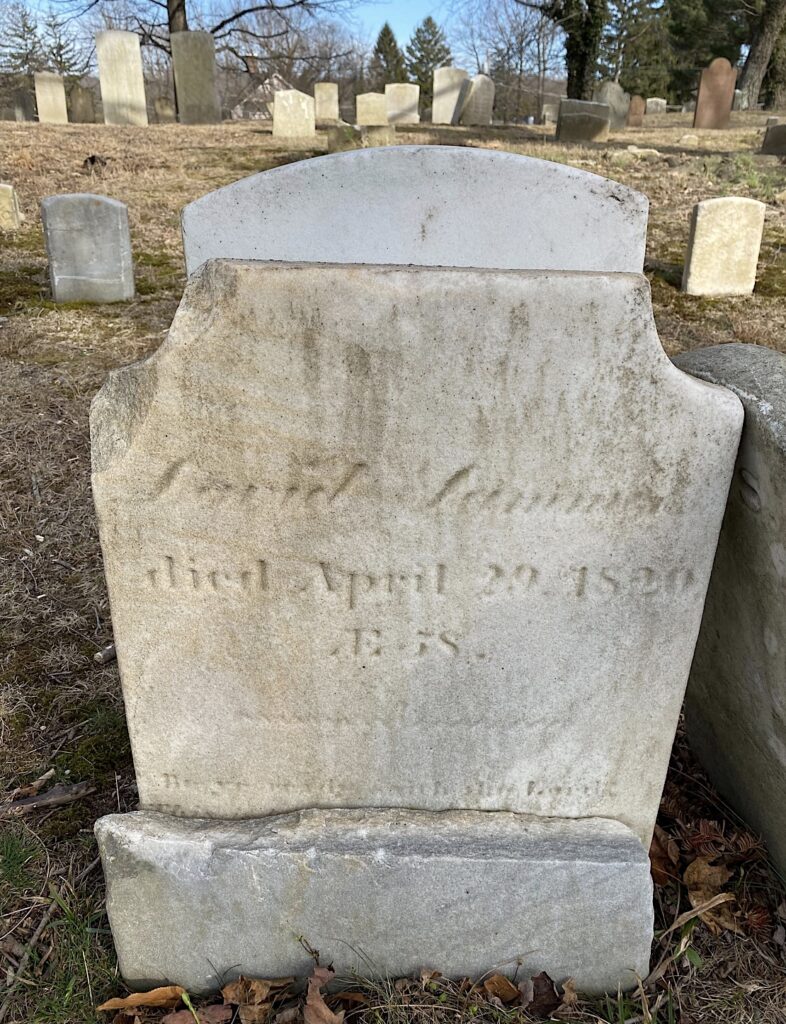
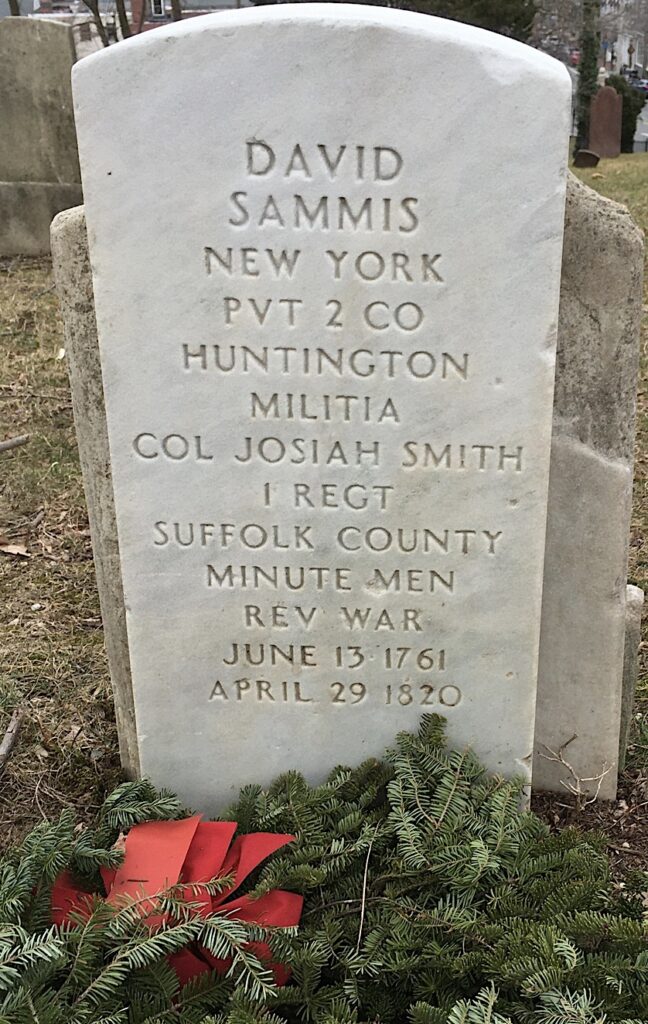
Find A Grave and his family tree on Ancestry note that he was interred at the Old Burying Hill Cemetery after his death in Huntington on April 29, 1820, at the age of 58; that place is now called Huntington’s Old Burying Ground. On August 2, 1973, Huntington’s Town Historian Rufus B. Langhans applied for a government-issued upright marble headstone with no religious emblem based on David’s service as a private in the 1st Suffolk Regiment under Colonel Josiah Smith. His new gravestone is inscribed with his military service during the American Revolution.