PLATT, AMOS (1759-1821). Private, Colonel Josiah Smith’s Regiment, 1st Regiment of Minutemen, Suffolk County Militia, Captain Thomas Wickes’s Company. Wendy Polemus-Annibell, head librarian, Suffolk County Historical Society in “A Brief Biography of the Some of the Huntington Patriots” (April 3, 2024), includes a biography of Amos Platt and reports that he was born in Huntington in 1759 and was baptized at the Old First Church on July 8, 1759. The Platt Lineage: A Genealogical Research and Record by George Lewis Platt (1891) states that the Reverend Ebenezer Prime (see) officiated at the baptism of Amos. His biography on Find A Grave reports his birth in Huntington to Jonas Platt (1727-1804) and Rebeckah (or Rebecca) née Bennett. Find A Grave noted that Amos had four sisters: Rebecca (1756-1834); Mary (1761-1811); Judith (1766-1823); and Zurviah (1775-1851).
During the American Revolution, Platt enlisted at age 16 or 17 and served as a private in Colonel Josiah Smith’s 1st Regiment of Minutemen. Polemus-Annibell indicates that Mather reported in his Refugees of 1776 from Long Island to Connecticut (1913) that Amos was in Captain Wickes’s Company from July 29 through August 31, 1776. Confirmation of Amos’s service as an enlisted man in the 1st Regiment of Minutemen is acknowledged in New York in the Revolution as Colony and State, Volume I, 1894. An original muster roll of the unit, held by the Suffolk County Historical Society and copied, note the following for Thomas Wickes’s Company G (original spelling):
Sir, this is a List of the men that belong to my Company & all Except one are Equipt and have got some Ammunition as to make a Compleat Return. At Present I cannot for there is a Considerable Number that have not yet turn’d out. Gen. Woodhall & Coll. Floyd you may remember told the Officers that they need not be Exact about the Number & from that the Officers have Done nothing about Completing their Compliment & the Draft that was made to Smithtown makes the Company so small.
As per Huntington Town Records of 1887, Amos Platt was listed as among the troops serving in Cornelius Conkling’s Company on July 11 and October 13, 1777. This is after Huntington was occupied by the British after the humiliating defeat at the Battle of Long Island (Battle of Brooklyn) on August 27, 1776. The town records also show that Amos was among those in Conkling’s Company who were ordered to work on the fort that was built at Lloyd’s Neck in May 1778, a site where Huntingtonians and other Long Islanders who escaped to Connecticut came and left from in whale boats. In 1778, Amos was among the many Huntington residents who swore allegiance to the Crown; most did so under coercion as the British threatened to take their property and belongings; Amos’s work on the fort was another example of the British suffering imposed on those under occupation. In their hearts, those who took the oath abhorred what they did and sympathized with the patriots who were fighting for independence. In addition, the Town Records from December 25, 1781 show that Amos was among those who served as a Tuesday night guard in Town Spot; those assigned vowed that they did this voluntarily “for our Own & our Neighbours Preservation…” On November 5, 1782, Amos was listed as one who worked on the construction of Fort Golgotha, built with lumber from the church that was torn down at the site and where the First Presbyterian Church now stands. Amos worked six of the fifteen days needed to construct the fort but he did not supply any wagons, timber or straw that others did. Town records note how tombstones were dug up and used for fireplaces and ovens and how outrageous it was to build the fort given that peace talks were underway between Great Britain and the new nation.
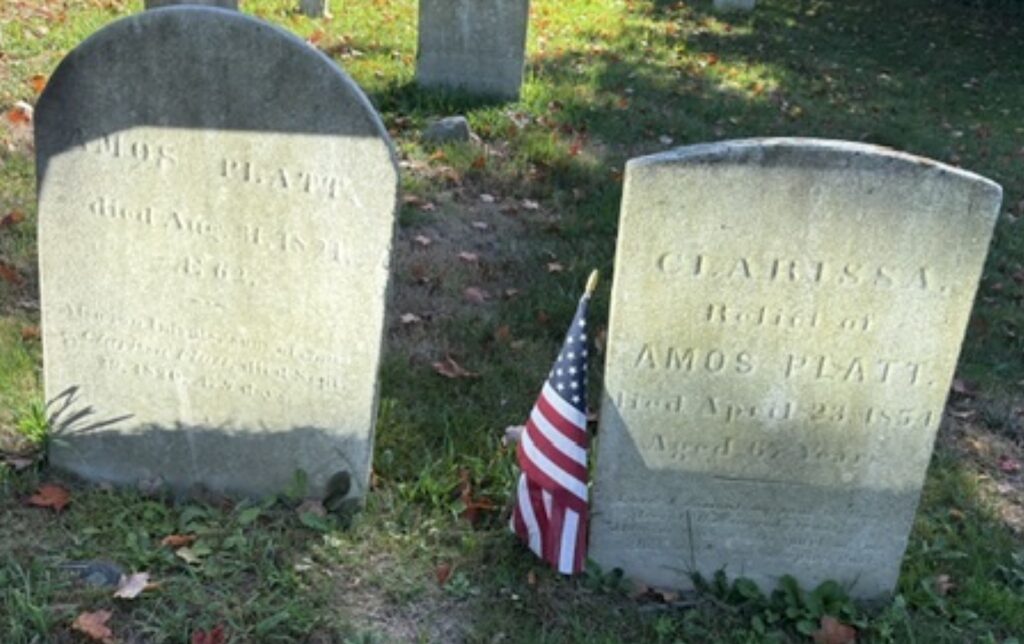
Platt married Clarissa Sammis (born in 1787) on May 3, 1815 in Huntington. Their daughter, Rebecca (1816-1880), married Warren Conklin. Their two infant sons, Jonas and Amos, who died on September 29, 1820 at the age of nine days, have their names etched on Amos’s headstone.
Amos’s work history in his hometown is recorded in “Occupation After Military Service,” in Huntington Town Records. That account indicates that in 1798, he was chosen to serve as one of the three Commissioners of Highways and was reappointed to that position for several years (records show his name from 1800 through 1807 and 1811). Additionally, as of 1805, Platt was asked to take responsibility for Intestate Estates (those without a will) in Huntington. New York Tax Assessment Rolls of Real Estate and Personal Estates, 1799-1803, details that in 1893, Amos Platt’s estate was valued at $1,270 with taxes assessed at $2.75.
At the time of the 1810 census, Amos lived in Huntington. His household was comprised of two free white persons, aged 16-25; one free white male over 45; one free white female aged 10-15; one free white female, aged 16-25; one free white female over 45, totaling six residents. The 1820 census showed five household members: one free male under 10; one free male over 45; one free female, under 10; one free female, aged 16-25; one free female over 45.
Amos died on August 31, 1821 in Huntington. His gravestone is alongside that of his wife who died in 1854. Prior to her death, the 1850 census reported that she was living with her daughter and her husband Warren, and grandchildren: Amos (14), Alonzo (11), Mary (9), Jeremiah (6), Warren (3), and Henrietta (3+months). Clarissa’s headstone bore this poem: Lord I commit my soul in thee, Accept the sacred trust, Receive this nobler part of me, And watch my sleeping dust. Both Amos and his wife are buried in Huntington’s Old Burying Ground; Find A Grave website names the place of interment as the Old Burying Hill Cemetery. The Sons of the American Revolution (SAR) Database, confirms his service as a private in New York and notes that a SAR marker had been ordered for Amos’s Grave 191 in Section 1 near the South Fence.