By Barbara LaMonica, Assistant Archivist
Finding enslaved African-American ancestors prior to the Civil War can be very difficult. The following article, while not exhaustive, provides information on some basic records critical to this genealogical research.
From 1790-1840, the names of slaves were not listed in census records since they were considered property rather than persons. Only the names of the head of household appear with the number of slaves they owned. Enslaved individuals rarely had surnames, many, but not all, took the surname of their owners. However, there are resources that may provide clues to tracking down enslaved ancestors.
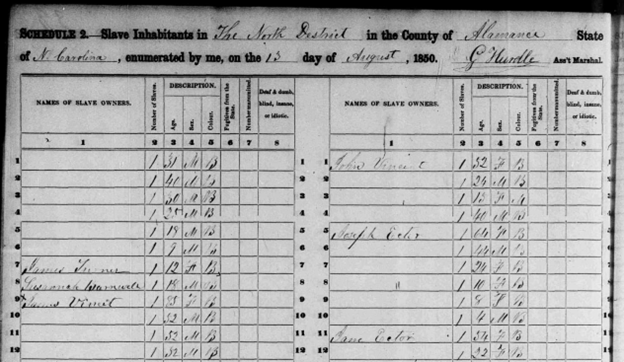
For the 1850 and 1860 census, the Federal government required that enslaved individuals be recorded separately in “slave schedules”. These schedules do provide more details about these persons including age, sex, color (i.e. mulatto), if they were a fugitive slave, if manumitted, and their physical and mental condition but no names.
The family papers and records of Southern plantation owners contain an abundance of information such as slave registers, personal correspondence, photographs, and business account books. Sometimes in personal and business letters, the names of slaves may be mentioned. Unfortunately, many plantation records were lost or destroyed during the Civil War. However, most of the surviving papers were often donated to libraries throughout the south. A guide to these papers “Index to Records of Ante-bellum Southern Plantations: Locations, Surnames, and Collections” lists where records can be found, usually university libraries. If the area where the ancestor lived is known one can go to this guide and see if there are existing plantation records. The link below provides further information.
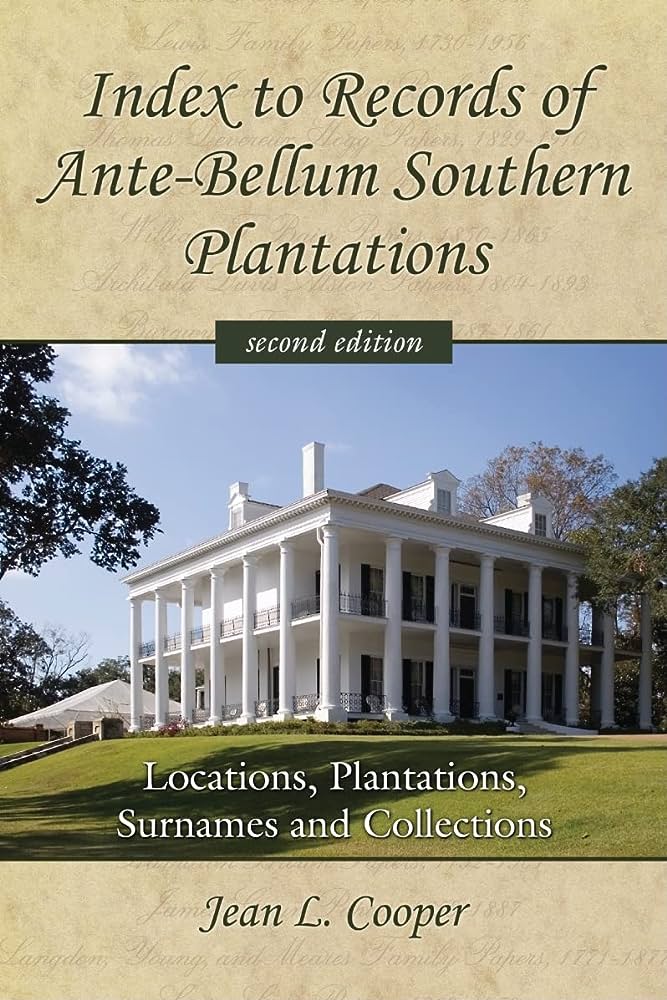
Click for Index to Records of Ante-bellum Southern Plantations
Eighteen-seventy is an important turning point for African-American genealogy since the 1870 census is the first one to include the names of former slaves. Therefore, after 1870, a genealogical search of records will be similar to those of European Americans; census reports, births and deaths, service records etc.
Other post-Civil war records that can illuminate ancestors’ lives include:
-1867 Voter Registration whereby Southern states were mandated to register all African American men over the age of 21 to vote. Since these records include place of birth and name this can be useful to trace back to where person was enslaved.
-Records of United States Colored Troops in the Civil War lists the over 186,000 African Americans who served in the Union Army.
-The Freedmen’s Bureau Records 1865-1874 known as the Bureau of Refugees, Freedmen, and Abandoned Lands, was established by the War Department. The Bureau supervised abandoned and confiscated property in the South and provided relief and assistance to former slaves. The bureau dispensed clothing and food, operated hospitals and schools; legalized marriages conducted during slavery, and assisted black soldiers and sailors to apply for pensions. The field office records, organized by state, contain personal correspondence from freedmen revealing their experiences in the harsh and still racially divisive society of the post- Civil War South. Here one can find former slaves’ full name, residence, and former masters’ names and plantations.
In 1807, Congress outlawed the African slave trade. However, the right to buy and sell slaves and transport them from state to state remained legal. Certain requirements applied to the coastal transport of slaves. The captain of the vessel had to provide a manifest of slave cargo to customs at the port of departure and the point of arrival. This is one of the rare resources prior to 1870 where one can find the name of the enslaved person. In addition to name, the age, sex, color, and residence of owner are provided. Annapolis, Beaufort South Carolina, New Orleans, New York are among the port records with remaining manifests.
Below is a link to the Freedmen’s Bureau records and links to other pertinent collections at the National Archives. Many but not all of these records are digitized.
Click to link to Freedmen’s Bureau records
For local assistance contact the African Atlantic Genealogical Society, a member of the Genealogy Federation of Long Island. They are located in the Joysetta & Julius Pearse African American Museum of Nassau County in Hempstead
Click for information