CONKLIN, SELAH B. (1752-1797). Private, 3rd Regiment, Colonel James Clinton’s Regiment, Captain John Grennell’s 3rd Company; 4th Regiment, Colonel Henry B. Livingston’s Regiment, Captain Daniel Roe’s Company, Continental Army; associator, Huntington, New York. Conklin’s family tree, posted on Ancestry.com, reports that Selah was born in East Huntington, New York in 1752 to Major Thomas Conklin and Mary Naomi Conklin. His family tree also records the birth of his many siblings: John (1855-1808), Thomas (1755-1830), Rebecca (1756-1842), Cornelius (1860-died in infancy), Zophar (1760-1815), Hannah (1762-1842), Lucinda (1765-1843), Peleg (1771-1788) and Susan (1772-1850).
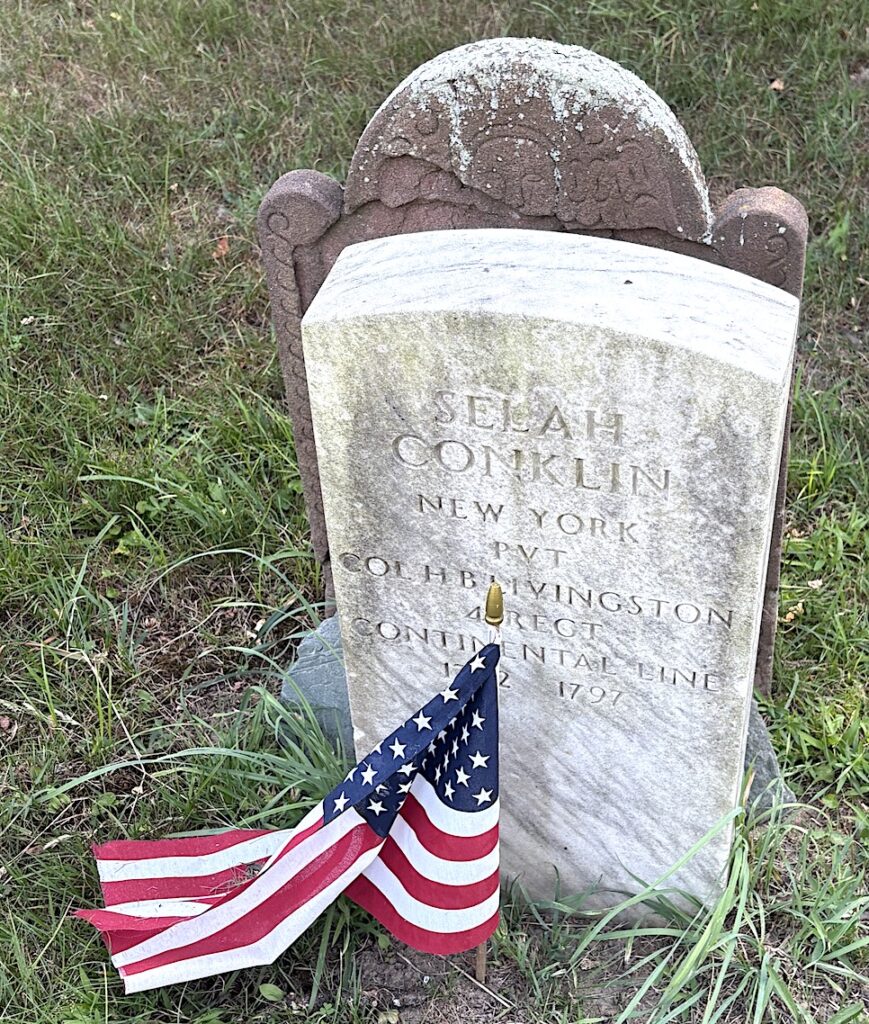
According to his headstone at Huntington’s Old Burying Ground, Selah was a private in Colonel Livingston’s Continental Line; that information is likely incomplete. As per Wendy Polemus-Annibell, the head librarian of the Suffolk County Historical Society, Conklin’s service during the American Revolution was in the 3rd Regiment, Colonel James Clinton’s Regiment, likely in Captain John Grennell’s 3rd Company and in the 4th Regiment, Colonel Henry B. Livingston’s Company, Captain Daniel Roe’s Company, Continental Army. (The 4th Regiment, which was re-organized and re-designated often, was initially the 2nd Regiment in 1775 and also consolidated into the 2nd Regiment after January 1781.)
Selah’s online family tree notes his marriage to Lydia Beers in 1776, a year after the death of his mother at the age of 42. No children are named on the family trees.
As per Polemus-Annibell, Selah was a signatory to the Association of Huntington, known formally as an associator. On May 8, 1775, 403 men, most of them Huntington residents (a few were from Islip), “shocked by the bloody Scene” that had occurred just weeks before at Lexington and Concord in Massachusetts, where patriot Minutemen and British regulars had engaged in a bloody armed struggle, put their signatures on Huntington’s Articles of Association. Only 37 Huntington residents, either Loyalists or those wanting to stay out of the fray, refused to sign. The Articles noted that the signers affirmed their “Love to our Country,” agreed “to whatever Measures may be recommended by the Continental Congress; or resolved upon by our Provincial Convention, for the Purpose of preserving our Constitution, and opposition to the Execution of the several arbitrary, and oppressive Acts of the British Parliament,” and prayed for “a Reconciliation between Great-Britain and America.” The actions of these associators were seen by both patriots and the British as a step towards rebellion. The fact that these men signed these Articles, placing themselves in danger of British retaliation, including imprisonment, seizure of their property, and exile from Long Island, is proof of their patriotic service. She also noted that Conklin, who later lived in Connecticut, petitioned the Connecticut General Assembly on January 7, 1780, for relief from the poll tax.
Conklin died on September 16, 1797, in Huntington; his father survived him as did all but two of his siblings; his mother had died in 1775. His burial at the Old Huntington Cemetery is cited on his family history posted on the Geneanet Community Trees Index website; Find A Grave names the cemetery as the Old Burying Hill Cemetery. In 1973, Rufus B. Langhans, Huntington Town Historian, filed an application for Selah’s government-issued upright marble headstone, with no emblem, noting his rank as private in Colonel H. B. Livingston’s 4th Regiment, Continental Line and also as a private in the 3rd Company; the Old Burial Ground in Huntington was listed as the cemetery.