By Barbara LaMonica
According to market analysts the rise of Amazon in 1995 and e-readers in 2007 would cause the demise of brick-and-mortar bookstores due to “technological shock”. And as predicted between 1995 and 2000 the number of independent bookstores declined by 43% as consumers ran to online platforms with unlimited inventory and lower prices. Others predicted with e-readers the printed book would go out of print.
But starting in 2010 against all odds bookstores started to make a resurgence. Furthermore, according to a Harvard Business School study, (Raffaelli, Ryan. “Reinventing Retail: The Novel Resurgence of Independent Bookstores.” Harvard Business School Working Paper, No. 20-068, January 2020), the sale of printed books has been steadily increasing and since 2009, and the number of indie bookstores has increased by 49%. Even a large book retailer like Barnes and Noble are now reopening stores.
So what is the appeal of brick and motor stores? Maybe browsing is more fulfilling than scrolling. For a booklover nothing compares with the tactile experience of holding a book and flipping through its pages, and browsing shelves always presents the opportunity of discovering an exciting new title. Bookstores are curatorial in nature providing inventory reflecting the interests of their customers. Algorithms still cannot reproduce the personal buying experience and the expertise of a bookseller.
According to market analysts the rise of Amazon in 1995 and e-readers in 2007 would cause the demise of brick-and-mortar bookstores due to “technological shock”. And as predicted between 1995 and 2000 the number of independent bookstores declined by 43% as consumers ran to online platforms with unlimited inventory and lower prices. Others predicted with e-readers the printed book would go out of print.
But starting in 2010 against all odds bookstores started to make a resurgence. Furthermore, according to a Harvard Business School study, (Raffaelli, Ryan. “Reinventing Retail: The Novel Resurgence of Independent Bookstores.” Harvard Business School Working Paper, No. 20-068, January 2020), the sale of printed books has been steadily increasing and since 2009, and the number of indie bookstores has increased by 49%. Even a large book retailer like Barnes and Noble are now reopening stores.
So what is the appeal of brick and motor stores? Maybe browsing is more fulfilling than scrolling. For a booklover nothing compares with the tactile experience of holding a book and flipping through its pages, and browsing shelves always presents the opportunity of discovering an exciting new title. Bookstores are curatorial in nature providing inventory reflecting the interests of their customers. Algorithms still cannot reproduce the personal buying experience and the expertise of a bookseller.
Besides providing a personal buying experience a bookstore is rooted in the community and is a big part of the “shop local” movement supporting the economy of the town.
Huntington Village has always had bookstores, at one time boasting several. The oldest, Hunts opened in 1948 at 324 Main Street and closed in the early 1980s, The Little Professor opened in 1974 on Main Street across from the library, concurrently a rare bookstore North Shore Books on Green Street, another used bookstore on New York Avenue, and Book Revue, one of the largest bookstores on Long Island, opened in 1977 and closed in 2021. Today The Next Chapter, which opened in 2023 on New York Avenue is doing a booming business carrying on the tradition of Book Revue. There is one bookstore I have fond memories of and that is Oscar’s Paperback Bookstore where I worked in the mid-1980s while I was in school.
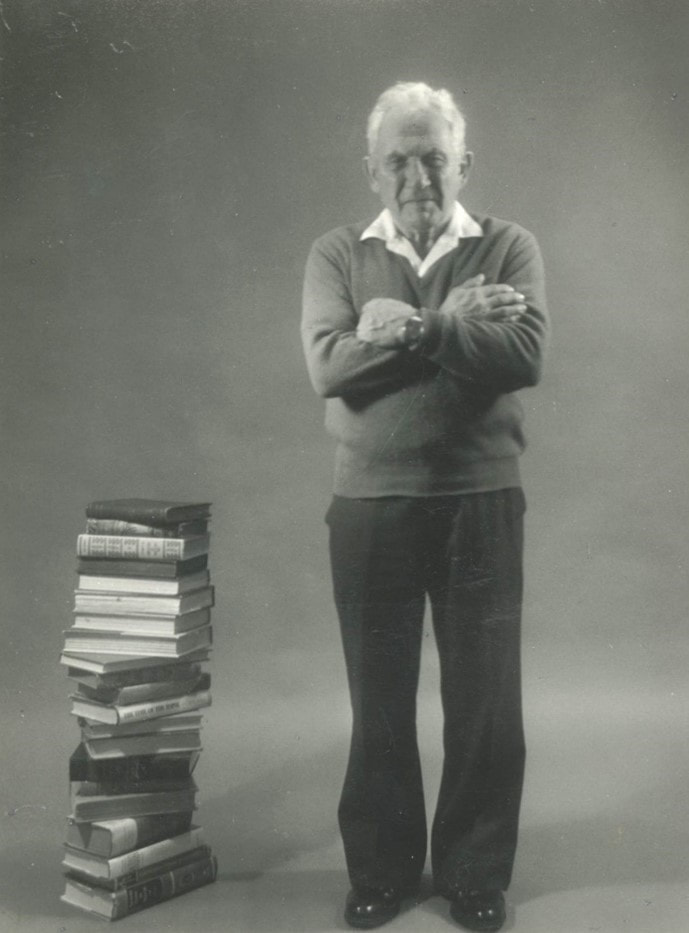
Oscar’s Paperback Bookstore opened in 1962 at 389 New York Avenue. Run by Oscar Chudinowsky, a book loving 4-foot 11inch lovable and witty curmudgeon who liked to argue all the “forbidden” topics-religion, politics etc., with his customers. Oscar’s became a haven for authors, artists, academics and students. I hear tell that before my time Jack Kerouac was a recurring presence, and Nobel Laureate scientist Barbara McClintock was a regular customer.
With over 75,000 titles including a labyrinth of rare and out-of-print books in the basement, and of course Oscar himself, the store could attract over 200 customers a day. Oscar had the books arranged by publisher and he knew where each book was. “It’s the third aisle, two shelves down, five books to the left” and he would never hesitate to give his opinion- “What do you want to read that for?”
Oscar was born in 1907 in Manhattan to Russian immigrants. In 1929 he opened his first bookstore with his wife Ida in Greenwich Village. After that store failed, he tried again in Liberty and Beacon New York, but these also succumbed to the Great Depression. Eventually he opened a toy and gift store in Middle Village Queens which became a great success. By the time he made enough to retire he decided to fulfill his lifelong dream of being a bookseller. After looking around he decided that Huntington was “a good book town”. In later years Oscar sold the store to his longtime employee David Ramage, who eventually closed the store in 1994. Oscar died in his sleep in 1999 at the age of 92.
In my mind Oscar’s will always be the epitome of a great indie bookstore. Let’s hope the resurgence continues.