By Barbara LaMonica, Assistant Archivist
Beginning in the 17th century the Town of Huntington began to codify guidelines for taking care of their poor residents. These policies, as well as those of towns and villages of all colonies, were based on English Poor Laws, one of the earliest being the Elizabethan Poor Law of 1601.
This law addressed the gap in care of the poor created by Henry VIII’s dissolution of the monasteries, as the monasteries had been the main source of charity.
The Elizabethan law established the precept of local control, meaning each village had the responsibility for its own poor. Local officials had the power to raise taxes and appoint an overseer to administer the charity funds. A later law, The Law of Settlement and Removal, empowered villages to expel persons back to their home village should they become dependent, insuring that “no vagabonds or beggars allowed. “
As early as 1687, the Province of New York passed a law mandating towns and counties take care of their own poor. Pre and post revolution New York continued to establish statutes such as binding out poor children as apprentices and servants, and the establishment of poor or work houses. Eventually children were removed from these institutions and placed in orphanages.
According to Huntington Town Records, the town trustees who acted as overseers evaluated destitute residents on a case-to-case basis. Eventually separate overseers were appointed. These individuals came from prominent Huntington families. Town overseer records show in 1763 the first overseers came from the Brush, Platt, and Wood families. Over the years such personages as William Woodhull, Solomon Ketchum, John Rogers, Israel Scudder, Hiram Baylis served multiple terms. As an interesting aside, it was not until 1921 that the first woman overseer, Maude E. Henschell, was elected. A Brooklyn Times Union article dated December 29, 1921 took note of her reelection:
“There previously had been grave doubts as to whether the office could be fulfilled successfully by a woman…the women and children with whom she came in contact find in her a friend ready to aid them and many of the kindness have been done by her outside of her official duties. She has ably proved that some features connected with the office can be looked after by a woman better than a man.”
A proportion of funds raised by the town from taxes, licensing fees and fines were distributed to the overseers. Traditionally, destitute able-bodied residents were placed with families to do household chores or farm work in exchange for room and board. The families were expected to provide food, clothing and shelter, and medical care. Some professionals were paid by the town as records show that during the early 1800s Dr. Kissam received $35 a year to attend the poor.
Children whose families could not maintain them or who were orphaned were placed as apprentices. The town also paid for younger children to be boarded with families. Widows were often placed with families as well, as an entry in the records of the Huntington Overseers of the Poor dated October 29 1736 states:
“M. Wickes President of the Trustees-I desire you to Lett the Carrel here of Isaac brush have the Sum of Thirty four Shill it being the third payment for my keeping the widdow Jones in so doing you will Oblige your friend Benjamen Soper.
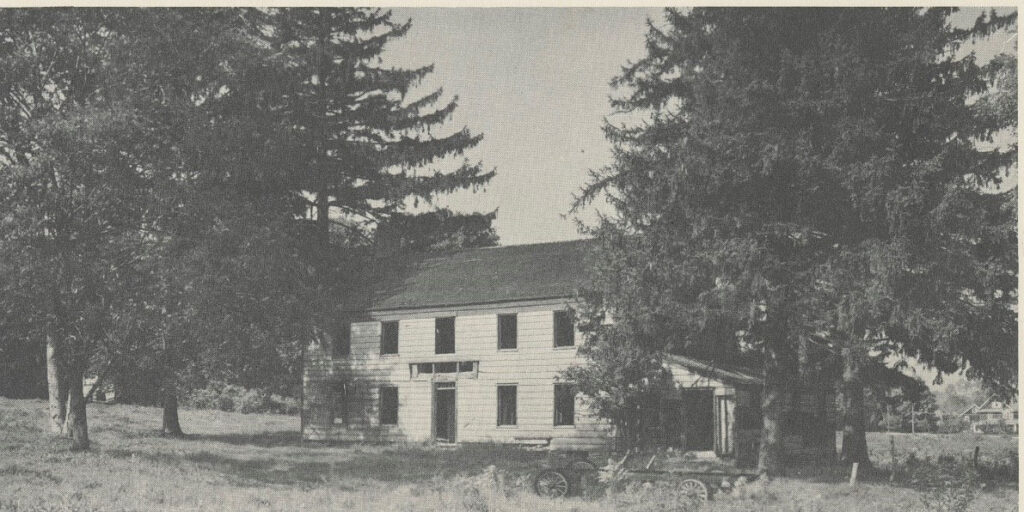
Over time responsibility for the poor slowly evolved toward a more centralized model. By the mid-1800s with the growth in population, it was becoming obvious that the practice of placing the poor in homes was becoming unwieldly and inefficient. In 1821, It was determined that the poor should be placed in one location, and by 1824, the town purchased a farm on the the village green to house the poor. Those who refused to go would be denied any further aid. A manager was hired to work the farm with the residents. Proceeds from the farm went to support the house. Concurrently New York State passed a law requiring each county to construct a poorhouse. By 1871, a poorhouse was constructed in Yaphank and the town resolved to relocate the poor there, but Town overseers continued to provide for widows and families in their own homes. Eventually however care of the poor would be transferred from the local level to county and state. The last Overseer or Superintendent of the Poor was in 1929.
In 1929, the year of the Great Depression, New York State enacted a repeal of the poor laws in order to expand responsibility for the poor from a local level to more centralized control with uniform standards throughout the state. Previous laws were deemed a hodgepodge of incoherent rules and amendments differing from town to town. Now each county would have a Superintendent of the Poor who had control over local overseers. The new state laws emphasized in home care and rehabilitation, with special concern for child welfare. The New Deal and the Social Security Act of 1935 solidified care for the poor and unemployed in Federal and State programs thus completing the transfer from town/local control to county, state and federal levels.
For more detailed study see:
Bond, Elsie M. “New York’s Public Welfare Law”. Social Service Review, vol. 3, 1929, pp.412-21. http://www.jstor.org/stable/30009380
Lindsay, Samuel McCune, “Social and Labor Legislation”. American Journal of Sociology, vol. 35, no.6. 1930 pp.967-81. http://www.jstor.org/stable/2766847
Huntington’s Legal History, Antonia S. Mattheou, Town Archivist, Town of Huntington Joanne Raia Archives. Companion publication to exhibition at the Soldiers and Sailors Memorial Building, March 1-May 15, 2023.
Stuhler, Linda S. “A Brief History of Government Charity in New York (1603-1900). VCU Libraries Social Welfare History Project. https://socialwelfare.library.vcu.edu
Town of Huntington Records of the Overseers of the Poor Addendum 1729-1843. Rufus B. Langhans Huntington Town Historian, Town of Huntington 1992.