ROLPH, MOSES (1718-1791) Associator, Huntington Articles of Association. Born on April 28, 1718, in Middlesex, New Jersey Colony, Moses was the son of John Rolph and Mary Hale Higgins. John Rolph was born in Elizabeth, New Jersey in 1681, according to a family tree on Ancestry.com (cemetery records show 1699, but that date would not be possible, based on his older children’s birth years) and he died in Rahway, New Jersey in 1749. His wife was born in 1678 and died in 1739. Birth and date records from the early 18th century are not always accurate and may differ by many years, depending on the source of information. To complicate matters even further, the family tree lists John Rolph’s given name as Moses. There are records from the First Parish Burying Ground in Newbury, Essex County, Massachusetts, 1634-1681, that list brothers John Rolfe, born in 1663 or 1664 in Newbury, Nantucket, and Moses Rolfe, born in 1681, who settled in Woodbridge, New Jersey, “with his brothers.” It appears that the records for both brothers may have been mixed-up as time went by. Cemetery and genealogical/family tree records often differ in regard to members of the Rolph/Rolfe family.
In the 17th century, the Rolph family arrived in Massachusetts from the Hampshire region of Southern England and settled in New Jersey by the early 18th century, according to cemetery records. Per a family tree on Ancestry.com, Moses had several siblings: Samuel (1703-1774), Esther (1707-1742); Nathaniel (1712-1758); Jonathan (1714-1791); Richard (1717-1719); Robert, born in 1719; Sarah, born in 1721; and Henry (1723-1804.)
Portrait and Biographical Record of Suffolk County, Long Island, New York (1896) shows that Moses moved from Rahway, New Jersey and settled in Huntington in 1740, in what became known in the late 1800s as the “old Rolph place.” (In this book, Moses’s father, John Rolph, is indicated as being born in 1660 – the third year of birth we have for Moses’s father – and was believed to be the first settler of the name Rolph on Long Island. The family tree and cemetery records show that John died on March 5, 1749, in either Rahway, Union County, or Woodbridge, Middlesex County, both in New Jersey, and cemetery records show he was interred in Rahway Cemetery, Rahway, New Jersey.)
Moses married Phebe Smith in about 1741 in Huntington, New York. Phebe was born in 1718, according to an Ancestry.com family tree, but cemetery records indicate her birth month and year as February 1698. Again, this earlier date could not have been possible based on her children’s birth years. Also, it would be highly unlikely that Phebe would have been twenty years older than Moses.
The couple had six children, as shown on the family tree and Cemetery Inscriptions from Huntington, Long Island, New York, compiled by Josephine C. Frost in 1911: Reuben (see) (1744-1807); Rebecca (1747-1822); Hannah (1748-1763); Benjamin (1751-1832); Phebe (1758-1798); and David (1761-1837.) In 1760, the family was living in New Providence, part of the Elizabethtown tract, New Jersey, as shown on Ancestry.com records, but they seem to have soon thereafter moved to Long Island: their son David died in Huntington in December 1761 and their daughter Hannah died in Smithtown, New York, in December 1763.
On September 4, 1770, a request was written and signed by Moses Rolph to William Smith for payment to be sent to him for two days’ worth of “services.” The actual handwritten note is posted online on New York University’s Special Collections Search Portal, Fales Library and Special Collections, Sylvester Manor Archive.
In the events leading up to the Revolutionary War, Moses Rolph was listed as a signer of Huntington’s Articles of Association on May 8, 1775, according to Frederick Gregory Mather’s The Refugees of 1776 from Long Island to Connecticut (1913). By signing, Moses publicly demonstrated his patriotism. More than 400 other Huntington residents also signed the document, expressing their anger over the deadly conflicts in the Boston area between American patriots and soldiers of the British Crown. Although they asserted their rights as freemen, they still hoped for reconciliation at that time.
Two of Moses’s sons, Reuben and Benjamin, also signed Huntington’s Articles of Association. During the war, Reuben, suffered greatly, with his house being confiscated several times as headquarters by the British and both he and his ox team “pressed into their service,” according to Portrait and Biographical Record of Suffolk County. Both were very frequent behaviors of the British during the war. Benjamin served in the Continental Army as a member of Colonel Josiah Smith’s First Regiment of Minutemen, Suffolk County, as related by a descendent in cemetery records.
In Charles R. Street’s compilation, Huntington Town Records, Including Babylon, Long Island, New York, 1776-1873, Volume III (1889), Moses is listed as an inhabitant of Huntington in about 1783. The 1790 federal census for head of household Moses Rolph in Huntington shows six free white persons, with one male 16 and over, one under age 16, and four females.
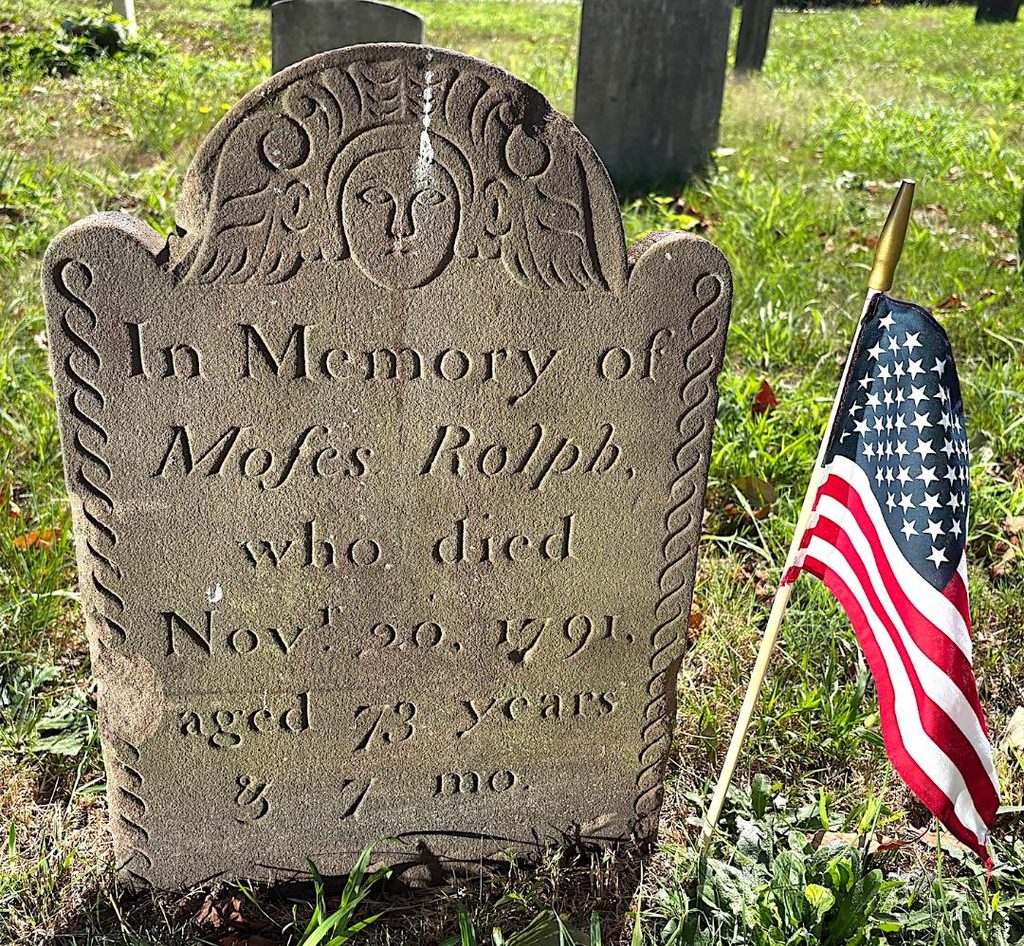
Moses’s wife, Phebe, died on January 7, 1775, per Josephine C. Frost’s compilation of cemetery inscriptions. Moses died in Huntington on November 20, 1791. Both are interred in the Old Burying Ground in Huntington, along with their daughters Hannah and Phebe, and their sons Reuben and David. Reuben’s son and Moses’s namesake, Moses Rolph, who was born in 1774 and died in 1838, was a judge in Huntington as well as town clerk. He is also interred in the Old Burying Ground as are many other Rolph family members, including his well-regarded son Reverend Jarvis Rogers Rolph (1813-1894). Jarvis Rogers Rolph served as justice of the peace for the town of Huntington for many years, was appointed one of four associate judges of Suffolk County, and was a presidential elector in 1832 and 1836.