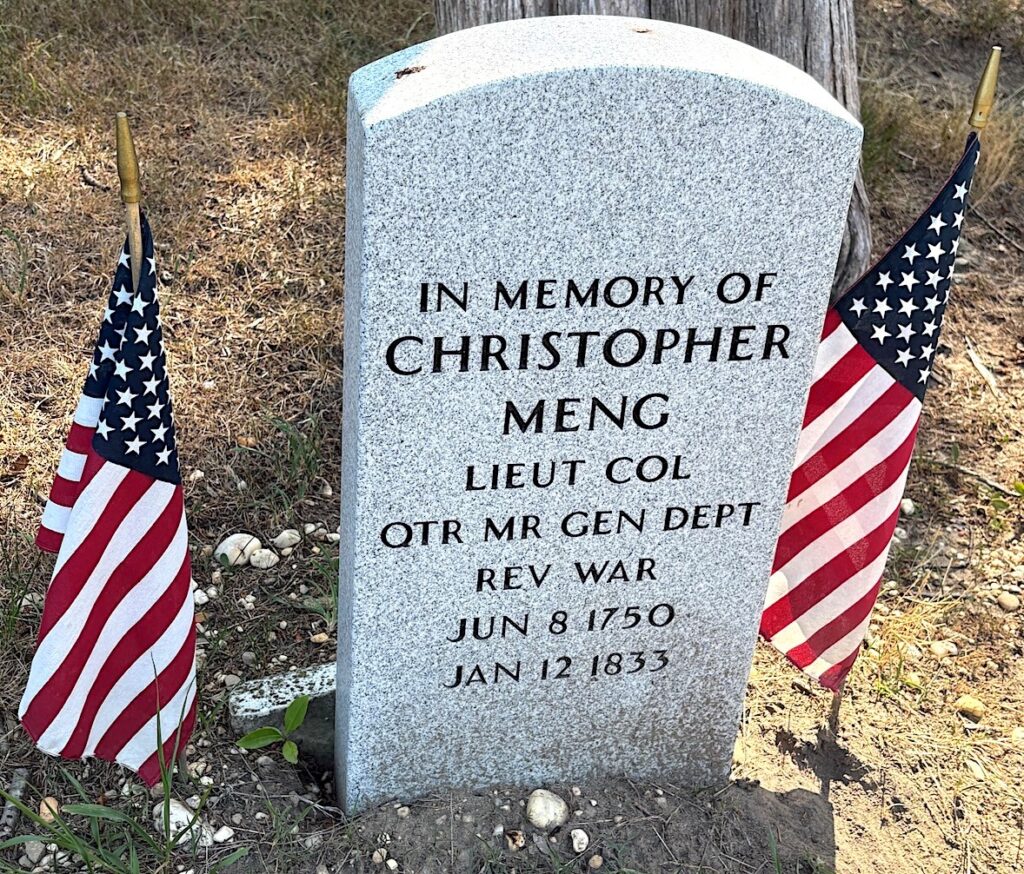

MENG, CHRISTOPHER (1750-1833). Lieutenant colonel, Continental Army. Born on June 8, 1750, and named John Christopher Meng per Family Search genealogical records, Christopher Meng was a native of Germantown, Pennsylvania. His father, Johann Melchior Meng, or Melchior “John” Meng, was born in 1726 in the city of Mannheim, Rhineland, Prussia, in what is now the state of Baden-Württemberg, Germany. His mother was Anna Maria Magdalena Colladay, born in 1731. The couple married about 1748 in a Quaker ceremony in Philadelphia, Pennsylvania, then British Colonial America. Christopher had a younger brother, Jacob Meng, who was born in Germantown on April 1, 1756. However, there may have been as many as six other siblings, as shown in Family Search records.
Christopher’s paternal grandfather, Johann “John” Christopher Meng, was born in 1697, in Mannheim, and was a burgher (a free municipal resident subject to municipal law rather than feudal tenure) and master mason. Christopher’s paternal grandmother was Anna Dorothea Baumann, born Baroness von Ebsten in 1723. The couple immigrated to Philadelphia and settled in Germantown. The records of the German Reformed Church in Germantown contain a certificate for these grandparents, signed and sealed by Samuel Michael Dorgahf, Preacher of the Reformation, in Mannheim, dated May 3, 1728, before their journey to America, certifying the good religious character of the couple. On August 24, 1728, Christopher Meng’s grandfather took the oath of allegiance upon arrival in Pennsylvania, following a 1727 law that ensured loyalty to King George II and was required of all adult males from non-British nations, as shown in the Colonial Records of Pennsylvania, Volume III (1852).
As written in “The Germantown Road and its Associations,” an article by Townsend Ward in The Pennsylvania Magazine of History and Biography (1882), Christopher was educated at the Germantown Academy, the oldest non-sectarian school in what became the United States, founded in 1759. It was Christopher’s grandfather, John Christopher Meng, who was responsible for its design and construction. Christopher’s mother died in Pennsylvania in 1764. A silhouette profile portrait of Christopher, dated 1768, has been preserved showing him “with his long pocketbook.”
Although Christopher’s father and brother were loyal to King George III, according to “The Germantown Road and its Associations,” the family was divided. A document from the United States Department of Veterans Affairs Claim for Standard Government Headstone or Marker indicates that Christopher Meng began his military service in the army on September 18, 1779, and was discharged in January 1782, serving at the rank of lieutenant colonel, assistant deputy quartermaster. The dates of Christopher’s military service differ in other records. According to information from “The Germantown Road and its Associations,” Christopher served in the Continental Army for seven years, initially with the Second Battalion of the Philadelphia Militia, and participated in the Battle of Brandywine in 1777. On September 18, 1779, he was commissioned assistant deputy quartermaster general of the army under General George Washington. At the battle of Yorktown, in 1781, he was the keeper there of the stores of both armies, those of the Continental Army and those surrendered by the British General Cornwallis.
After the British left Philadelphia, Christopher’s brother was arrested as a spy. As printed in Colonial Families of Philadelphia, Volume II (1911), edited by John W. Jordan, Christopher’s “brilliant record in the Continental army won sympathy and consideration for his accused father and brother, which lasted long after their acquittal.”
It is not known why Christopher moved to Huntington, Long Island, but his first wife, Sarah Williams, was born there in 1760 and the couple was married there in 1783. Sarah died in Huntington on August 26, 1787, at age 27. She was interred in the Old Burying Ground, near her parents, Nathaniel Williams, Jr. and Rachel Fleet Williams. According to Josephine Frost, in her “Cemetery Inscriptions from Huntington, Long Island, New York (1911)”, it appears that she was survived by their infant daughter, also Sarah Williams Meng, born in 1787, but little Sarah died on March 2, 1788, at 6 months of age. It appears that Christopher’s wife, Sarah, died during or soon after the birth of their daughter. There was also an older child, Henry Fleet Meng, born in 1784 or 1786, who only lived until 1789.
On May 24, 1792, Christopher married Charlotte Williams, the younger sister of his late wife, Sarah, in New York City, according to the New York City Compiled Marriage Index, 1600s-1800s. Charlotte was born in 1769 and died just a couple of years after this second marriage, on August 10, 1794, at age 26.
By the late 1700s, Christopher had established himself as a merchant in Huntington. The Huntington-Babylon town history, published by the Huntington Historical Society in 1937, reveals a bill of his to the town for the years 1785-1786 for materials that would have been bought to be made into clothing for the poor. As also related in the Huntington-Babylon town history, he contributed funds to help build the Huntington Academy, following in the tradition of his grandfather John Christopher Meng. He is listed as the first owner of the federal-style Doran House, on Wall Street in Huntington Village, not far from Main Street.
It appears that Christopher operated a tavern in Huntington in the late 1780s. A record in the Huntington Town Clerk’s archives from March 29, 1788, show that Christopher Meng was granted a license to sell liquor in Huntington for one year. A later record, found in Charles R. Street’s Huntington Town Records . . . 1776-1873, Volume III, dated February 26, 1789, lists Christopher as having renewed his liquor license. Christopher Meng is listed in “Estimate of Estates,” a Huntington property tax assessment document found in the Huntington Town Clerk’s archives.
Christopher’s father died at age 86 in Germantown, Pennsylvania on October 13, 1812, as shown in cemetery records there. The 1790 federal census shows Christopher, a widower, residing in Huntington. However, in 1795, Christopher married Jane Nichols in Huntington. She was a “companion” of the widowed Mrs. John Lloyd, who lived on East Street near the head of Huntington Harbor, in the central village area. Christopher was still living in Huntington when the 1800 federal census was recorded. The only other household member was a female over the age of 45, presumably this third wife, Jane. This was the same situation with the 1820 federal census, which also showed that Christopher was working in agriculture.
A United States Department of Veterans Affairs headstone/marker claim, filed by Wayne Haddock on February 15, 2024, and genealogical records for New York, 1675-1920, show that Christopher died on January 12, 1833, and is interred in Huntington’s Old Burying Ground. Jane, his third wife, died in 1846 and is also interred there. Both of Christopher’s children with his first wife predeceased him, and he had no children with his second or third wives. The Sons and Daughters of the American Revolution marked his grave as one of a Revolutionary soldier “worthy of mention,” as written in the April 8, 1921 Long-Islander newspaper.