By Barbara LaMonica
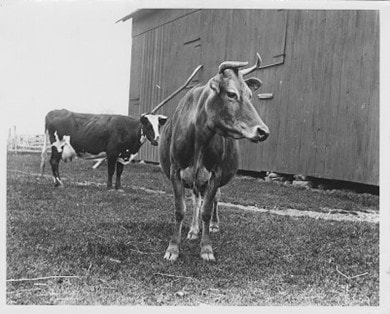
Once upon a time there were over 70 commercial dairy farms in the Town of Huntington. In the early years, when Huntington was an agrarian community, people relied on locally produced goods. Many grew their own food, or patronized local retail shops like butchers, bakers and produce stores-all selling local products. During the 19th century as the town population grew, a larger market for fresh produce developed and farmers began to specialize in certain crops. Many farmers started to raise more dairy cows to meet the increasing demand for fresh milk. Milk would be delivered by horse and wagon. Customers would bring out their own crocks and the milk was ladled out of metal cans in the back of the wagon. By the late 1800s dairies began to bottle their own milk with the name of the town and dairy embossed on the bottle. These early milk bottles used metal caps similar to Ball canning jars, others used a paper cap to seal the bottle.
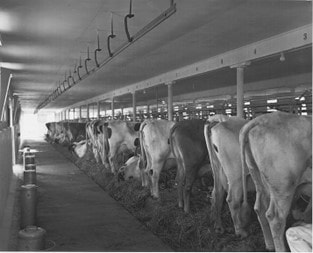
Some of the earliest dairies were the Frank E. Armstrong Dairy on Woolsey Avenue in Huntington (1890) and the Merrit Dairy in Centerport (1892). Early dairies in Cold Spring Harbor included the Eugene Model Dairy (1911) and McKowen Brothers (1914).
For the most part local dairies were small with only about 10-15 cows. However, there were some much larger operations. On Park Avenue the two large dairies were the Brush Dairy at 575 Park Avenue (1911) and the Swezey Brothers, also know as the Park Avenue Diary, at 471 Park Avenue, (1911). Both of these dairies had over 50 cows. By the 1940s the Brush Dairy had 10 delivery trucks and produced 3,989 quarts of milk per day and had 1,612 customers. The Swezey Brothers sold approximately 1,400 bottles of milk daily. Their customers included Huntington Hospital, Huntington Yacht Club, and the Huntington Fire Department. As an interesting aside many of the local estates had their own dairies, including Marshall Field (Caumsett) and Oheka. They provided milk for their workers, and sometimes sold excess milk to other local dairies.
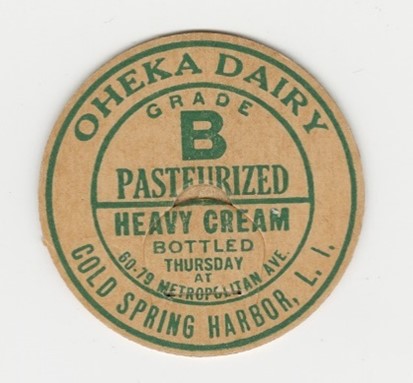
By the 1970s most of the local dairies had closed. There were many factors which led to their decline. Primarily was the growth of suburbia, the development of industry, and the introduction of supermarkets.
After WWII Long Island saw an increase in population. Farmland was often sold off to accommodate housing and industrial development. It became more difficult for the dairy farmers to find help to meet the increasing demand since many workers gravitated toward manufacturing jobs.
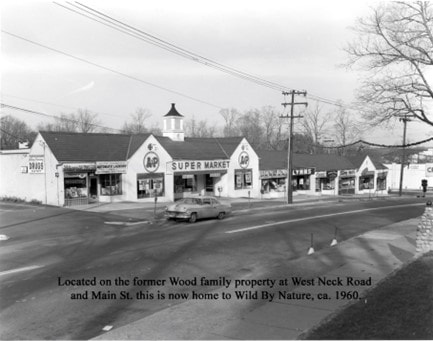
Long Island’s King Kullen is designated as America’s first supermarket (although it has been contested that Piggly Wiggly in Tennessee came before). Customers were attracted to markets because of self-service, all products conveniently in one place, and most importantly the markets could undersell local producers by dealing with large dairy companies such as Bordens.
Another blow came to the local dairies when the Department Health mandated all milk be pasteurized. Many smaller dairies could not afford the equipment to meet this requirement. Finally, the famers could not afford the wages demanded by milk delivery drivers during the milk strikes of the 1960s and 70s.
If you have any memories of these local dairies feel free to share with us!