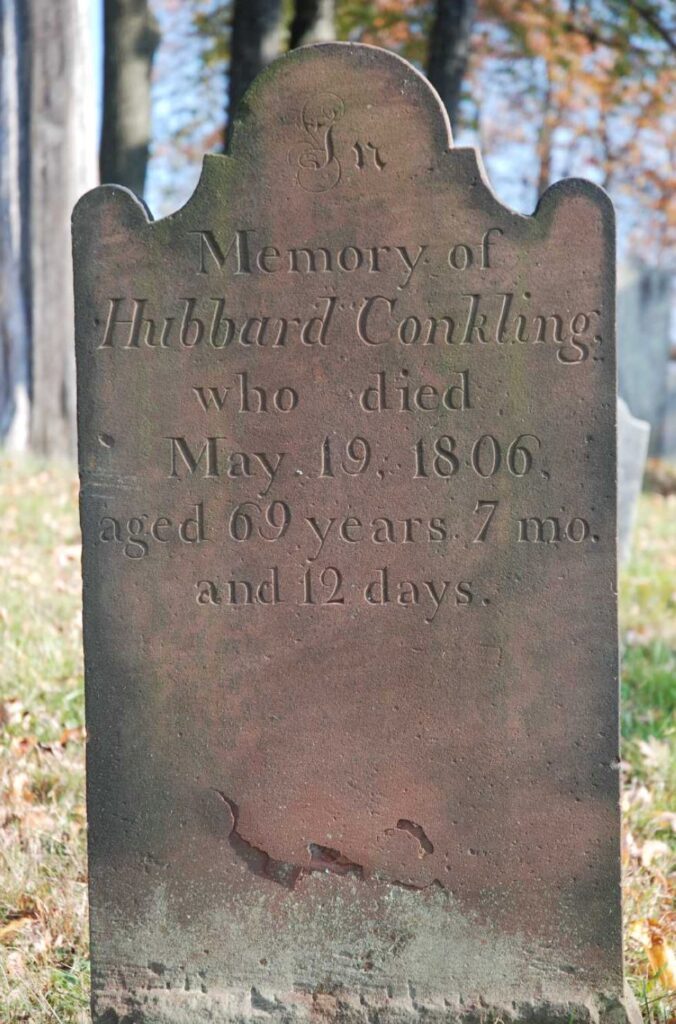
CONKLING (or CONKLIN), HUBBARD (1736-1806). Associator, Town of Huntington. Hubbard’s surname is spelled as Conkling on his gravestone and on his descendant’s application to the Sons of the American Revolution (SAR) but numerous sites and his soldier history have the surname as Conklin. As per the Find A Grave website, Hubbard was born in Huntington, New York on October 7, 1736, to Thomas and Abiah Hubbard Conklin (spelled without the g). Find A Grave lists his siblings as: Thomas (a major), Timothy, Rebecca, Ezekiel, Abiah and David.
As per the Sons of the American Revolution application of Edwin Garfield Reynolds, a great-great-great grandson of Hubbard (Hubbart) through his daughter, Naomi Vandewater, Conkling was an “associator” who signed the Association Test in the town of Huntington during the American Revolution as stated in the “Callendar of Historical Manuscripts, N.Y., Vol. I, page 51.” The Patriot Research System details that his qualifying patriotic service was that he “Signed Oath of Association.”
As a signer of the Huntington’s 1775 Articles of Association (an associator), Hubbard Conkling demonstrated that he was a patriot. On May 8, 1775, 403 men, most of them Huntington residents (a few were from Islip), “shocked by the bloody Scene” that had occurred just weeks before at Lexington and Concord in Massachusetts, where patriot Minutemen and British regulars had engaged in a bloody armed struggle, put their signatures on Huntington’s Articles of Association. Only 37 Huntington residents, either Loyalists or those wanting to stay out of the fray, refused to sign. The Articles noted that the signers affirmed their “Love to our Country,” agreed “to whatever Measures may be recommended by the Continental Congress; or resolved upon by our Provincial Convention, for the Purpose of preserving our Constitution, and opposition to the Execution of the several arbitrary, and oppressive Acts of the British Parliament,” and prayed for “a Reconciliation between Great-Britain and America.” The actions of these associators were seen by both patriots and the British as a step towards rebellion. The fact that these men signed these Articles, placing themselves in danger of British retaliation, including imprisonment, seizure of their property, and exile from Long Island, is proof of their patriotic service.
Robert C. Hughes, Huntington Town Historian, in a posting on Huntington History on June 21, 2024, explains Huntington’s Declaration of Rights, issued on June 21, 1774, in response the Boston Port Act of 1774. Hughes writes that Huntingtonians were in complete support of Bostonians in their belief that the common cause of the colonies was to fight taxation without representation, declaring “that our brethren in Boston are now suffering in the common cause of British America.” On June 21, 1774, the Huntington Declaration of Rights vowed that “every freeman (sic) property is absolutely his own, and no man has a right to take it from him without his consent, expressed by himself or his representatives.” That statement affirmed that without representation in Parliament, the colonies could not be taxed by that body, a long-held view of the people of Huntington dating to 1670. The views expressed in Huntington’s Declaration of Rights were consistent with those adopted by the First Continental Congress which met from September 5 through October 26, 1774. Hughes goes on to say that in May 1775, after the Battles of Lexington and Concord, Huntingtonians voted “that there should be eighty men chosen to Exercise and be ready to march.” Hughes comments that it is believed that the Declaration of Rights was written by John Sloss Hobart, Lord of the Manor of Eaton, who had legal training and later served as a representative to the New York Provincial Congress and was a United States senator and a judge after the Revolutionary War. The Declaration supporting the people of Boston states, “That therefore all taxes and duties imposed on His Majesties subjects in the American colonies by the authority of Parliament are wholly unconstitutional and a plain violation of the most essential rights of British subjects.”
At the Battle of Long Island (also known as the Battle of Brooklyn) on August 27, 1776, the American forces suffered a humiliating defeat and Long Island was occupied, within days, by the British. Huntington became a headquarters for British forces and a supply depot. Its residents were forced to take an oath of allegiance to the Crown, their property was seized and many had to do labor for the British, including Hubbard Conkling. As per the Huntington Town Clerk’s Archives Manuscript Collection, Colonel Benjamin Thomson ordered Huntington carpenters to arrive and work on Fort Golgotha as of November 26, 1782. Thomson was a Loyalist colonel, a spy for the British and a commander of the King’s Dragoons. Captain Philip Conkline signed the hand-written order demanding that those named report to work every morning on the fort in town bringing their tools to the site and not leaving until ordered to do so; Hubbard Conkline (sic) was the first name on the list of those ordered to report. Fort Golgotha, one of several British fortifications on Long Island, was built on the site of the Old Burial Ground using timber from the nearby Old First Presbyterian Church. After the British withdrew in 1783, the fort was dismantled, the burial ground restored, and the church rebuilt.
The Huntington Town Clerk’s Archives list Hubbard Conkling’s name on several documents. According to a document in the Huntington Town Archives, Hubbard Conkling was among several locals who were paid by the town “for the poor”—an apparent reference to him having taken in a poor person, offering shelter. Another Town Archives document shows that Conkling submitted a bill in November 1783 for three days work on the town house, including his labor and the purchase of two cords of wood; although the total for the work is smudged, it looks like he asked for a little more than 3 pounds. Another archived hand-written document lists Hubbard Conkling and David Reses “Chosen by ye trustees” of the Town of Huntington to appraise items and notes that the bells from the meeting house (now the Old First Church) that were taken by the British, one was valued at 400 pounds and another at 75 pounds. In 1782, Hubbard is listed as owning 12 Woodlands; he is among many Huntingtonians named on that document in Captain Philip Conkling’s district. Woodlands were very important—and became a source of anger/dispute during the occupation of the town by the British. In a farm community, woodlands allowed a farmer to heat his home, cook on a wood fire, and add to his income by selling his wood. Throughout the war, the residents complained about abuse of their woodlands—loyalists stealing their wood, British demanding it for promised payment that never came, etc. Another archival document lists reimbursements to residents of Huntington in 1783; Hubbard Conkling is listed.
On February 10, 1782, Hubbard Conklin married Mary Wood at Huntington. As per Cemetery Inscriptions from Huntington, Long Island, New York, copied by Josephine G. Frost in August 1911, Hubbard and his wife, Mary, lost three of their children: Gilbert Conkling (September 19, 1776) age 9 years, ? months, 17 days; Hubbard Conkling (July 8, 1779) 8 months, 17 days; and daughter, Experience Conkling (October 29, 1781), in her 20th year. Find A Grave names daughters Charlotte (1765-1810) and Naomi (1784-1830); the family tree on Ancestry.com, which has both spellings of his surname, lists son Buel (1770-1822), but not daughter Naomi.
Mary Wood Conkling, Hubbard’s first wife, died on October 29, 1786 at the age of 46. The biography on his Find A Grave webpage notes that Hubbard’s second wife was Rebecca née Titus, the widow of Richard Conklin (see); Hubbard and Rebecca married on January 7, 1789. After Rebecca’s death, he married Sybel née Mead (or Sibbel) on October 7, 1793; he was widowed again after her death on September 1, 1805.
Hubbard died on May 19, 1806, and was interred at the Old Burying Ground in Huntington; Find A Grave notes the burial place as the Old Burial Hill Cemetery. The Burial Index, referred to above, names Old Huntington Cemetery as his final resting place.