SMITH, HENRY (1728-1802). Associator, Huntington Articles of Association, 1775. Born in Huntington, New York Colony, on February 3, 1728 (although some records show 1729), Henry Smith was the son of Zachariah Smith and Huldah Hand. As listed in “Long Island Surnames,” the database archives of Long Island Genealogy, Zachariah Smith was also born in Huntington, about 1693, and his wife was born in East Guilford, Connecticut, about 1697. They married about 1717 in Guilford. The Smith family was established in North America by Richard Smith/Smythe (died 1691/1693), a Quaker, who immigrated from England to Southampton, Long Island. He was one of the founders of Smithtown, Long Island, in 1665.
Information posted on Ancestry.com indicates that Henry had seven siblings: William (1718-?), Zachariah (1720-1758), John Howard (1721-1761), Sarah (born and died 1722), Thomas (1727-1772), Mary (1727-?), and James (1734-1783.) Henry’s father died about 1737 in Huntington.
As depicted in “New York, Marriages, 1686-1980,” Henry married Mary Chichester on February 23, 1751, in the First Church, Huntington, although 1752 has also been listed by some sources as the year of their marriage. Mary was born in 1730 in Huntington, to Abraham and Elizabeth Chichester. According to information from FamilySearch and “Long Island Surnames,” Henry and Mary were the parents of at least ten children, including seven sons and, possibly, four daughters, although cemetery and other records are imprecise as to some of the dates: Henry (1751/52 or 1761-1846), Zachariah (1753-1829), Esther (1755-1847), Sarah (born 1757), Rebecca (1759-1792), Silas (1762-1773), Jerusha (born 1764), Epenetus (1766-1830), and Eliphalet (1773-1849.) All the children were born in Huntington, with the possible exception of their first-born, Henry, who may have been born in Islip, Suffolk County, rather than in Huntington. Mary died on September 25, 1772, in Huntington, at the age of 42.
According to FamilySearch records, Henry married Anna Wickes on April 13, 1773, in Huntington. Born in 1755 in Suffolk County, Anna was the daughter of Elifelet Wickes. She and Henry had a son named Enoch (1776-1858) and, per Family Search, may have had at least one other son. Anna died on September 22, 1778, at the age of 23.
Although it does not appear that Henry served in an active military role during the Revolutionary War, he did express his patriotism by signing Huntington’s Articles of Association on May 8, 1775, as shown in The Calendar of Historical Manuscripts Relating to the War of the Revolution, in the Office of the Secretary of State, Albany N.Y., Vol. I (1868) and “Long Island Surnames.” Information from Sons of the American Revolution indicates that Henry’s qualifying service as a patriot was as a signer of these Articles, in which he pledged allegiance to the Continental Congress. On May 8, 1775, 403 men, most of them Huntington residents (a few were from Islip), “shocked by the bloody Scene” that had occurred just weeks before at Lexington and Concord in Massachusetts, where patriot Minutemen and British regulars had engaged in a bloody armed struggle, put their signatures on Huntington’s Articles of Association. Only 37 Huntington residents, either Loyalists or those wanting to stay out of the fray, refused to sign. The Articles noted that the signers affirmed their “Love to our Country,” agreed “to whatever Measures may be recommended by the Continental Congress; or resolved upon by our Provincial Convention, for the Purpose of preserving our Constitution, and opposition to the Execution of the several arbitrary, and oppressive Acts of the British Parliament,” and prayed for “a Reconciliation between Great-Britain and America.” The actions of these associators were seen by both patriots and the British as a step towards rebellion. The fact that these men signed these Articles, placing themselves in danger of British retaliation, including imprisonment, seizure of their property, and exile from Long Island, is proof of their patriotic service.
Huntington Town Records also report that, on October 6, 1776, two horses, “said to be worth 40 pounds,” were taken from Henry by two men under orders of a British Colonel Birch or Burch of the 17th Light Dragoons. On that same date, “One Pair of Fatt Oxen” were also stolen from him on the colonel’s order. As the British occupation continued, Henry signed the Oath of Loyalty and Peaceful Behavior to the British Crown in 1778, as did almost all of Huntington’s heads of households, under threat of losing their homes and other property, and becoming refugees, as chronicled in Charles R. Street’s compilation, Huntington Town Records, including Babylon, Long Island, New York 1776-1873, Volume III (1889.)
Huntington Town Records also reports that Henry was selected to serve as one of the overseers of the poor at a town meeting on May 4, 1779. In October of 1780, the British Forage Master of Suffolk County seized “Four Hundred Weight of English Hay.” In 1782, at around the end of the Revolutionary War, these records also show that his property was assessed at £222, at the high end of local values. An excerpt from these records indicates that, in 1783, Henry was an inhabitant of Huntington.
A widower since 1778, Henry married for a third time, in May 1785. His wife, Jemima Smith, was the daughter of Othniel Smith and Deliverence Longbothan. Othniel Smith was a descendent of Richard Smith, per longislandgenealogy.com/bulls.html.
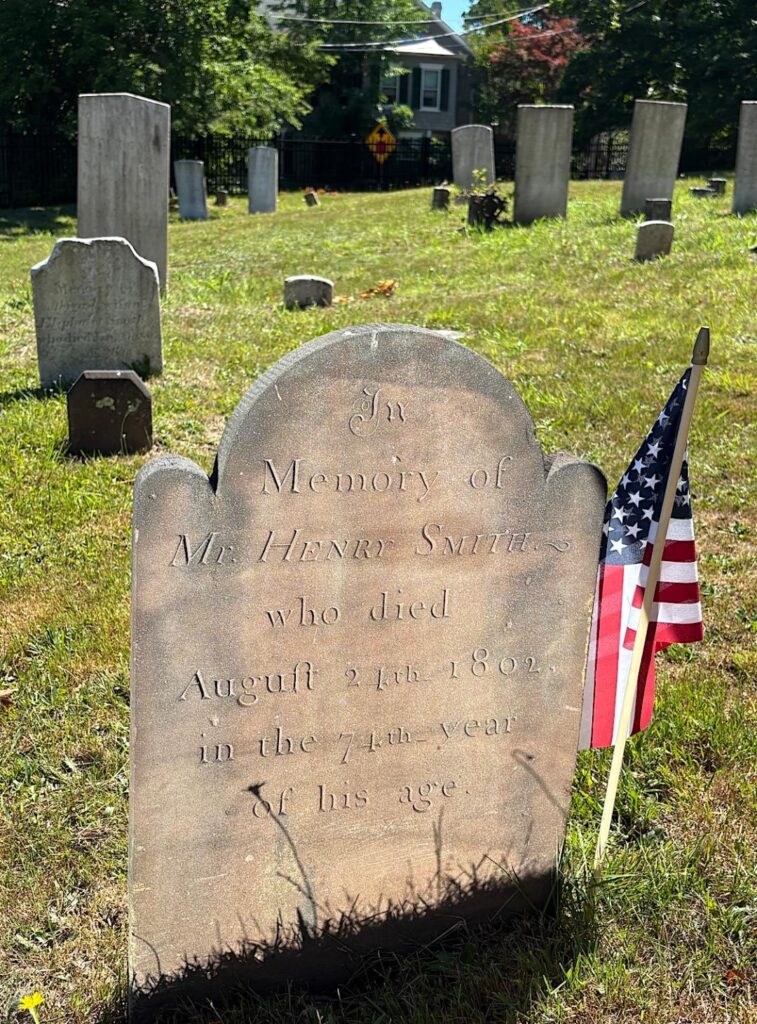
The 1790 United States federal census specifies that there were six people residing in Henry Smith’s house in Huntington that year: four free white females, one free white male over the age of 16, and one white male under 16. Genealogical records document Jemima’s death as “sometime before 1792.” Henry died in Huntington and his headstone, in Huntington’s Old Burying Grounds, records the date of his death as August 24, 1802.