POTTER, GILBERT (1725-1786). Lieutenant colonel, Suffolk County Militia. As per Huntington Town Records, Volume 3, footnote, Dr. Gilbert Potter was born in Huntington on January 8, 1725, to Nathaniel Potter, a native of Rhode Island. The Find A Grave website posting notes that his mother’s name was Martha.
Gilbert married Elizabeth Williams (1728-1811) (see), whose father, like her husband’s, was also named Nathaniel (see). Their marriage took place on February 23, 1748, at the First Church in Huntington. The marriage is also recorded on the Geneanet Community Trees Index website. As per Find A Grave, the Potters children were: Peleg (1750-1751); Peleg (died 1764); Sarah (1756-1823) who married William Rogers (see); Elizabeth (1757-1759); Seraphena (Seraphina) (1762-1782), and Martha (1764-1813). Not mentioned on Find A Grave is Nathaniel (1761-1841).
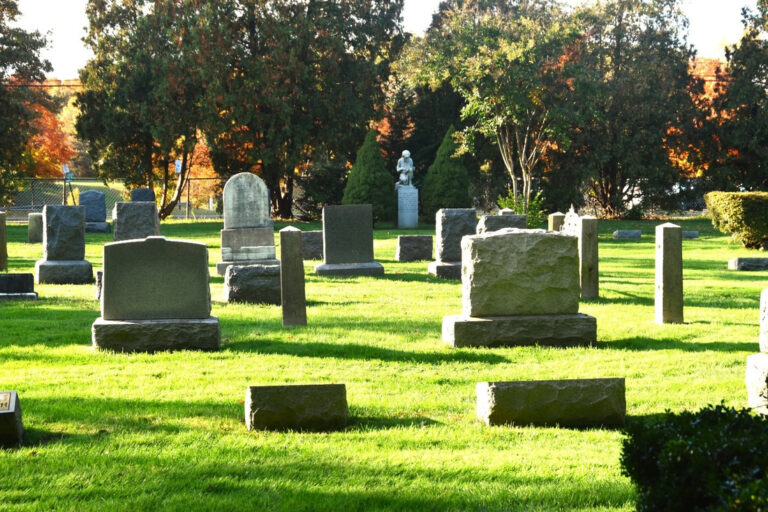
Gilbert’s life as a physician and patriot is remarkable. A Newsday article (Melville edition), written by Bob Pfeifle and published on December 18, 1948 headlined, “Romantic Past Lives in Old Granite,” notes that Dr. Potter studied medicine with Dr. Jared Elliott of Guilford, Connecticut and was one of Suffolk County’s first doctors. That article is posted on his Find A Grave page and recounts the story behind the weather-beaten gravestones of Gilbert, Elizabeth and Nathaniel Potter (see) in Huntington’s Old Burying Ground.
Serving in both the French and Indian War and in the American Revolution, Pfeifle and other sources report that he sailed as a surgeon on a privateer in 1745. A captain in the former war, he was stationed at Fort Ticonderoga. Frederic G. Mather, in his scholarly text, The Refugees of 1776 from Long Island to Connecticut (1913), reports that he was a captain of a Suffolk County company at that site. Mather adds that in July 1758, many troops on their way to Frontenac (Canada), became sickly and Potter headed the Medical Department at a hospital set up in Schenectady, New York.
Returning to Huntington at the conclusion of the French and the Indian War, Potter practiced medicine there until the outbreak of the Revolutionary War. Liva Weil, in her Newsday article of November 25, 1957, entitled “Her Weapons Were Kindness and Good Manners,” which primarily focused on Gilbert’s wife Elizabeth, Weil noted that in 1771, Dr. Potter, a noted surgeon, turned his home in Cold Spring Harbor into a hospital to isolate smallpox victims during an epidemic. As per the Huntington history website, Potter and another Huntington doctor, Daniel Wiggins, were chosen in February of that year to provide smallpox inoculations (the vaccine was not produced until 1796) and a quarantine hospital.
A patriot who strongly supported American independence, Gilbert was a signatory to the Articles of Association in Huntington and sided with the Patriots during the American Revolution. On May 8, 1775, 403 men, most of them Huntington residents (a few were from Islip), “shocked by the bloody Scene” that had occurred just weeks before at Lexington and Concord in Massachusetts, where patriot Minutemen and British regulars had engaged in a bloody armed struggle, put their signatures on Huntington’s Articles of Association. Only 37 Huntington residents, either Loyalists or those wanting to stay out of the fray, refused to sign. The Articles noted that the signers affirmed their “Love to our Country,” agreed “to whatever Measures may be recommended by the Continental Congress; or resolved upon by our Provincial Convention, for the Purpose of preserving our Constitution, and opposition to the Execution of the several arbitrary, and oppressive Acts of the British Parliament,” and prayed for “a Reconciliation between Great-Britain and America.” The actions of these associators were seen by both patriots and the British as a step towards rebellion. The fact that these men signed these Articles, placing themselves in danger of British retaliation, including imprisonment, seizure of their property, and exile from Long Island, is proof of their patriotic service.
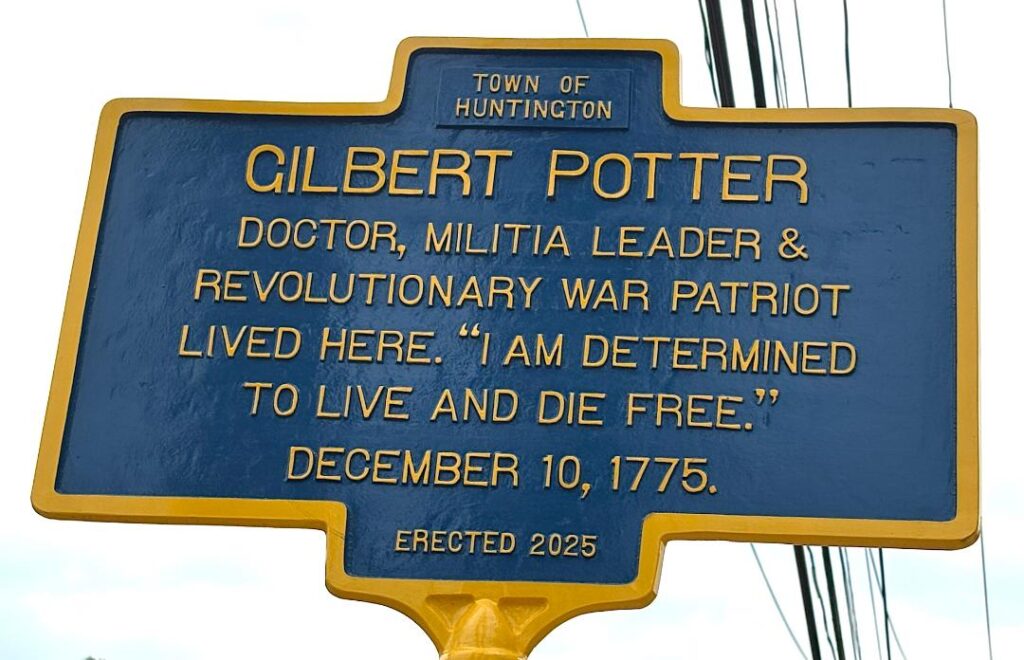
Frederic G. Mather notes that Dr. Potter was a member of the Committee of Huntington, the Committee of the 1st Regiment and the Sons of Liberty, all rebel organizations. Henry Onderdonk Jr., in Revolutionary Incidents of Suffolk and Kings Counties: with an Account of The Battle of Long Island (1849), states Potter was among those nominated for field officer in the Western Regiment of Suffolk County at a meeting in Smithtown on September 5, 1775. As per Huntington Town Records, on December 10, 1775, Potter wrote to a fellow patriot, complaining that patriots had “a slackness in military preparation” and that military forces were needed to intimidate and subdue the loyalists of Queens County. Onderdonk adds that Potter requested help on December 10, 1775, to make the town (Queens) ready to defend itself; he added that he was “determined to live and die free.” Potter was troubled that there were many loyalists in Queens County and that they were undermining the patriot cause. Five days later, another letter reported that 710 able-bodied men had enlisted as minutemen and needed powder, balls, guns, drums and colors.
Weil, in the aforementioned Newsday article, noted that Potter joined the patriot militia when the Declaration of Independence was read in Huntington on July 22, 1776, and served as a lieutenant colonel of the Western Regiment of Suffolk County, also called Colonel Floyd’s Regiment. The Huntington history website elaborates that when the Declaration was read that day, Huntington citizens burned an effigy of King George III on the Town Common and celebrated in Platt’s Tavern with 13 patriotic toasts. Gilbert quoted this poetic summary of the patriot cause:
Rudely forced to drink tea, Massachusetts in anger,
Spills the Tea on John Bull; John falls on to bang her,
Massachusetts, enraged, calls her neighbors to aid,
And give Master John, a severe bastinade.
Now good men of the law pray, who is in fault,
The one who began, or resents the assault?
On August 24, 1776, just before the Battle of Long Island (Battle of Brooklyn), Mather reports that Potter was asked to lead his militiamen in securing the local livestock from the British and drive the herd to the east. However, on page 590, Onderdonk includes the letter from Potter below.
In his role as lieutenant colonel of militia, Dr. Potter tried to protect the local patriots from the British and their loyalists. On August 26, 1776, the day before the momentous Battle of Long Island, Dr. Potter wrote to patriot General Nathaniel Woodhull from Huntington, noting that the British, in an apparent effort to give the Suffolk Militiamen second thoughts about joining the imminent battle to the west, in Brooklyn and Queens, had landed to the east of Huntington:
I had not arrived at my house from Jamaica half an hour, before I received information by express from Capt. Thompson of Brookhaven, that two ships, one brig and three tenders had landed a number of regular troops between Old Man’s and Wading Rivers, who at one o’clock were shooting cattle . . . . I expect them in our bay before morning, the only harbor in the Sound: I have not ordered any men from here as yet, but am mustering them to make as good opposition as possible. We must have help here; every thing possible for me shall be done. I think Gen. Washington should be acquainted. Our women are in great tumult.
In great haste, Yours,
Gilbert Potter
When Huntington and much of Long Island were occupied by the British after their victory at the Battle of Long Island on August 27, 1776, Potter quickly fled to patriot-held Connecticut while his wife, Elizabeth, remained in Huntington, keeping an eye on their affairs and running his medical practice. The North America, Family Histories, 1500-2000, states indicates that Elizabeth took over his medical practice, and also served as a nurse at a hospital for wounded soldiers.
After the humiliating defeat of General George Washington’s patriot forces at the Battle of Long Island on August 27, 1776, Potter refused to sign the Oath of Allegiance to the Crown, unlike many Huntington residents and associators. Mather and others note that Elizabeth carried on his medical practice and his affairs until Gilbert returned to Huntington at the end of the war. She was sometimes referred to as Dr. Elizabeth Potter, the first woman physician in Huntington. Lora Horton Higgins in “Seven Years in Exile: The Long Island Refugees,” reports that Dr. Gilbert Potter was a surgeon in Washington’s Army and practiced medicine in New Haven, Connecticut during his exile there. According to Mather, after the British occupied Long Island, Dr. Potter fled to Connecticut, “retired within the American lines (page 173); and was employed in confidential, rather than active, service.” A document in the New York State Library lists Dr. Gilbert Potter of Huntington as one of the “40 Physicians and Surgeons who were in the Hospital Service.” In 1783, after the war, Dr. Potter returned to his medical practice in Huntington.
Two applications to the Sons of the American Revolution were approved for Gilbert’s descendants, based on his patriotic service. In 1920, Robert Woodhull Walker, a great-great-great-great-grandson, stated that Gilbert was a lieutenant colonel who defended Long Island; Walker was also cited in the Daughters of the American Revolution database. As per the application to the Sons of the American Revolution, which is noted on Potter’s Find A Grave website, of a descendant and great-great-great-grandson, Gilbert Williams Griffiths, dated and approved in 1938, Dr. Potter “acted as a spy for Washington, was a refugee from Long Island to Connecticut, was Lt. Col. Of Western Regiment Suffolk County New York Militia and led the troops at Jamaica at the Battle of Long Island.” Griffiths was also a member of The National Society of Children of the American Revolution, Washington, D.C. As per Dr. Potter’s Find A Grave page, the Colonel Gilbert Potter Chapter of the Daughters of the American Revolution was established in Amityville, Suffolk County, on October 10, 1957. It states that Dr. Potter “safeguarded Long Island’s livestock and served in the underground network that kept Gen. Geo Washington informed of enemy activities.” The Revolutionary War Burial Index describes his service as being in the Dutchess County Minutemen, New York, and confirms his interment in Huntington’s Old Burying Ground.
Wendy Polhemus-Annibell, the head librarian of the Suffolk County Historical Society, in “Brief Biography of Some of the Huntington Patriots,” dated April 3, 2024, notes that Nathaniel, only 15 during the war, spent part of his time with his father in Connecticut. While there, with his father’s help, he outfitted a privateer ship at Greenport, and captured several British ships. She also notes that Gilbert was an associate to patriot General Nathaniel Woodhull prior to the Battle of Long Island in command of about 100 Huntington troops. Woodhull was captured (and later died from his wounds on September 20, 1776). Gilbert retreated, fled to Connecticut and was assigned to confidential service, possibly espionage. He was also in the hospital service.
The Huntington Town Records of 1785 indicate that Fort Golgotha, which was built late in the British occupation, was demolished and Dr. Potter was among five men who purchased timber and boards from the demolition at a public auction for ₤18,18s.
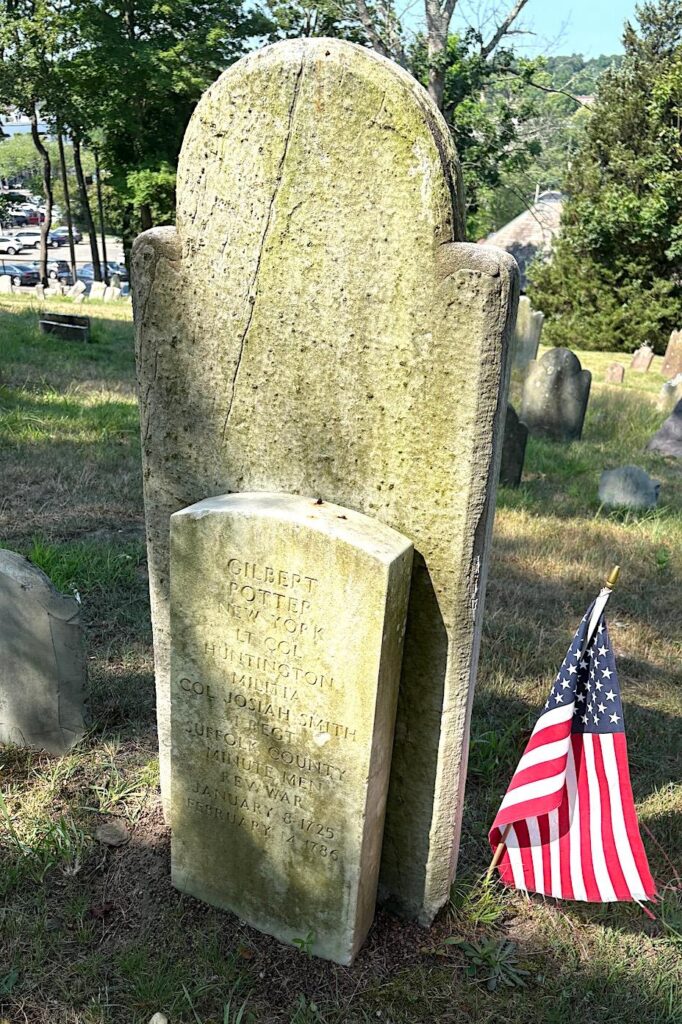
Potter died on February 14, 1786. As per Josephine Frost, in Cemetery Inscriptions from Huntington, Long Island, 1911, his original stone read, “Col. Gilbert Potter, M.D., died Feb. 14, 1786, Age 61 years.” On August 2, 1973, Rufus B. Langhans, Huntington Town Historian, applied for a Department of Veterans Affairs upright marble headstone with no emblem, citing Potter’s service as lieutenant colonel of Suffolk County’s 1st Regiment of Minutemen under Colonel Josiah Smith. Written in red ink on the application “Document in Disch NY State File.” That gravestone is inscribed, “New York, Lt Col, Huntington Militia, Col Josiah Smith, 1 Regt, Suffolk County, Minutemen, Rev War.” There are DAR bronze tablets for Gilbert and Elizabeth next to their original side-by-side headstones, placed by the Amityville chapter on October 5, 2019. At that ceremony, much of the biographical information outlined in this sketch was noted.
Gilbert Potter’s will was probated on August 4, 1784 in New York City. Named in it were his wife, daughters Sarah and Martha, son Nathaniel, and friends, Thomas Brush and William Haviland. A plaque honoring Gilbert Potter stood on Wall Street where he lived and honors him as a Revolutionary Patriot and was recently replaced by a new one. On May 1, 2026, the Town of Huntington unveiled a new marker honoring Dr. Potter as part of the 250th celebration of America. Town Historian Robert Hughes spoke at the ceremony and introduced the current residents to the sacrifices of Gilbert and his wife, noting that Dr. Potter was a healer, military leader and patriot who was determined “to live and die free.” The dedication ceremonies were televised locally.