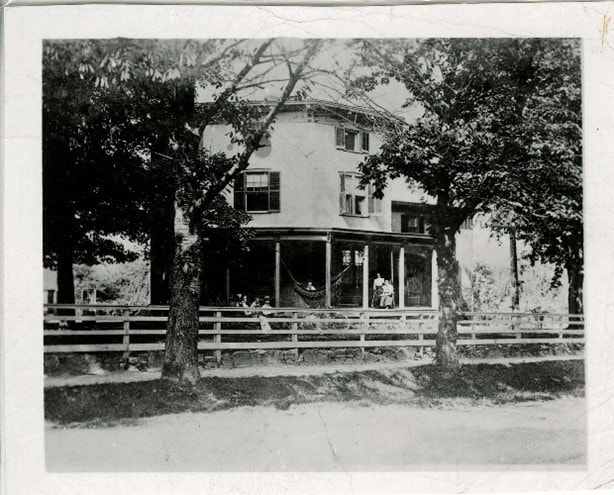
By Barbara LaMonica, Assistant Archivist
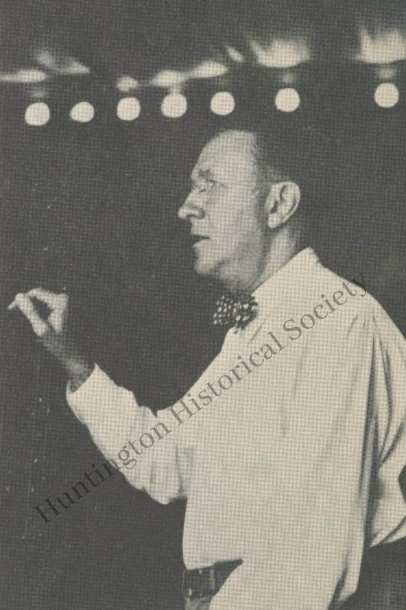
The Huntington Historical Society’s Archives holds the papers of many former Huntington residents. One of our most accomplished residents was an inventor named Fred Waller. Perhaps not a household name, Waller nevertheless was responsible for over 50 patents, including patents for water skis, the Waller Gunnery Trainer and Cinerama.
Fred Waller was born in Brooklyn in 1886, and died in Huntington in 1954. His father was one of the first commercial photographers in New York City. At the age of 19, he joined his father’s photography business as vice president, a position he held until 1917, when he became vice president of Rotograph a company that produced post cards. Eventually he opened his own illustrating studio producing photographic title illustrations for silent movies, exclusively for the Famous Players Lasky, (which later became Paramount Pictures Corporation).
Huntington Historical Society
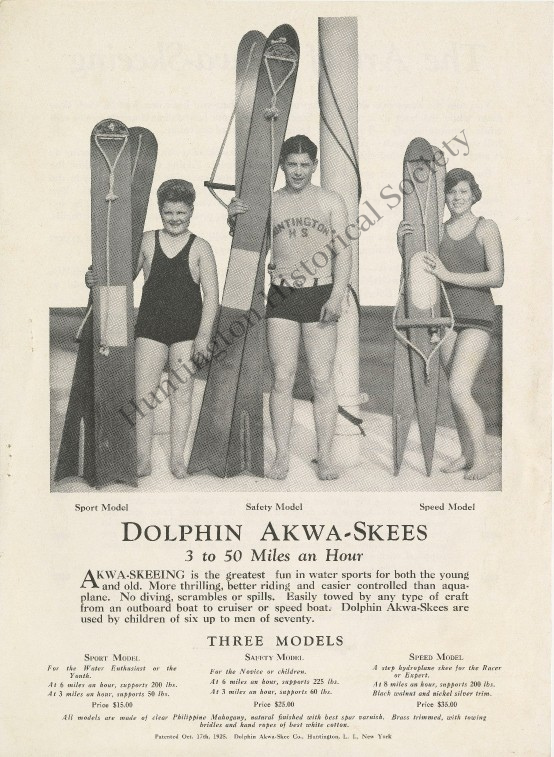
Eventually Waller became head of Paramount Studios special effects department, specializing in trick and miniature photography. When Paramount temporarily closed their eastern studio, Waller became partners in a sales agency for motor boats and equipment. He was the first to patent water skis. However, he did not invent the concept of using boards to ski on water. This was actually first tried in 1922 by Ralph Samuelson, who due to a back injury, had to give up the skis. He never patented or took credit for them. Waller improved upon the design and tested them himself. He organized the Dolphin Akwa Skee Company of Huntington to market water skis in three models.
Waller Collection, Huntington Historical Society
He returned to Paramount in 1929 and left in 1936 to begin work on special features for the New York World’s Fair. He created special motion pictures projected on the interior of the Perisphere, an enormous modernistic structure that served as the central theme of the fair. He built his first model for the Cinerama process but it was considered too expensive and radical at the time. During this period, he bought the Kenyon Instrument Company of Boston and relocated it to Huntington as the Kenyon Instrument Company. The new company produced nautical and aircraft instruments.
During WWII, he developed the Waller Gunnery Trainer, a simulator utilizing multiple cameras projecting pictures of moving planes onto a conclave screen. This resulted in producing realistic aerial battle situations, thus showing gunners how to hit them. The U.S. Air Force, Navy and the British Admiralty used the trainer, which is credited with saving over 350,000 lives during combat.
After the war, he set up a research laboratory in Huntington to continue the development of the Cinerama process.
“If Cinerama has an actual birth-date it would be sometime in the middle of the 1930’s when as head of Paramount’s special effects department, I became aware that motion picture scenes that had been shot with an extremely wide angle lens seemed to convey a heightened sense of realism…. It was this that gave me my first hunch that the way to recreate reality on the screen was to extend the visual frame of reference to include “peripheral” sight, or what we normally see out of the corners of our eyes.”
“Cinerama Comes of Age”
by Fred Waller
Waller Collection, Huntington Historical Society
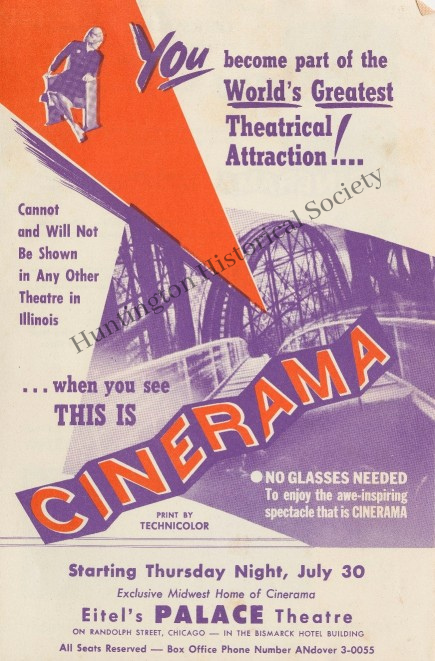
Essentially the process Waller created called for three 35 mm cameras equipped with 27mm lenses. Each camera photographed one-third of the picture in a crisscross pattern. The film was projected from three projection booths onto a large curved screen. The process attracted Lowell Thomas who organized a corporation to further market Cinerama. Louis B. Mayer was Chairman, Thomas was Vice President and Waller was Chairman of the Board.
On September 30, 1952, This is Cinerama opened in New York City to a capacity crowd. The film opened with a breathtaking rollercoaster ride, and critics lauded the production, seeing it as an alternative to the rising popularity of television. The Wonderful World of the Brothers Grimm and How the West Was Won were two of the first features to be shot in Cinerama. However, it soon became obvious that the Cinerama process was too cumbersome to shoot with three cameras mounted on one crane, and the need for three projection booths with at least three projectionists added to a prohibitive cost. Most existing movie theatres could not be easily converted to accommodate the process, as the cost for this could be as high as $75,000. Eventually producers decided to shoot on 70mm film with a single camera and project onto a larger screen with a single projector. Even though the Cinerama process gradually faded out it still remains a significant contribution to cinema technology being a precursor to IMAX and Virtual Reality.