CONKLING (or CONKLIN, CONKLINE), DAVID (1743-1787). Associator, Huntington, New York. The Conkling family ancestors, of French Protestant extraction, arrived in the American colonies from England as early as 1634. The family, whose trade was glassmaking, initially settled in Salem, Massachusetts. David’s great-great grandfather was born in Salem, but by 1670 the Conklings were living in Huntington. David Conkling was born on August 24, 1743, in Suffolk County, at the family’s Dix Hills farm. David’s parents were Thomas Conkling (1700-1793) and Abiah Hubbard Conkling (1696-1793). He was christened at the First Church in Huntington on October 21, 1744. David had anywhere from six to ten siblings, depending on the source record; an elder brother, Thomas (born 1731), also an associator, is interred in the Old Burying Ground.
David married Sybel Wheeler (1744-1788) on October 12, 1766. They had a large family themselves—their family bible lists eight children: Almeda, Phebe, David, Keturah, Ruth, Daniel, Philetus, and Ansel (or Ezra). According to other documents, there may have been a first-born daughter (Levina, born 1767), for a total of nine.
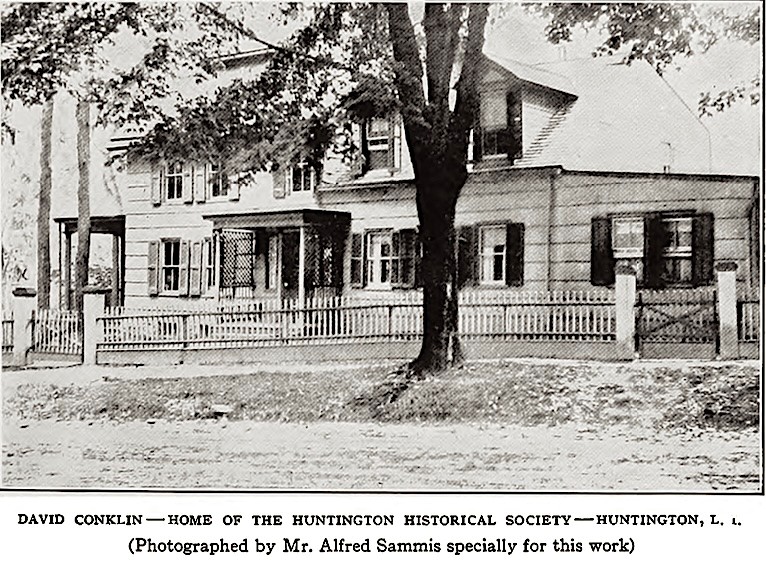
From 1750, the Conkling family, including young David, lived on their farm at 2 High Street in Huntington. As per “David Conklin House” on the website of the Huntington Historical Society, father Thomas:
built a small 1 ½ story dwelling on what was then the outskirts of town. The original homestead of 105 acres straddled both sides of present day New York Avenue from Nassau Avenue on the east to Oakwood Road on the west; and roughly Carver Street on the north to the south line of Huntington Rural Cemetery on the south. The area at the northwest corner of New York Avenue and High Street contained a peach orchard. The corner field at High Street and Oakwood Road contained an apple orchard. Between the apple orchard and the house was the barnyard complex, enclosed by a crude fence that extended to the lean-to kitchen on the western side of the house. The well was to the east of the house.
In 1775, David, his brother Thomas, and his father, also Thomas, signed Huntington’s Articles of Association. This petition protested the taxes imposed on them by the British while also praying for a peaceful resolution with the British. On May 8, 1775, 403 men, most of them Huntington residents (a few were from Islip), “shocked by the bloody Scene” that had occurred just weeks before at Lexington and Concord in Massachusetts, where patriot Minutemen and British regulars had engaged in a bloody armed struggle, put their signatures on Huntington’s Articles of Association. Only 37 Huntington residents, either Loyalists or those wanting to stay out of the fray, refused to sign. The Articles noted that the signers affirmed their “Love to our Country,” agreed “to whatever Measures may be recommended by the Continental Congress; or resolved upon by our Provincial Convention, for the Purpose of preserving our Constitution, and opposition to the Execution of the several arbitrary, and oppressive Acts of the British Parliament,” and prayed for “a Reconciliation between Great-Britain and America.” The actions of these associators were seen by both patriots and the British as a step towards rebellion. The fact that these men signed these Articles, placing themselves in danger of British retaliation, including imprisonment, seizure of their property, and exile from Long Island, is proof of their patriotic service.
After the British victory at the Battle of Long Island (also known as the Battle of Brooklyn) on August 27, 1776, David fled to Connecticut. The largest group of such refugees came from Suffolk County and comprised a high percentage of the voluntary signers of the Articles of Association.
David’s wife and children stayed behind at the farm, where their lives were difficult. The British declared martial law on Long Island and regularly pillaged farms. According to the Huntington Historical Society, British soldiers ransacked the Conkling farm and demanded Sybel’s wedding ring. She put it in her mouth, and as a soldier moved to strike her, an officer stopped him, telling the soldier to “leave the plucky little lady alone”.
In 1777, David made his way back to Huntington to look after his farm. On August 8 of that year, he was taken prisoner, charged with holding correspondence with rebels, and confined to the notorious Provost Prison in New York City until the spring of 1778. British treatment of prisoners of war was extremely brutal. According to the booklet, The Old Martyrs’ Prison, the Provost Prison alone held nearly 5,000 American prisoners by the end of 1776, in conditions of starvation, disease and torture. In the next few years, 2,000-3,000 patriots would die there.
The British continued to occupy Huntington for the next five years. According to Refugees of 1776 from Long Island to Connecticut by Frederic Gregory Mather, published in 1913, David was in the “Illicit Trade” (the smuggling of goods in violation of British import trade laws) from 1780 to 1781. The illicit trade was rampant throughout the colonies; during the war, Washington depended on it to supply his army. According to “David Conklin House” on the website of the Huntington Historical Society, the British commandeered wooden boards from his barn as well as cordwood and hay. He was also forced to help construct Fort Franklin and then Fort Golgotha on the Old Burying Hill, as well as to provide meals for the British soldiers stationed there. A descendant, Clarence Burt Doughty, in his application for membership in the Sons of the American Revolution, details David’s signing of the Association and his imprisonment. The D.A.R. website also confirms that he was an associator.
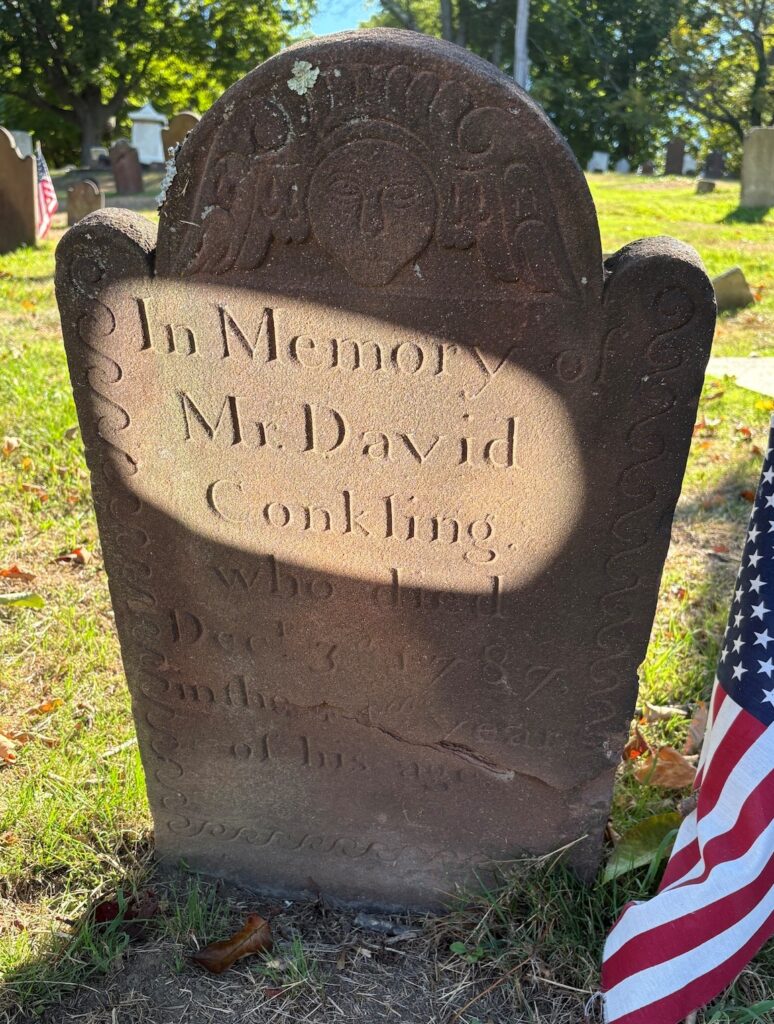
David died on December 3, 1787, at the age of 43. His wife, Sybel, died the following year. David’s nephew, Abel Conklin, acquired their house and raised David’s children there. The house remained in the Conklin family and in 1911, Ella Jayne Conklin Hurd deeded the house to the Huntington Historical Society, which still owns it; it stands at the corner of High Street and New York Avenue (Route 110).