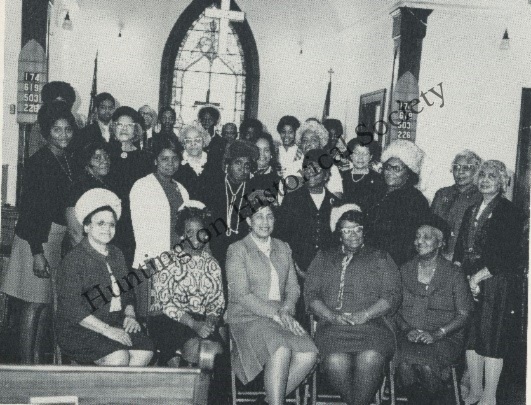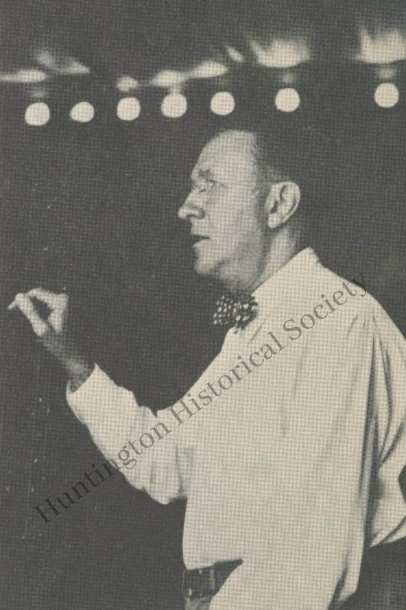
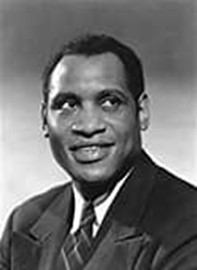
In 1946 Paul Robeson, world-renown African American baritone, actor, and social activist came to Huntington to perform a concert at Toaz Junior High School for the benefit of the Bethel A.M.E. Church’s planned Community Center and Nursery.
Roberson was born in 1898 in Princeton New Jersey. His father, a Presbyterian minister, had escaped slavery as a teenager, his mother was a Quaker abolitionist of mixed ancestry. Robeson won a scholarship to Rutgers University where he won 15 varsity letters in baseball, basketball, football, and track. He was Phi Beta Kappa and graduated Valedictorian. Subsequently he graduated from Columbia Law School but later left law practice when a white secretary refused to take dictation from him. He decided to use his artistic talents to promote African-American history and culture in the theater and music. In London, where he won acclaim for his performance in Othello and Eugene O’Neill’s The Emperor Jones, Robeson found that racism was not as pronounced in Europe as in the United States. At home, it was difficult to find restaurants to serve him or hotels to house him, and his performances were often surrounded by threats of violence.
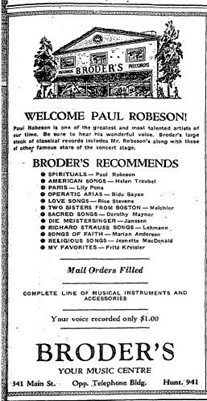
outed as the greatest baritone in the world Robeson used his talent to interpret Black Spirituals for a world audience, using his performances to speak out against racism and injustice. He performed throughout Europe, the United States and the Soviet Union. Because of his advocacy for organized labor and peace, he became a target for J. Edgar Hoover and the House Un-American Activities Committee and was accused of being a Communist. In 1950, his passport was revoked and he could not travel for eight years. Nevertheless, during this time he published his autobiography Here I Stand, sang at Carnegie Hall and continued to support labor worldwide through transatlantic broadcasts. He retired from public life in 1963 and died at age 77.
On November 29, 1946, Paul Robeson came to Huntington through the efforts of his acquaintance, Dr. C.V. Granger, a member of the Concert Committee of Huntington and a practicing physician in the town.
“Since the days of Huntington and Suffolk County there has never been a concert of this type here before. One may expect men and women from every walk of life to hear this great Negro baritone”, declared Rev. Carpentier of the Bethel A.M.E. Church, (Long Islander, November 28, 1946).
During the sold out concert, attended by hundreds of people, Robeson expressed his pleasure at being in Huntington and donating money to the efforts of the A.M.E. Church. In addition to selections from opera and spiritual songs, Robeson performed excerpts from Shakespeare’s Othello. It was truly an historic night for the Town of Huntington.