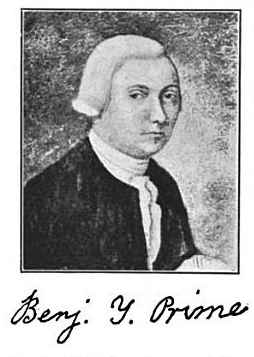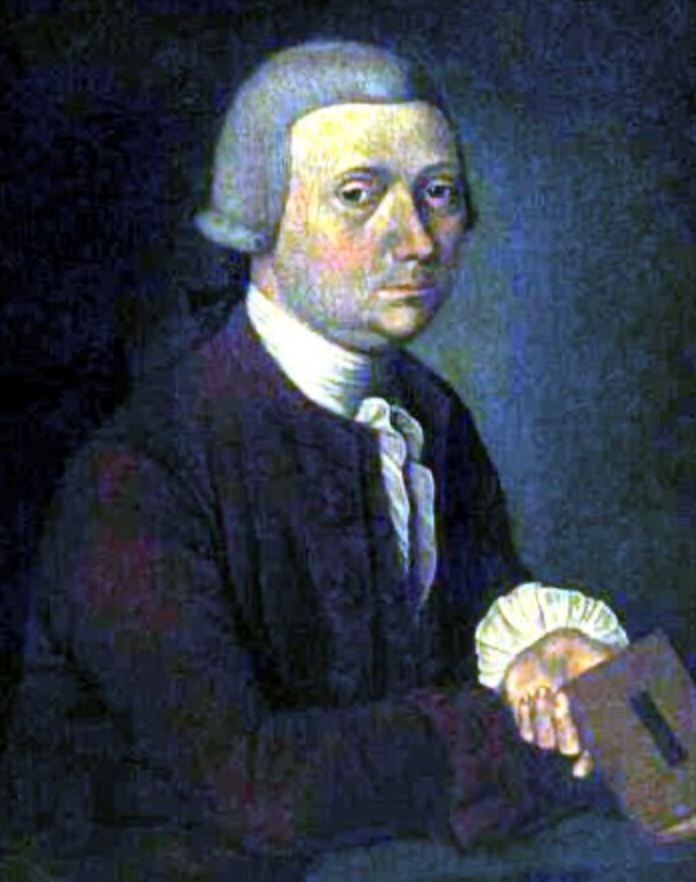
PRIME, BENJAMIN YOUNGS (1733-1791). Associator, Huntington, New York; member, Sons of Liberty; poet, writer and physician. As per Frederic G. Mather in his scholarly work, Refugees of 1776 from Long Island to Connecticut (1913), ancestors of the Primes probably came from Yorkshire, England to New Haven, Connecticut in 1638 and then settled in New Milford, Connecticut. Benjamin was born on December 20, 1733, in Huntington, New York. A family tree on the Ancestry website lists the Reverend Ebenezer Prime (1700-1779) (see) and Hannah née Platt (1706-1776) as his parents. However, that same genealogy shows that his biological mother, Experience Youngs, died on January 1, 1734, about a week after Benjamin’s birth. As per Mary Noble Dudley, the great-great-granddaughter of the Reverend Ebenezer Prime (see), her application to the Daughters of the American Revolution cites her ancestor as a patriot preacher who was forced to flee from his home which was destroyed by the British during the occupation of Huntington after the Battle of Long Island (Battle of Brooklyn) on August 27, 1776. A 1939 application to the Sons of the American Revolution by William J. Prime, Ebenezer’s great-great-great grandson, reports that Ebenezer Prime’s library was partly destroyed, his church torn down and the lumber from the church used to build Fort Golgotha on Cemetery Hill in Huntington. Benjamin had an older sister, Margaret (born in 1726), who died in Huntington on January 19, 1750.
Benjamin was highly educated in both Ivy League colleges and Europe. As per his genealogy posted on Ancestry, he was a student at Princeton in about 1751 and received an honorary Master of Arts degree from Yale in 1760; his name appears on College Student Lists, 1763-1954, as being honored by Yale in 1760. He studied medicine in Edinburgh, Scotland, in 1752, and was awarded a medical degree from Leyden University in the Netherlands in 1764. As per The Wetmore Family of America and its Collateral Branches (Benjamin’s wife’s family), Benjamin was a tutor at Princeton in 1756 and 1757 and studied medicine with Dr. Jacob Ogden in Jamaica, New York. According to his Find A Grave page and other biographical sketches, Bejamin could speak and write fluently in several languages. Mather’s and Stoddard’s biographies of Benjamin (in Colonial Families of America, Volume 6) note that he traveled to Moscow before embarking on his medical career. By 1765, Prime was practicing medicine in New York City. Stoddard notes that Benjamin had sailed for England on June 16, 1772, and was wounded when a French privateer attacked the ship; that information is also recorded in The Wetmore Family of America.
As per Stoddard, Benjamin was said to be a member of the Sons of Liberty, a leading rebel group. After participating in the destruction of a statue of King George III at Bowling Green in lower Manhattan, Prime fled for Huntington. However, as Mather specifies, Benjamin fled from Huntington on September 1, 1776, as the British, in the wake of their triumph at the Battle of Long Island, began their occupation of Long Island, “and for 7 years suffered almost intolerable hardships, sinking the greatest part of his estate by enormous expense, depreciation, etc. Was marked out and plundered as a singular Rebel, both in Huntington and New Haven.”
As per the Encyclopedia of American Biography, 1800-1902, which spelled his middle name as Young, Benjamin was a physician in Huntington, Long Island who wrote patriotic verses during the Revolutionary War. His work, The Patriotic Muse, was published in 1764 and included his earlier poems. Anecdotally, his daughter, named Liberty, was born in Huntington in 1777. Find A Grave’s biography notes that he was sought by the British for his “treason” at Bowling Green and was forced to flee, finding refuge in Connecticut. While in Connecticut, he used his pen to chastise the enemies of his country and raise the spirits of his fellow citizens who supported independence. Daughters Ann and Mary were born while he was in Connecticut. His long poem, Columbia’s Glory or British Pride Humbled, was published in 1791.
Benjamin’s name is also listed in the Patriot Research System, an index of the Sons of the American Revolution (SAR). Benjamin John Prime, Benjamin’s great-great grandson, filed an application for both Benjamin and the Reverend Ebenezer Prime in May 1939.The applicant noted that Benjamin signed the Articles of Association in Huntington in 1775. On May 8, 1775, 403 men, most of them Huntington residents (a few were from Islip), “shocked by the bloody Scene” that had occurred just weeks before at Lexington and Concord in Massachusetts, where patriot Minutemen and British regulars had engaged in a bloody armed struggle, put their signatures on Huntington’s Articles of Association. Only 37 Huntington residents, either Loyalists or those wanting to stay out of the fray, refused to sign. The Articles noted that the signers affirmed their “Love to our Country,” agreed “to whatever Measures may be recommended by the Continental Congress; or resolved upon by our Provincial Convention, for the Purpose of preserving our Constitution, and opposition to the Execution of the several arbitrary, and oppressive Acts of the British Parliament,” and prayed for “a Reconciliation between Great-Britain and America.” The actions of these associators were seen by both patriots and the British as a step towards rebellion. The fact that these men signed these Articles, placing themselves in danger of British retaliation, including imprisonment, seizure of their property, and exile from Long Island, is proof of their patriotic service.
Further, the application states that Benjamin belonged to the Sons of Liberty, assisted in destroying the statue of George III, and wrote in “The American Whig.” Benjamin also penned patriotic songs and poems, one of which was part of the phraseology of the Associators’ Oath. The applicant confirmed that Prime’s caustic writing made him an object of British hatred, and that his family was forced to flee to Connecticut where he lived in exile for seven years. The descendant added that Benjamin was a public speaker, physician and master of several languages. Much of the application contains information included in the sketches of Mather and Stoddard. As per Mather, on April 12, 1781, Benjamin’s wife was allowed to go to Long Island to get his apparel and furniture. A family member noted that somewhere along their journey to Connecticut, they buried their silverware in a well and upon their return to Long Island, two pieces of the retrieved silverware were recovered. As of the early 2oth century, those pieces were held by his descendants. The Daughters of the American Revolution (DAR) lists Benjamin Youngs Prime in its index for “Patriotic service,” through Julia Ann Jermain, a descendant of Mary Wheelright, Benjamin’s wife, through their son Nathaniel.
Benjamin married Mary Wheelwright (1744-1835) on December 29, 1774. Find A Grave’s website indicates that Mary was the widow of Reverend James Greaton, as do his other biographies. As per the Wetmore Memorial, Mary’s was the granddaughter of the Reverend John Wheelwright, the sister-in-law of Anne Hutchinson, who fled from Massachusetts to Rhode Island. His online family tree on Ancestry reports that he had a son Ebenezer (1755-1842) but the birth year is apparently an error; other documents name that son as born in 1775 which seems more likely as only one marriage is reported. The couple had other children named on the online family tree: Liberty (1777-1855), Polly (1778-1807), Ann (1780-1813), Mary (1782-1835) and Nathaniel Scudder (1785-1856); the Wetmore family lists a Nancy but not Polly who is not on other biographies either.
After British armed forces and loyalist troops withdrew from Huntington in 1783, Benjamin and family returned to Huntington. Mather reports that on January 5, 1784, Benjamin petitioned both branches of the New York Legislature, stating that he suffered hardships and losses from the war and asked to be allowed to recover debts due to his father Ebenezer that were prohibited by a law of July 12, 1782. Benjamin and a niece and nephew were the only heirs and prayed that the law, as it pertains to him, might be repealed. His petition was read and referred in the State Senate.
Benjamin’s name is listed in the American Genealogical-Biographical Index (Volume 140, page 450) as Benjamin Young (sic) Prime and as a physician, writer and scientist. In 1790, the Primes were living in Huntington. As per the 1790 census, there were 10 residents in the household including a male over 16, two males under 16, four females and three enslaved people. He died on October 31, 1791; confusingly, his online family tree and North American Family Histories list his death year as 1796, an apparent error.
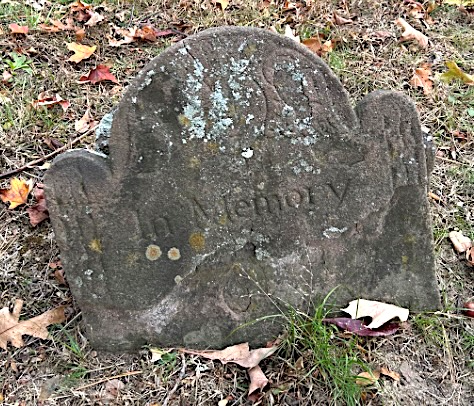
His Find A Grave webpage notes that he is buried in the Old Burying Hill Cemetery, Section III, plot 145. As per Cemetery Inscriptions from Huntington, Long Island, compiled by Josephine C. Frost in 1911, Benjamin’s gravestone in the Old Burying Ground has this inscription: “Benjamin Y. Prime, died Oct. 31, 1791. Age 58 years.” His widow, Mary, died on March 7, 1835, at the age of 91, as per Frost’s note of the inscription. Benjamin’s death is also listed in the Abstract of Graves of Revolutionary Patriots.