By Barbara LaMonica, Assistant Archivist
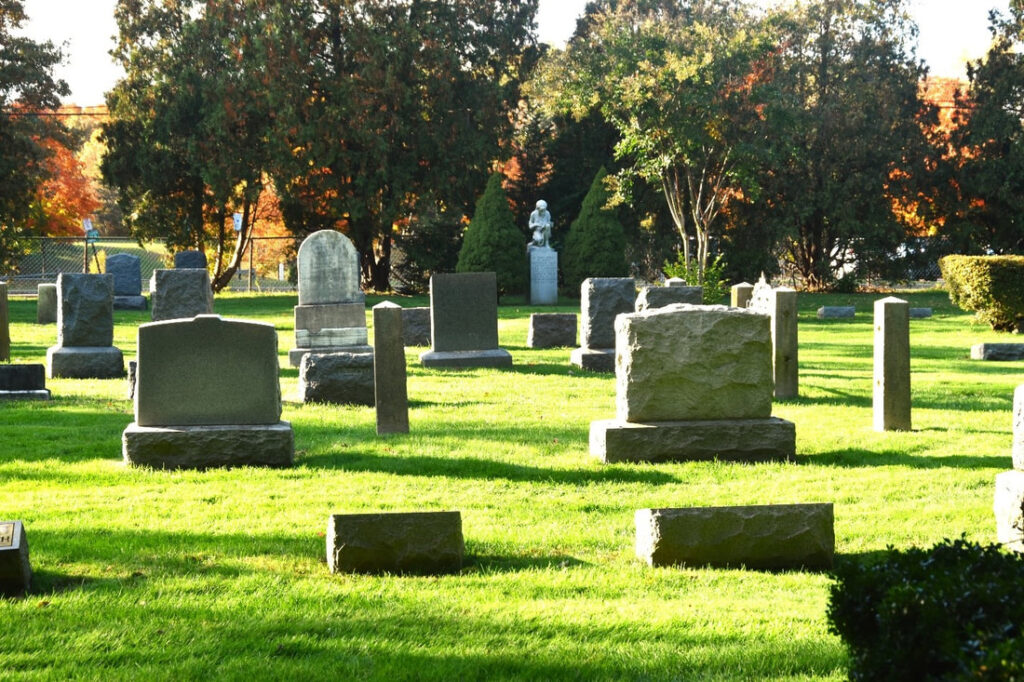
If you are fascinated by cemeteries and love to spend time reading tombstone inscriptions, looking for the graves of famous people, or simply enjoying the verdant and peaceful surroundings of park-like burial grounds then you qualify as a true taphophillac (Taphophilla -ancient Greek taphos, funeral rites, burial, philia, love).
Genealogists, historians, and photographers are drawn to cemeteries for various reasons. Both professional and amateur historians go to cemeteries for the information they can reveal about a town’s history. For example, family names which coincide with names of local streets indicate those families were prominent in the community. In the earliest burial sites, which were often in churchyards, the areas closest to the church, or those facing east were reserved for the more important citizens. Death rates and infant mortality can be measured. Large groupings of death dates can indicate an epidemic or other natural catastrophe.
Genealogists can find previously unknown ancestors as family members were often buried next to each other or in mausoleums. Birth and death dates can be compared to written records. Because the census comes out only every ten years, tombstones may be the only record for a child who was born and died within that period.
Many cemeteries have ornate sculptures and elaborate mausoleums considered artistic architecture, which attracts photographers. Older weathered tombstones have interesting textures and contrast creating pleasing images. Park like cemeteries provide lush landscapes as well as being habitats for wildlife.
Burial grounds and grave markers have changed over the years. In early colonial America, burial grounds were mainly in churchyards or in the center of a village, preferably on a hill. In keeping with strict puritan tradition, grave markers were plain usually made of fieldstone or wooden planks, with only the name and date of death. Eventually sandstone and slate were used, etched with simple verse or something about the person’s life. Images of crossbones and skulls were prevalent as reminders of mortality. Later on, more positive images of winged cherubs emphasizing the afterlife became popular.
As churchyards became overcrowded and real estate values rose, rural cemeteries were established on the outskirts of towns and cities. Not being associated with a particular church, many of these were public and non-denominational. This led to more landscaped cemeteries that were garden- like. With winding paths, benches, and shade trees, cemeteries were now conducive for family outings and even picnicking. Founded in 1831 Mount Auburn Cemetery in Cambridge, Massachusetts was the first rural cemetery in American. Green-Wood Cemetery in Brooklyn followed shortly after in 1838.
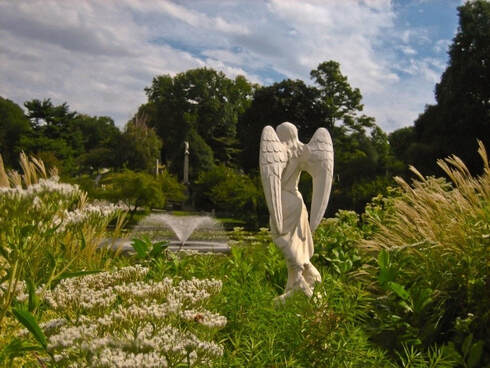
Gravestones became more elaborate, representing testaments to the person’s life. Symbols of professions such as an anchor for a sailor or scales for law. A rose bud or broken flower signifies a life cut short, a finger pointing up symbolizes a soul gone to heaven, clasped hands indicate a couple who will reunite in eternity. Obelisks and pyramids became popular in the mid-1800s influenced in part by Napoleon’s Egyptian campaign and the discovery of pharaohs’ tombs. Obelisks in particular were considered tasteful, were less expensive and could be placed in small spaces.
There are many historic cemeteries within the Town of Huntington for one to explore. Four in particular are within the the village area.
The Old Burial Ground- Located at 228 Main Street, the Old Burial Ground was founded in the 17th century and in 1981 was placed on the National Register of Historic Places. It is the former location of an English revolutionary fort. After the American Revolution, the fort was dismantled and the burial grounds restored. There one can find graves of Revolutionary and Civil War veterans.
Huntington Rural Cemetery
Located at 555 New York Avenue. founded in 1851, is one of the earliest rural cemeteries in New York State, and is an example of the rural cemetery movement as evidenced by winding roads and park-like atmosphere. Several prominent Huntington families are represented here including the Scudders, the Brown family of Brown Brothers pottery, and famous singer-songwriter Harry Chapin.
St. Patricks Cemetery
Located on Huntington Road off West Neck Road, was founded in 1849. This was the first Catholic cemetery and was built on the site of the first Roman Catholic Church. The church burnt down in 1867, and was rebuilt on Main Street.