PLATT, OBEDIAH (1745-1829). Signatory, Huntington’s Articles of Association, 1775. Son of Isaac Platt (who was born and died in Huntington, New York Colony (1723-1772)) and Esther Ketcham (1720-1772), Obediah (sometimes spelled Obadiah) was born either in 1745 in Huntington, per cemetery records or, less probably, in Long Island City, also in New York Colony, as listed in the Geneanet online database. It is thought that the first Obadiah Platt, Obediah’s grandfather, emigrated from England about 1682 and settled in Fairfield County, Connecticut. One of his four sons was Isaac Platt, Obediah’s father, who was one of the grantees of the Patent of Huntington, a series of colonial land and governance charters issued to the Town of Huntington during the 17th century. Per U.S., Family History Books, Isaac Platt was said to have been on General George Washington’s staff in New York City during the Revolutionary War, but that is unlikely. Records show several Isaac Platts who lived in Huntington during the 17th and 18th centuries and dates during those years were not kept accurately. Obediah’s parents are thought to have married on February 27, 1744 or 1745, in the First Church, Huntington, according to Long Island Surnames, the database archives of Long Island Genealogy. Obediah had several siblings, including twins Mary and Sarah, born on June 25, 1756 (Sarah died in 1819), Jesse Platt III (1761-1827), and Isaac Platt IV (1763-1849), all born in Huntington.
Obediah married Mary Platt (her name before marriage was also “Platt”) on February 15, 1769, as shown in genealogical records or in 1770, as displayed in Geneanet. Mary was the daughter of Epenetus Platt and Sarah Scudder. Obediah and Mary Platt had seven children: Elkanah (1770-1842), Esther (1772-1865), Philetus or Pheletus (1774-1850), Daniel (1776-1850), Rebecca (1778-1858), Phebe (1781-1859), and Sarah, born in 1783. Their children were also all born in Huntington, as shown in genealogical records, including Geneanet and U.S. Family History Books, and cemetery records.
At a Huntington general town meeting on May 3, 1763, Obediah Platt was chosen as a trustee as well as an overseer of the poor, as recorded in Huntington Town Records, including Babylon, Long Island, New York, 1688-1775, Volume II (1888.)
There were several Obediah or Obadiah Platts living, at times, in Huntington in the 18th century, including a father and son who were both married to women named Mary. This certainly creates confusion. For example, the Long-Islander newspaper of June 12, 2003, published an article about an enslaved man named Elijah Platt who had fought against the British during the Revolutionary War in what became known as the “Battle of Platt’s Tavern.” Elijah Platt was interred in the Platt family plot in Huntington’s Old Burying Ground. However, the Obediah Platt who owned the tavern died in 1770, according to the article, while his wife, also named Mary, ran the tavern on her own after his death. So, the Obediah Platt we are discussing, who was a farmer and died in 1829, cannot be the same person who owned the tavern.
Obediah was a signatory of Huntington’s Articles of Association. On May 8, 1775, 403 men, most of them Huntington residents (a few were from Islip), “shocked by the bloody Scene” that had occurred just weeks before at Lexington and Concord in Massachusetts, where patriot Minutemen and British regulars had engaged in a bloody armed struggle, put their signatures on Huntington’s Articles of Association. Only 37 Huntington residents, either Loyalists or those wanting to stay out of the fray, refused to sign. The Articles noted that the signers affirmed their “Love to our Country,” agreed “to whatever Measures may be recommended by the Continental Congress; or resolved upon by our Provincial Convention, for the Purpose of preserving our Constitution, and opposition to the Execution of the several arbitrary, and oppressive Acts of the British Parliament,” and prayed for “a Reconciliation between Great-Britain and America.” The actions of these associators were seen by both patriots and the British as a step towards rebellion. The fact that these men signed these Articles, placing themselves in danger of British retaliation, including imprisonment, seizure of their property, and exile from Long Island, is proof of their patriotic service.
On August 2, 1778, Huntington Town Records, including Babylon, Long Island, New York, 1776-1873, Volume III (1889) listed, in its appendix, the claims for property taken or destroyed by the occupying British, with no receipts given. It was recorded that Obediah loaned one wagon and horses to carry General William Tryon’s baggage to Southold. This journey took eighteen days, charged at 12 shillings per day.
According to Long Island Surnames, the database archives of Long Island Genealogy, “Obadiah Platt, a farmer,” took the Oath of Allegiance and Peaceable Behavior in November 1778,” when the town was under British occupation. This was an oath of loyalty to the British Crown and many of the signers residing in Huntington at that time were forced to sign to affirm their allegiance. If Obediah had not done so, he might have lost his farm and been forced to flee to Connecticut, as other patriots had done.
After the Revolution, according to Long Island Surnames, Obediah made his home on his farm at West Hills, a hamlet in the town of Huntington. An entry on June 1, 1793, Volume III of Huntington Town Records lists Obediah as one of the founders of The Huntington Academy. He contributed funding to establish this private school, owning one share. In a footnote to this entry, it is explained that the school was built by an association of about fifty of the leading citizens of Huntington, and “furnished a more liberal education than the common schools of that period. For more than fifty years some of the best educators in the country taught within its walls, and many of their pupils attained eminence in all the avocations of life.”
The 1820 federal census, recorded on August 7, 1820, shows that living in the household headed by Obediah Platt in Huntington were a total of three free, white persons, with two engaged in agriculture. There were two males, one 45 and over, who would have been Obediah, and the other, 26 to 44. The third person was a woman, 45 and over, presumably Mary.
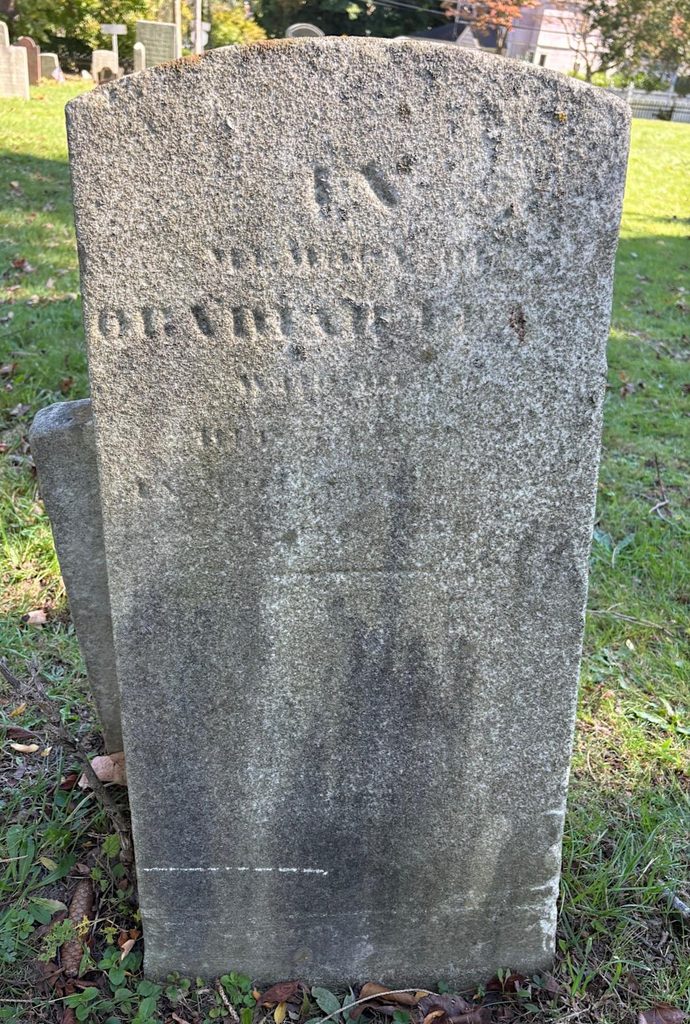
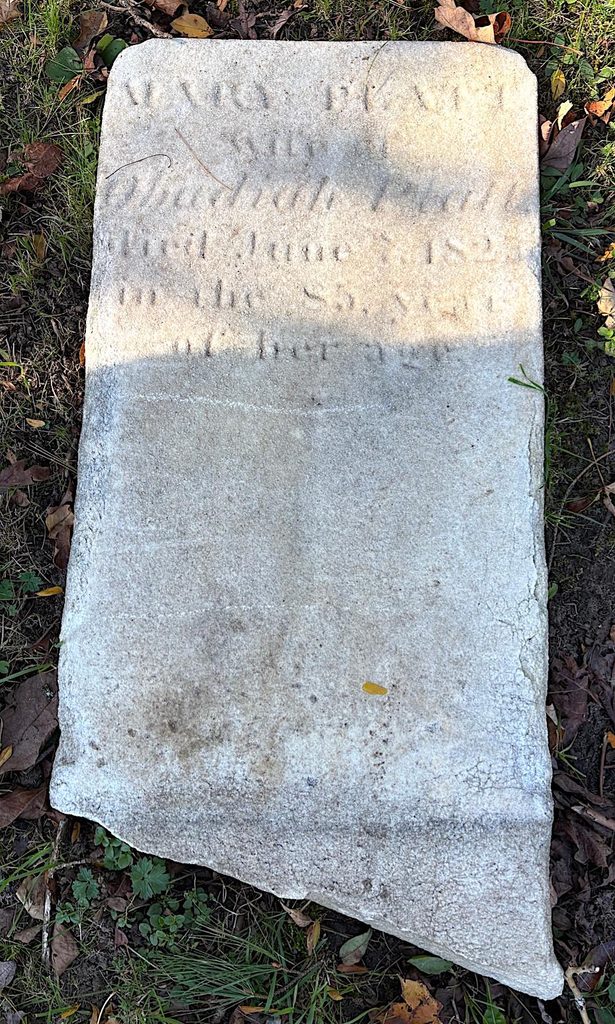
Mary Platt died on June 7, 1825, and was interred in the Old Burying Ground in Huntington, per Cemetery Inscriptions from Huntington, Long Island, New York, compiled in 1911 by Josephine C. Frost. Obediah died on December 29, 1829, according to the Charles Platt genealogy found on Ancestry.com, or December 7, 1829, per Josephine C. Frost’s Cemetery Inscriptions and as carved on his gravestone in the Old Burying Ground. One of the couple’s children, their son Elkanah, is also interred there.