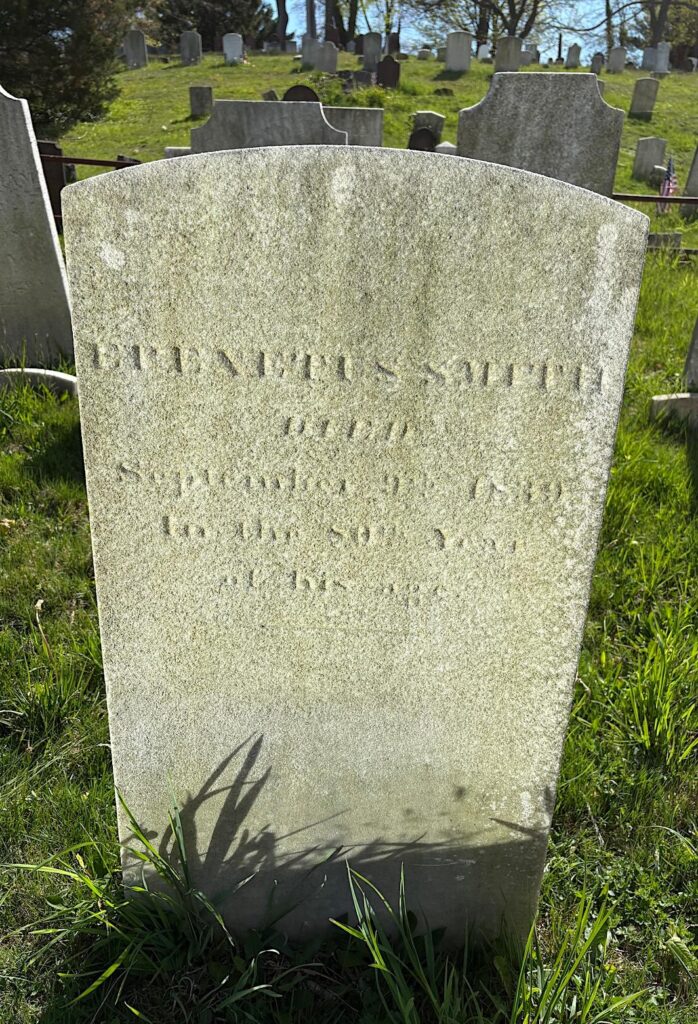

SMITH, EPENETUS (1759-1839). Private, Colonel Josiah Smith’s First Regiment of Minutemen (Suffolk County Militia); associator (signer of the Huntington Articles of Association). As per information from Find A Grave, Epenetus was born in 1759, in Huntington Station, New York, to Ichabod Smith (1730-1801) and Phebe (Phoebe) Vail Smith (1735-1801). According to Colonial Families of Long Island, New York, and Connecticut: Being the Ancestry & Kindred of Herbert Furman Seversmith, Col. I by Herbert Furman Seversmith, Epenetus had eight siblings: Ichabod Jr., Peleg, Elizabeth, Ebenezer, Phoebe, Lemuel, another daughter also named Phoebe, and a sibling with an undocumented name.
Documentation from The Empire State Society of the Sons of the American Revolution Supplemental Application, submitted by his great-great grandson on March 3, 1928, denotes that Epenetus (transcribed as Epenetue) was born in May 1760. His rank during the Revolutionary War was private. Epenetus’ patriotism and service are recorded in numerous documents. New York in the Revolution as Colony and State, 2nd Edition (1898), indicates that Epenetus served under Colonel Josiah Smith as an enlisted man in the Suffolk County Militia – First Regiment of Minutemen.
Records indicate that Epenetus Smith was a fairly common name in 18th-century Suffolk County. One of them was 2nd Lieutenant Epenetus Smith (1745-1826), who was born in Huntington, New York, served in the Revolutionary War in the 3rd Company, 3rd Regiment, New York Militia—and is interred at Crab Meadow Burial Ground. Other Epenetus Smiths, father and son (1724-1803 and 1760-1832, respectively), were owners of the Smithtown Tavern, and are interred at Smithtown Cemetery. These three men are not the subject of this biography.
The Refugees of 1776 from Long Island to Connecticut or New York in the Revolution or Colonial Families of Long Island, New York, and Connecticut, by Frederic Gregory Mather (1913) lists the signers of the May 8, 1775, Huntington Articles of Association. On that list are Epenetus Smith, his father, Ichabod, and his brother, Ichabod Jr. The fact that these close family members signed the Association leads us to conclude that the Epenetus Smith who is the subject of this biography is the signer with that name. On that date, 403 men, most of them Huntington residents (a few were from Islip), “shocked by the bloody Scene” that had occurred just weeks before at Lexington and Concord in Massachusetts, where patriot Minutemen and British regulars had engaged in a bloody armed struggle, put their signatures on Huntington’s Articles of Association. Only 37 Huntington residents, either Loyalists or those wanting to stay out of the fray, refused to sign. The Articles noted that the signers affirmed their “Love to our Country,” agreed “to whatever Measures may be recommended by the Continental Congress; or resolved upon by our Provincial Convention, for the Purpose of preserving our Constitution, and opposition to the Execution of the several arbitrary, and oppressive Acts of the British Parliament,” and prayed for “a Reconciliation between Great-Britain and America.” The actions of these associators were seen by both patriots and the British as a step towards rebellion. The fact that these men signed these Articles, placing themselves in danger of British retaliation, including imprisonment, seizure of their property, and exile from Long Island, is proof of their patriotic service.
The Huntington Town Records, Including Babylon, Long Island, New York, Volume III, report that Epenetus, among hundreds of his neighbors, signed the Oath of Loyalty in 1778 pledging “loyalty and peaceable behavior before Governor Tryon in Suffolk County.” Patriots had little choice in this matter; they signed because their town had been forcibly occupied by the British and their loyalist forces, and failure to sign would have resulted in the loss of their homes and property.
Epenetus’s life after the war is documented in Colonial Families of Long Island, New York, and Connecticut: Being the Ancestry & Kindred of Herbert Furman Seversmith, Col. I by Herbert Furman Seversmith. As per Seversmith:
Epenetus was a tailor in New York City from 1801 to 1821, residing chiefly at 157 Chatham Square. He married in the First Presbyterian Church at Huntington and by the Reverend Abraham Schenck, 1 April, 1792 to Temperance Ketcham of Babylon, New York, daughter of Jesse and Temperance (Brush) Ketcham…
Ichabod Smith (Epenetus’ father) of Huntington, New York made his will 10 March 1800; it was proved 9 April, 1801 at Riverhead, New York. Therein he mentions his wife Phoebe and the children Epenetus, Lemuel, Elizabeth, Phoebe, Peleg, and Ebenezer…and it was found that two of his sons had removed to New York City. These were Epenetus Smith and Lemuel Smith.
In his book, Seversmith also detailed Epenetus’s and Temperance’s children:
- Charles W., Born probably at New York City in 1796, died 20 December, 1849, and buried in the Smith Cemetery at South Huntington. His wife Harriet died 21 August, 1833, aged 35 years, 6 month and 6 days; she is buried beside him. Issue not traced.
- Clarissa, born at New York City, 13 February, 1799; recorded as baptized in the First Presbyterian Church in New York shortly afterward, date not given. Not traced further.
- Elias Locke, born at New York City, 18 February, 1801, baptized in the First Presbyterian Church there 19 April, 1801. He was a hardware merchant and alderman of New York City, and retired to Oyster Bay, New York; he died at the latter place 7 August, 1874 and was buried in the village cemetery…
- Jess Ketcham, born at New York City, 9 February, 1803, baptized in the First Presbyterian Church at New York, 24 April 1803; died 1 June, 1803.
- Walter James, born at New York City 28 July, 1804, baptized in the First Presbyterian Church there, 30 September, 1804. Not traced further.
- George E., a tailor on Chatham Square in Ner York City.
As per Find A Grave, the Smiths had another child, Giles Wood (1810-1870). No further information is given about this person. This data is validated by Seversmith, as Giles is mentioned in Epenetus’s will, dated March 15, 1836, and approved on November 28, 1839.
According to the 1810 United States federal census, Epenetus was residing in New York city in Ward 2 as of August 6, 1810. There were seven members in his household. As per the 1820 United States federal census, by August 7, 1820, he lived in Ward 4 in New York City, possibly at 157 Chatham Square, with a total of eight household members.
Both Temperance and Epenetus passed away in 1839. Temperance died at South Huntington on April 15, 1839, and, according to the New York Evening Post, publication date 1839, Epenetus, described as formerly a resident of New York City, died on August 19, 1839, in Huntington. He and Temperance are interred, side by side, at the Old Burying Ground in Huntington.