
BRUSH (CONKLIN), DOROTHY (or DOROTHEA, DORITY) (1754-1835). Patriot. Born Dorothy Platt on July 27, 1754, or possibly as early as 1750, in Smithtown, Long Island, Dorothy’s given name is also recorded as Dorothea or Dority in some genealogical records. She was the child of Zephaniah Platt and Anna or Ann née Smith, according to Genealogies of Long Island Families, Vol. 1, and cemetery records. Anna Smith may have been Zephaniah’s second wife, and he may have been her second husband. However, Colonial Families of the USA, 1607-1775 shows Phoebe Hedges of East Hampton, Long Island, as Zephaniah’s second wife and Dorothy’s mother. According to that source, Dorothy was Zephaniah’s youngest child. It should be noted that eighteenth-century genealogical information can be confusing and inaccurate, especially when pertaining to women. Zephaniah was a direct descendant of Richard Platt, who was born in Ware, Hertfordshire, England in 1603, and settled in the Connecticut Colony, as chronicled in George Lewis Platt’s The Platt Lineage: A Genealogical Research and Record (1891).
Dorothy had several siblings and, possibly, half-siblings including Zephaniah, Elizabeth, Nathaniel, Charles, Jeremiah, and Daniel. Some of her brothers were patriots who helped in the creation of an independent United States. For example, Zephaniah Platt was the founder of the town of Plattsburgh, New York, as well as a delegate from New York to the United States Continental Congress from 1775 on, as detailed in the Biographical Directory of the United States Congress. Another brother, Captain Nathaniel Platt, served in patriot military campaigns in Huntington as well as Dutchess County, New York, during the Revolutionary War. And Judge Charles Platt, one of the first settlers of Plattsburgh, was a leader of Minutemen and served in many military campaigns in New York and New Jersey during the war, as he explained to Dr. Samuel Jenner in a letter dated November 30, 1809.
Dorothy married Jesse Brush Jr. (see), also a patriot, in Smithtown Church on January 5, 1774, per Genealogies of Long Island Families, Vol. I. Jesse was born in 1752 in Huntington, Long Island, according to “Long Island Surnames,” the database archives of Long Island Genealogy, as well as in records kept by the Reverend Ebenezer Prime (see), pastor of the Old First Presbyterian Church in Huntington. During the Revolutionary War, Jesse’s name appeared on the first list of those who took the Oath of Loyalty to the Crown in 1778 and, according to “Long Island Surnames,” his name appears on several rolls of men called out by the British to work with them. Note that many residents of Huntington who supported the patriots, including Jesse who first signed the Articles of Association in 1775, signed the oath of Loyalty to the Crown, often under duress, and were impressed by the British to work on their behalf.
Dorothy’s father, Zephaniah Platt, was imprisoned by the British on a ship off Brooklyn in 1776. Such imprisonment was often a death sentence, due to starvation and disease. Per the narration of Vivian Hanlon, Dorothy’s great-granddaughter, posted on the Long Island Historical Association’s Facebook page on December 13, 2024, Zephaniah allowed his barn on his land in Sunken Meadow to be used to hide whale boats, which were used by patriots who had exiled themselves to Connecticut to attack British ships in Long Island Sound and to stage attacks on loyalists in Huntington. After her father’s capture, Dorothy went by herself to the British forces’ commander to negotiate her father’s immediate release. He was freed but, unfortunately, had contracted smallpox while imprisoned and died just four days later, on January 27, 1778, at age 73 or 74. As written in Wikitree.com, Dorothy was “a woman of culture and great determination” and that “she was one of the most noted women of her day,” doing much “to elevate those who needed uplifting, and was remarkably good to the poor.” Dorothy’s courage and perseverance are noted in the Daughters of the American Revolution’s online “DAR Genealogical Research Databases.” However, it is noted there that her “claimed service was a humanitarian act, not patriotic service.” Nevertheless, given the many patriots in her family, and her brave act in singlehandedly getting her patriot father released from imprisonment, we conclude that she was a patriot.
Dorothy and Jesse had several children: Thomas (1779-1862), Zephaniah (1781-1861), Samuel Sammis (1787-1842), Jonas Platt (1794-1872), and Sarah (1797-1817.) There may have been other children; along with those just listed, Jeremiah, Charles, and Jesse were also named as children in Jesse Brush’s will of July 3, 1800, and two others, Job and Temperance, are listed in genealogical records. The federal census of 1790 shows that the Brush household contained one man over 10 years of age, five under 16, three females, and two enslaved people. When Jesse died on July 12, 1800, he was living in West Neck, Long Island. He was interred in the Old Burying Hill Ground (Old Burying Ground). Dorothy was one of his will’s executors, per Genealogies of Long Island Families, Volume I.
After Jesse’s death, Dorothy married Richard Conklin (see), a widower, in 1805. The Conklin surname, over generations, also has been spelled as “Conkling.” The son of Captain Cornelius Conklin and Elizabeth Rogers, Richard was born around 1748 in Huntington. He had previously been married to Abigail Strong, who died in 1795. Her gravestone can be found in the Old Burying Ground. Richard died in 1818 in Huntington and was also interred in the Old Burying Ground.
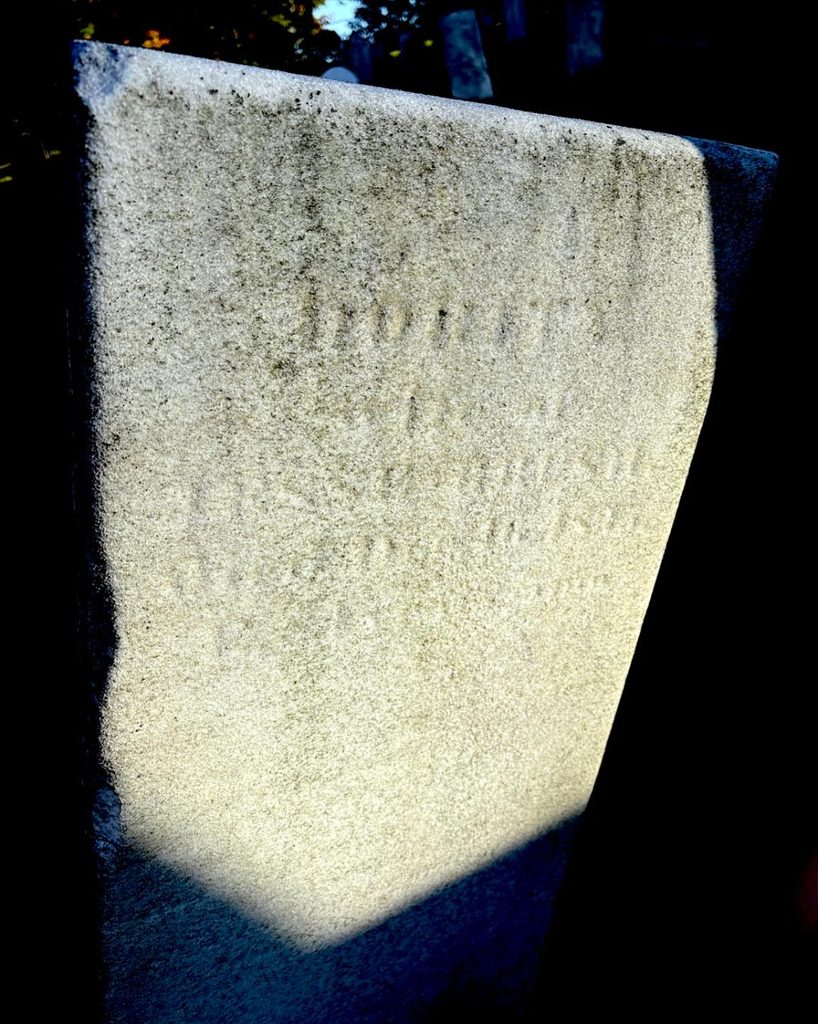
According to Genealogies of Long Island Families, Vol. 1, and cemetery records, Dorothy Platt Brush Conklin died on December 16, 1835. She was interred in the Old Burying Ground next to her first husband, Jesse Brush. Her gravestone names her as “Dority.” Many Brush and Conklin/Conkling family members were also interred there, including Richard Conklin’s parents, grandfather, and great-grandparents. Dorothy and Jesse’s youngest child, Sarah Brush Kelsey, who was born in 1757 and died in 1817, was also interred in the graveyard.